Tuesday, May 27, 2014

CABARET - REVIEW OF SHAW FESTIVAL PRODUCTION


Reviewed by James Karas

For the big musical of this year’s Shaw Festival, Artistic Director Jackie Maxwell has chosen Cabaret, the 1966 musical about the coming of the Nazis in Germany. It is a bold choice boldly executed.

The musical has gone through numerous productions and transformations but Maxwell has chosen the 1998 Broadway revival directed originally by Sam Mendes and co-directed and choreographed by Rob Marshall. The Shaw Festival production is ably directed by Peter Hinton.

When the play opens we see several iron staircases converging into a tower on a revolving stage. It could be the Tower of Babel (the Emcee makes a pint of singing in several languages) or the tower of evil and depravity.

The tower with its landings and lit beams serves as the tawdry Kit Kat Club, the slummy boarding house run by Fraulein Schneider and other incidental locales. The back of the stage is dark and spotlights are directed on the actors. It is a grim, dingy and scary world. In the second half a rock is tossed through the window of a fruit store operated by Herr Schultz, a Jew, and there is a burst of light at the back of the stage. After that red lights dominate the rear stage and a swastika hangs prominently on the wall. Hell has arrived.

The physical representation of Berlin in 1930 is of course matched by the people who inhabit it. On the political side we see the rise of the Nazis and anti-Semitism including a severe beating of the central character, Cliff, the prohibition of a marriage between a German and a Jew and the hint of the horrors to come.

On the personal level, the world of Berlin, with some exceptions, is one of depravity, seediness, violence and ugliness.

The moral centre is held by Cliff Bradshaw (Gray Powell), an American writer who has come to Berlin to write a novel. He unwittingly helps the Nazis, falls in love with Sally (Deborah Hay), an English woman who sings at the Kit Kat Cub and moonlights as a prostitute. Cliff is bisexual but his love for Sally is genuine. She becomes pregnant but does not know who the father is. He is bludgeoned by the Nazis and leaves Germany but does write his novel.


Herr Schultz (Benedict Campbell), the decent fruit vendor, is not so lucky. He is an optimist and thinks that the situation will blow over. Fraulein Schneider (Corrine Koslo) will not marry him – all her friends are Nazis!

The basic plots of Cabaret derive from the stories of Christopher Isherwood which were adapted into a play called I Am A Camera by John van Druten. Joe Masteroff wrote the book based on the play and John Kander composed the music to lyrics by Fred Ebb.

The music, of course, is what takes Cabaret away from being just another story about politics, love and depravity in Weimar Berlin or any other place. The dark, tense, edgy, blunt music creates a claustrophobic atmosphere full of terror, evil and ugliness. From the first appearance of the Emcee (Juan Chioran) with his painted face and spiked hair, singing “Willkommen” to the depraved lives of the characters, Cabaret gave me the feeling of people living as if the end of the world is imminent; the Titanic had struck the iceberg and is about to sink.

Supreme irony is reached when we hear “Tomorrow belongs to me” that starts with a folksy melody and bucolic lyrics about the sun in the meadow and the stag in the forest. It ends by asking for a sign from the Fatherland. The sign that it beckons is the swastika and the future belongs to the Nazi nightmare.

I have spoken mostly about the Mendes-Marshall conception of this great musical as executed by the Shaw Festival under the direction of Hinton. The musical direction is by Paul Sportelli and the set is designed by Michael Gianfrancesco.

Without taking anything from the individual performers, I think the whole is more important than the parts in this instance.. Chioran is animated, seedy and excellent – just what you would expect from an Emcee. Gray Powell and Benedict Campbell are almost the straight men in this collection of reprobates and they are good at it. Excellent performances by Deborah Hay and Corrine Koslo.
      
Go see it.
          ______


Cabaret  by Joe Masteroff (book), John Kander (music), Fred Ebb (lyrics), continues until October 18, 2014  at the Royal George Theatre, Niagara-on-the-Lake, Ontario. www.shawfest.com.

Monday, May 26, 2014

ARMS AND THE MAN - REVIEW OF SHAW FESTIVAL PRODUCTION


Reviewed by James Karas

Bernard Shaw gets only two pieces of this year’s Shaw Festival pie but his ghost is surely used to holding a minority position even if the festival is named after him.  The Philanderer and Arms and the Man are his two of the ten plays that make up the 2014 season.

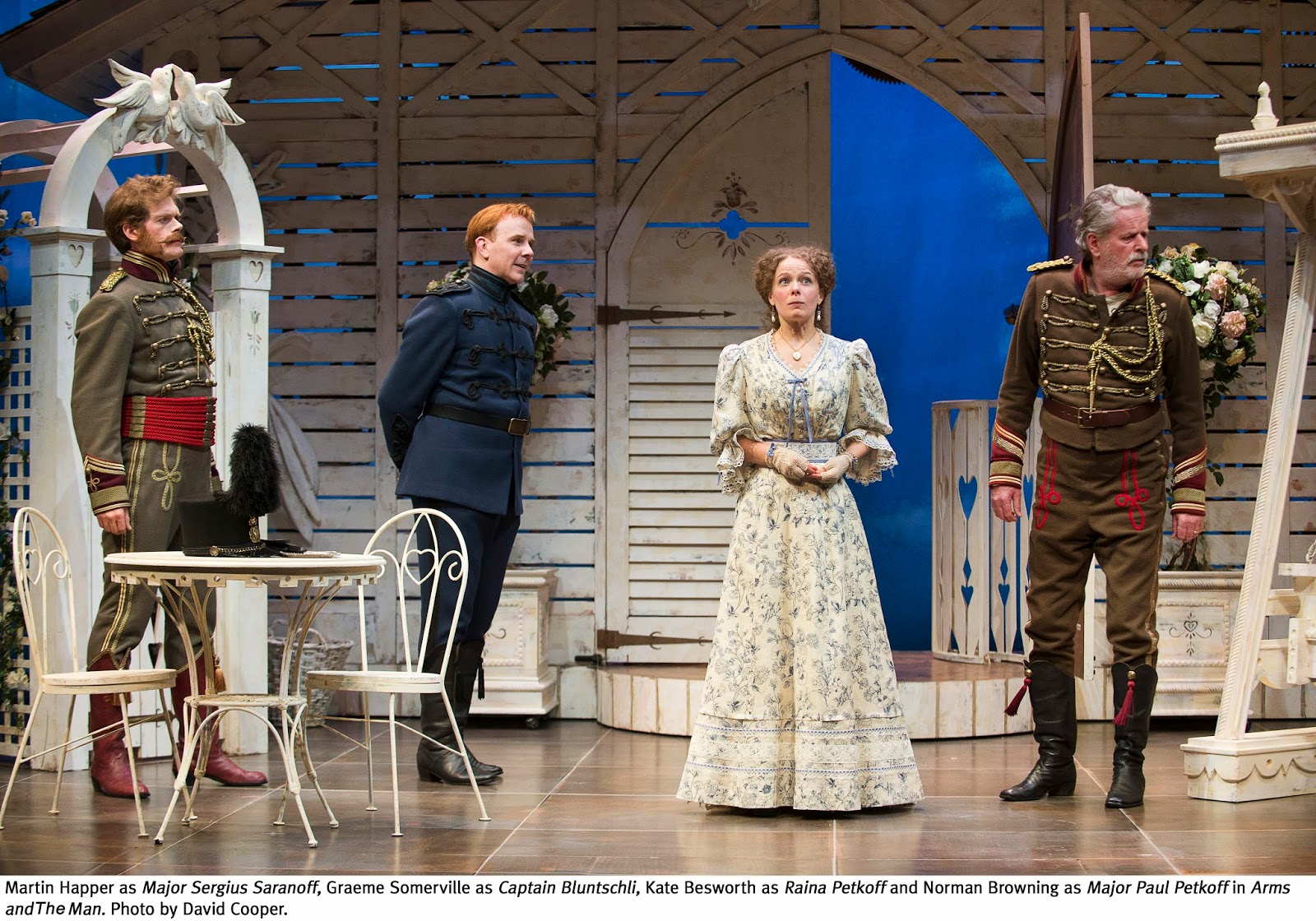
Arms and the Man receives a fine-tuned and thoroughly enjoyable production directed by Morris Panych at the Royal George Theatre. The cast is well-coordinated and gets the laughs and finer points of the play that is a take-off on romantic ideas of military glory, patriotism, militarism and Bulgaria.

The Serbians (led by the Austrians) are at war with the Bulgarians (led by the Russians) and Captain Bluntschli, a Swiss mercenary seeks refuge in the bedchamber of Raina Petkoff, a Bulgarian lady. He is fighting for the Serbians and the enemy is on his heels.

Graeme Somerville as Bluntschli must be realistic, practical, capable and, in the end, perhaps even more romantic than his supposed antithesis, Major Sergius Saranoff.  As a soldier he prefers chocolates to ammunition and survival to glory. Quite so, but as a youngster he ran away from home and joined the Serbian forces because they were the closest to his home.

The contrasting and in a way similar character to Bluntschli’s is Saranoff, a Byronic figure who leads a victorious cavalry charge that entitles him to admiration, glory and the Higher Love from Raina. Martin Happer strikes the proper poses and attitudes as the heroic major who practices a somewhat lower love in his lust for the servant Louka. In the end we see Saranoff’s practical side as well and enjoy Happer’s performance.

Kate Besworth as Raina is the woman in the centre who dreams of glory and pure love with Sergius while having a practical side as well. Besworth gives us a fine Raina but I found her hairdo jarring. I have no idea what style Bulgarian women went for in the 1880’s (not that the play is trying to give us a representation of Sofia high society) but her hairstyle seems inappropriate.

Peter Krantz as the servant Nicola and Claire Jullien as Louka were very good and gave us the laughs assigned to them Norman Browning made an excellent Major Petkoff, the incompetent, highest ranking officer in the Bulgarian army who is dominated by his wife Catherine, played well by Laurie Paton.


Panych adds many fine comic touches to the play. In the opening scene, Raina is looking out of her room onto the battle in the street. Set designer Ken MacDonald creates a revolving balcony so that we can “see” what is happening outside in the street as well as inside Raina’s bedroom. Soldiers rush around the theatre and we see Bluntschli escape into the bedroom. A very effective touch.

Aside from that, MacDonald’s sets left me cold. The bedroom and the garden in the Petkoff house boast exposed brick walls that reminded me of the hideous architecture of the 1960’s.

The Petkoff library looks like a log cabin from the Old West with some wheels that turn when the bell is rung. There are no books even though this is the only library in Bulagria. The set should either enhance the production or leave it alone. These sets did neither.

We are treated to some Bulgarian folk songs (I think) as we look for our seats. I was not paying much attention to them until I heard the familiar Greek song “Tsifteteli Tourkiko.” What is that doing in this play?

And speaking of ethnic sensitivities, Arms and the Man cannot be recommended to Bulgarian patriots. See it; have a few laughs and stand up for your country!           
        ______

Arms and the Man by Bernard Shaw continues until October 18, 2014 at the Royal George Theatre, Niagara-on-the-Lake, Ontario. www.shawfest.com.


Wednesday, May 21, 2014

THE CHARITY THAT BEGAN AT HOME – REVIEW OF SHAW FESTIVAL PRODUCTION


Reviewed by James Karas

The Shaw Festival has hit another home run by producing St. John Hankin’s The Charity that Began at Home, a wonderful comedy that most of us are unlikely to have seen. If you have been going to Niagara-on-the-Lake for the last dozen years, you could have already seen Hankin’s The Return of the Prodigal (2001-2002) and The Cassilis Engagement (2007). Don’t miss this production.

In The Charity, Hankin took common sense, turned it on its head and wrote a comedy that is entertaining, thoughtful and delightful. It was first produced in 1906 at the Court Theatre in London but was completely ignored for decades after that.

For its premiere at the Shaw Festival, director Christopher Newton has chosen an excellent cast and delivers an enjoyable production that makes one wonder why we had to wait seven years from the last time we saw a play by Hankin.

Lady Denison (Fiona Reid) and her daughter Margery (Julia Course) practice the preaching of Basil Hylton (Graeme Somerville), the founder of The Church of Humanity: people should be given what they want and not what they deserve. They therefore invite some dreadful people to their country house because no one else would have them. That is a very good formula for comedy.

Fiona Reid cannot be outdone as the cheerful, kind, not too bright Lady Denison. Her vocal intonations, pitch-perfect delivery of her lines and her body language make up a superb comic performance. Course does excellent work as her equally kind daughter Margery who does charity work for everyone and just loves the world.

The dreadful and colourful guests arrive. Jim Mezon plays the loud, brakeless-mouthed General Bonsor. He is not wanted anywhere else because he is an utter bore but in this house he is welcomed. Mezon has no problem handling the role and getting the laughs.

Neil Barclay plays Mr. Firket, a misfit of a commission salesman and Sherry Flett is Miss Triggs, a crotchety and unpleasant teacher of German. Donna Belleville plays the obnoxious and conceited Mrs. Horrocks. Hugh Verreker (Martin Happer) is the handsome and well-behaved young man that Margery falls in love with. But he has a “past” that will come to haunt him and add considerable interest to the plot right to the very end.

Reason and common sense are represented by Mrs. Eversleigh (Laurie Paton), Lady Denison’s sister-in-law. She believes that it is our duty to love our enemies but only on Sundays and without ever actually doing it. Paton turns in a splendid performance and acts as a fine foil Reid’s flighty Lady Denison.

Misplaced charity, decency, philanthropy and misfits misbehaving are all in the play but one cannot have good theatre without a love story and Hankin provides that as well.      

Lady Denison’s charity extends to her servants and needless to say she has hired some losers who cause nothing but grief. The straight-laced butler Soames (Andrew Bunker) impregnates the maid Anson (Darcy Gerhart) and cannot marry her because he already has a wife. William (Edmund Stapleton) wants to quit and there is havoc in the servants’ hall, you might say.

Newton gets superb performances from them all. The pacing is good, the actors’ raections excellent and it is a production that gets very high marks.

The first three acts of the play take place in the drawing-room and the fourth act is supposed to be in the dining room. Newton and Designer William Schmuck sensibly keep all the action in the drawing-room, an elegantly designed and brightly lit Edwardian space.
        
A thoroughly enjoyable evening at the theatre.
   ______

The Charity that Began at Home by St. John Hankin will run in repertory until October 11, 2014 at the Court Hose Theatre, Niagara-on-the-Lake, Ontario. www.shawfest.com.
Sunday, May 11, 2014

BINGO! – REVIEW OF MACIVOR PLAY AT FACTORY THEATRE


  John Beale, David KeeleyDov Mickelson, Jane Spidell and Sarah Dodd - Photo Credit Joanna Akyol

By James Karas

Nostalgia, those wistful reminiscences of times past when the world was young, the sun was always shining and all our future was ahead of us. Remembering the past, coming to terms with the present and perhaps glancing at the future are the themes of Daniel MacIvor’s Bingo!, now playing at the Factory Theatre.

Thirty years after graduation from high school in Cape Breton (it’s not mentioned but we can guess it), three friends get together in a hotel where they are celebrating a class reunion. Paul (John Beale)l is a shy engineer who has returned from Calgary for the occasion. Doug (David Keeley) is a real estate agent working in Halifax. He lies to his wife and is a braggart about his achievements as a salesman. Jeff (Dov Mickelson) is a “swinger” who would have preferred to have children but his wife barred such thoughts.

There are two women in the play: Kathy is a lonely and shy woman who has not found a lasting relationship with a man. Laura (Jane Spidell) is a mail carrier and just as lonely as Kathy. She finds some fulfilment by being a foster parent to children in Africa. All the characters have nicknames but I am using their real names.

That is an interesting collection of people and there is a play in them as they look back to their golden years in high school, reveal their present situation and give us a glimpse of their hopes for the future – what is left of it or the “first day” of what is to come.

The main preoccupation of all of them is drinking. In the first act the men are gulping booze in the hotel room, punching each other in the stomach and going on with a forced enthusiasm that is of limited appeal. Drunks are rarely amusing for long. The aim of their drinking is to reach the “bingo” stage when one of them runs to the bathroom and vomits. That certainly sounds like a barrel of fun.

  Dov Mickelson and Jane Spidell - Photo Credit Joanna Akyol

We meet the women in the hotel bar where the reunion is held. They are more subdued than the men and we learn about their past and present. They are lonely and sympathetic. The golden years of their high school are perhaps brighter in memory than they were in reality and the present does not amount to much nor does the future hold a lot of promise. Kathy has been left emotionally scarred because she did not finish high school because she did not want it to end.

The five get together in the hotel room where through the miasma of excessive drinking we get more nostalgic memories and revelations. Jeff’s swinging lifestyle includes posting pictures of his private parts on the internet. His wife may be out for the evening swinging and posting without him.

Doug’s wife finds out that he is deceiving her and that is his third strike. He is out, as he told us at the beginning.

There are some good lines, some fast-paced dialogue, some forced roistering and lots of drinking as the play moves towards its conclusion. There is a lyrical scene at the end as Paul and Kathy sit on the boardwalk by the sea watch the moon and the two shy people connect for a “happy ending”.

MacIvor sketches out his characters quite nicely. They are recognizable people and we have some empathy for all of them except for the philandering real estate agent, I suppose. The actors do an excellent job in conveying these people. Director Nigel Shawn Williams does a very good job with the cast.

Lindsay Anne Black’s set is simple and effective. A hotel room with a couch, a table and a bar provides the drinking venue for the men. To the right is the hotel bar where the two women meet. There is no break between the two locations. Stretching from the left of the stage and running across the front is the boardwalk where the last scene will take place. Again, there is no brake and we only realize that it is the boardwalk when Paul and Kathy sit on in the final secene.

The play, for all its charm and sympathetic people “remembering” the past, is rather thin on plot. There are hints that Jeff may have seen the light and will give up his swinging life and, I guess, Laura may hook up with him; Doug will be thrown out on the street by his wife. Paul and Kathy will live happily ever after. That is all good but it is not enough to make for a completely satisfactory play.      
     ____


Bingo! by Daniel MacIvor opened on May 8 and will run until June 1, 2014 at the Factory Theatre, 125 Bathurst Street, Toronto, Ontario. www.factorytheatre.ca

Thursday, May 8, 2014

A GOD IN NEED OF HELP – REVIEW OF SEAN DIXON’S PLAY AT TARRAGON THEATRE

Daniel Kash, Jonathan Seinen, Alden Adair, Tony Nappo. Photo Cylla von Tiedemann 

Reviewed by James Karas

A God in Need of Help by Sean Dixon. What a marvelous play and what a terrific production by Tarragon Theatre. Go see it.

This is a brief list of what you will get if you see the play: a history lesson, a lecture on art appreciation, an intimation of the encounter of the classical world with Europe of the Renaissance, an indication of the great encounter between the Muslim world and the Christian West, allusions to the war between Catholicism and Protestantism and …I know I have missed a few things. And did I say a terrific night at the theatre that is stimulating, thought-provoking and entertaining in the best sense of the word?

Let’s concentrate on the last point. You have gone to the theatre and not the Art Gallery, after all.

The plot is fascinating. In 1606, four strong men are selected to carry The Brotherhood of the Rosary, a large painting by Albrecht Durer, from Venice to Prague. They are led by a mercenary Captain in the employ of Rudolf II, Holy Roman Emperor and the recipient of the painting.

When the play opens we see the Captain bound and gagged and the four carriers of the painting hooded in prison and about to be interrogated by a Cardinal Archbishop and a Venetian Magistrate.  A miracle is alleged to have occurred on the way to Prague: the Virgin Mary stepped out of the paining with the Baby Jesus in her arms!

Photo of the company by Cylla von Tiedemann

The action of the play moves back and forth seamlessly between the present interrogation of the five men and events that took place on the way through the Alps. Dixon weaves all the items listed above into his plot with extraordinary dexterity and achieves theatrical magic. If the play relied on interesting historical and artistic facts, it would be something that can be replaced by lecture or a book.

The strength of Dixon’s play is that it has characters that are distinct, interesting and develop, a plot that has Aristotelian virtues and a production that is able to capitalize on these assets.

The cast is outstanding. Jonathan Seinen plays Rafal, a 17-year old who is a magician, an alchemist, a bit of a charlatan but also a visionary, a man who reaches from the Renaissance to classical mythology and civilization. He is beaten, sodomized and mistreated but he never ceases to grab our attention.
Dolfin, played by Tony Napo, is a flamboyant actor, a naïve human being and a man who wants to survive.  Cocco, played by Daniel Cash, is a retired soldier, a realist who can be a brute and Marco (Alden Adair) a rough-and-ready oarmaker. The leader of the group is a Captain (Dmitry Chepovetsky), a mercenary who is capable of almost anything from the destruction of art to abusing the men, especially Rafal.

The description of the journey by the five men is controlled by Borromeo, Cardinal Archbishop of Milan (Greg Ellward). Dixon eschews the easy characterization of the Cardinal as a closed-minded, authoritarian cleric of the Inquisition and gives us a man who is relatively humane, considers all pints of view and tries to save the prisoners.

The power of the state is represented by Zen, a prosecutorial Magistrate for the Republic of Venice played as a heavy by John Cleland.

The set by Set and Costume Designer Camellia Koo is effective simplicity itself. There is a large copy of the painting at the back. When the men “carry” the panting over the Alps, they pick up only the frame and raise it over their heads. The Cardinal is seated in a chair on a ramp in the audience and much of the time we see his back only and hear his rational voice.

Richard Rose directs masterfully a production that harkens to the Chorus in Henry V and shows us that the Tarragon Theatre can indeed hold a vasty part of history and a bloody good night at the theatre.

Now for your history lesson: Who won The Battle of Lepanto?
 ______

A God in Need of Help by Sean Dixon runs from April 16 to May 25, 2014 at the Tarragon Theatre, 30 Bridgman Ave. Toronto, Ontario.  www.tarragontheatre.com


Tuesday, May 6, 2014

THE ROAD TO MECCA - REVIEW OF SOULPEPPER PRODUCTION

  
Diana Leblanc and Shannon Taylor - Photo by Cylla von Tiedemann

Reviewed by James Karas

Athol Fugard’s The Road to Mecca receives an impeccable and superb production by Soulpepper theatre company. It has three outstanding performances and highlights all the strengths of this moving and multi-layered play.

The play is set in a desolate area of South Africa in the 1970s. The plot is deceptively simple, unfolds slowly and we do not appreciate its full impact and complexity until the end. Miss Helen (Diana Leblanc) is an elderly woman, living alone in a village and is visited by Elsa (Shannon Taylor), a young teacher who drove some eight hundred miles from Cape Town to see her friend.

Miss Helen is facing old age and the frailties that come with it. She almost perished when her house caught on fire, she is forgetting things and seems to be ready for a room in a retirement home. She is a diffident recluse who has no friends in the village and also a talented sculptor who has created a world of her own, her Mecca, in the yard of her house. Her only friend in the village is a servant and Marius Byleveld, the pastor (David Fox).

Elsa, her true friend, is visiting unexpectedly for one day because Miss Helen wrote to her indicating that she was confronting “darkness” which could be depression or a desire to end her own life.

The relationships and interactions among the three characters are set against the background of the reactionary morality of the village and the political canvas of South Africa. The focal point of the play is the fight for freedom by the two women and the fight for Helen’s soul. As the play progresses we see Helen as a woman of strength who abandoned organized religion and built her own Mecca despite the bigotry, hatred and indifference of the people in the village. Ow she is in danger of losing it all in the hands of the abominable pastor and the even more abominable village society.

Diana Leblanc delivers an outstanding performance. Her character grows or is revealed from a church-going, frightened, depressed woman who is ready to give up all her freedom and move to a retirement home to a woman of strength and pride who has rediscovered herself and her artistic talent.


Diana Leblanc and David Fox - Photo by Cylla von Tiedemann

The repressive society of the village and the cause of her “darkness’ is represented by the pastor, a dour, authoritarian, close-minded, moralistic and (in his own mind at least) utterly humane Christian. (Think of Pastor Manders in Henrik Ibsen’s Ghosts.) The role was surely written for an actor like David Fox. He has a fine voice, exuding authority and compassion even if it is hollow and based on the doctrine of a domineering cleric who wants to control people in the guise of saving their souls.

The antidote to the pastor is Elsa, a woman with her own problems, but a powerful friend of Helen. Taylor’s performance is simply marvelous. She is a tough no-nonsense woman who calls a spade a shovel and fights like a tigress for Helen even when she pretends indifference. Taylor deserves very high marks for a nuanced performance that goes from the fully energetic support of her friend to a fuller understanding of herself. It is the latter that illuminates the different worlds of the play and gives strength and life to both women.

David Storch directs the performance with an eye for detail and tone. He gets terrific performances from the three actors. Set and Lighting Designer Beth Kates fills the stage with heathen sculptures and her lighting enhances the action especially in the scene where the pastor is at his most stentorian moralizing and his face is lit from below making him look frightful.

I think there is dip in the middle of the first act where one’s attention is in danger of wandering. Storch’s directing and Taylor’s spirited acting prevent any such drifting and the play moves at a measured pace.

The Road to Mecca is a thought-provoking play that is worth seeing for many reasons, best of which is the quality of this production.         
     _________


The Road to Mecca by Athol Fugard opened on May 5 and will run until May 18, 2014 in the Michael Young Theatre at the Young Centre for the Performing Arts, 55 Tank House Lane, Toronto, Ontario. www.soulpepper.ca  

Sunday, May 4, 2014

KING LEAR – REVIEW OF NATIONAL THEATRE LIVE TELECAST

Kate Fletwood (Goneril) Anna Maxwell Martin (Regan) and Simon Russell Beale (King Lear). Photo: Mark Douet

Reviewed by James Karas

Live telecasts from far off theatres and opera houses have become a regular occurrence and Great Britain’s National Theatre is right in there. This is a godsend for most people who are not likely to attend performances in London or New York as well as other venues around the world. Being able to see both the performance in the theatre and the telecast in a movie house is a rare treat.

I saw Sam Mendes’ production of King Lear on the Olivier Stage of the National Theatre in London last February and caught the telecast of the performance in Toronto as well. I have already reviewed the performance in the theatre (see my posting of March 5, 2014 on this blog) and I want to compare that experience with watching the play in a movie theatre.

Seeing the play on the large screen is a mixed blessing. There are elements that enhance the experience of a seeing a magnificent production and there are some things that are less appealing largely because of the choices made by the Director for Cinema.

In the opening scene of King Lear, we see a man wearing a fedora with feathers on the side sitting on a stool on a ramp that extends from the stage into the audience. When the division of the kingdom ends and Lear sends Cordelia off, the man in the fedora gives her an embrace. We learn that he is Lear’s Fool (Adrian Scarborough).

In the movie theatre, we see the entire stage and have some close-ups but the Fool is not in camera range all the time. It is a minor loss but we do miss a point. The Fool is present as a witness and perhaps alter ego of King Lear from the start.

                                                                  Adrian Scarborough as the Fool - Photo: Mark Douet

The biggest advantage of the movie theatre over a live performance is the opportunity to see facial expressions that are difficult to notice from ten or twenty rows away from the stage. Simon Russell Beale gives a monumental performance as Lear. He is superb in the opening scene where as a stocky, stooped and raging dictator he fulminates first against Cordelia (Olivia Vinall) and later against Goneril (Kate Fleetwood) and Regan (Anna Maxwell Martin).

When Lear descends into madness, Russell Beale’s performance takes on the dimension of a great performance. His body, his voice, his face and his eyes, especially his eyes, combine to give an astounding representation of a demented person. Most of this is visible in a live performance but watching close-ups made it even more impressive.

This holds true for many scenes where the closer look at expression, physical appearance or action increase our appreciation of the production. But there is also a downside. The actors are speaking in their live theatre voices. That means they are addressing the people in the back row and there is no room for speaking softly.

Director for Cinema Robin Lough is fairly judicious in his shots but there were a few glitches and some infelicitous angles. When Lear embraces Cordelia, his microphone produced some unpleasant sounds. Mercifully, it did not last long. There are a number of stabbings in the play and the stabbers are armed with what looked like butter knives and they thrust as if they were, well, cutting butter. The stabbings appeared weak during the live performance but they were even worse in the movie theatre.

The solution is simple: would that we could see both.

The broadcasting of concerts and operas from around the world is on the increase and despite fears that it will affect sales of tickets locally I think it is quite positive trend. We will no doubt see more theatre productions from English-speaking countries. The next step will surely be to let us see major productions from non-English theatres with subtitles. How about something from the Comedie Française?
  __________


King Lear by William Shakespeare was transmitted Live from the National Theatre, London, England on May 1, 2014 at the Coliseum Scarborough Cinemas, Scarborough Town Centre, 300 Borough Drive, Scarborough, ON, M1P 4P5, (416) 290-5217 and other theatres across Canada.  For more information: www.cineplex.com/events