Sunday, February 16, 2014

COSI FAN TUTTE – REVIEW OF EGOYAN’S FABULOUS COC PRODUCTION

(l-r) Robert Gleadow as Guglielmo, Paul Appleby as Ferrando, Wallis Giunta as
Dorabella and Layla Claire as Fiordiligi. Photo: Michael Cooper

Reviewed  James Karas

The Canadian Opera Company has struck gold with a fabulous production of Cosi fan Tutte.

The production is directed by Atom Egoyan. All one expects from a director is to reimagine an opera and create something refreshingly new and marvelous especially from a familiar chestnut. Men and women in wigs singing beautifully amid opulent sets (if the company can afford them) or stage furnishings that look as if they were borrowed from Ikea will not kill Cosi but is there not something better? Ask Egoyan.

Forget the café where Don Alfonso (Sir Thomas Allen) challenges the besotted Guglielmo (Robert Gleadow) and Ferrando (Paul Appleby) about the constancy of women. No need for a garden in a villa for the sisters Fiordiligi (Layla Claire) and Dorabella (Wallis Giunta) or rooms in their aristocratic digs. The four lovers attend a school run by Don Alfonso. They and many other students are clean-cut young people, dressed very nicely in white blazers and ties, and are taking up fencing and perhaps lepidoptery. In any event, butterflies come in handy as symbols of freedom or faith or transformation all of which add to the enjoyment and subtlety of the production.

The action takes place in the school until we move to their house where the dominant feature is  Frida Kahlo’s “The Two Fridas.”
  
The school setting gives the production the sense of youth, freshness and vigour while maintaining a classy atmosphere. There are some frightful productions where the lovers look like the great unwashed but Egoyan will have none of that.

Egoyan adds a wonderful depth to the seemingly light-hearted treatment of constancy and infidelity. “The Two Fridas” is a dual portrait of the artist before and after her separation from her husband. The exposed heart on the woman on the right is intact. The heart of the post-separation Frida is broken and there is blood on her dress. Separation and infidelity are not fun.

 A scene from Così fan tutte, 2014. Photo: Michael Cooper

The Frida on the right holds an amulet with a portrait of her husband on it. The heart of the Frida on the right is bleeding and she cannot stem the flow.

Dorabella carries a miniature of Ferrando. In the second act of Cosi, Guglielmo’s amorous assault on her culminates in the removal of his friend’s portrait and its replacement with a pendant. They both know that they have betrayed Ferrando and describe the result as exquisite pain but Egoyan takes it one step further.    

The brilliant conception is accompanied with equally successful execution on stage and in the pit. Canadian soprano Layla Claire as Fiordiligi leads the outstanding cast. She sings the big and tough “Come scoglio” with fervour and passion. She may not have all the low notes that the aria needs but she gives a marvelous rendition and does an overall superb job in the role.

Canadian mezzo-soprano Wallis Giunta is excellent as Dorabella. Canadian bass Robert Gleadow and American tenor Paul Appleby make a nice set of lovers. They appear young, full of life and hormones. Guglielmo is usually sung by a baritone but I found Gleadow’s voice provided a pleasant contrast with Appleby’s light tenor range.

Baritone Sir Thomas Allen is approaching his seventieth birthday and deserves nothing but praise. When he states as Don Alfonso that he has gray hair he does not need any help from the hair salon. No doubt age is taking a toll on him but on Alfonso is not so much a job as a cake walk for him.

Canadian soprano Tracy Dahl played a sparkling Despina. She is small, comic, energetic and just a pleasure to watch and listen to.    

Johannes Debus conducted the Canadian Opera Company Orchestra in a well-paced performance of this new and memorable production. 
_____


Cosi Fan Tutte by Wolfgang Amadeus Mozart with libretto by Lorenzo da Ponte opened on January 18 and will be performed nine times until February 21, 2014 at the Four Seasons Centre for the Performing Arts, 145 Queen Street West, Toronto, Ontario. Tel:  416-363-6671. www.coc.ca

Thursday, February 13, 2014

LYSISTRATA - THEATRE NEFELI STAGES ARISTOPHANES NANCY-STYLE WITH ENERGY AND FUN


Reviewed by James Karas

Chaucer’s Wife of Bath offers the knight the choice of marrying an ugly hag who will be a loyal and faithful wife or a beautiful woman who may not hold fidelity in high regard. The production of Lysistrata by Nancy Athan-Mylonas with The Greek Community of Toronto’s Nefeli Theatre manages to be beautiful, blatantly unfaithful and yet quite loyal to Aristophanes.

Lysistrata was written in 412 B.C. during the Peloponnesian War and it has the virtues of being the ultimate anti-war play and a wild, ribald comedy. Old Comedy was not afraid of dirty jokes, phalluses being flung all over the place and riotous laughter. The Nefeli Theatre has far too many youngsters and the Greek community may simply not be ready for that type of humour and this Lysistrata showed considerable restraint in that regard.    

Lysistrata, of course, tells the story of the women of Athens and Sparta going on a sexual strike in order to force their men to stop a senseless war that was destroying Greek civilization. The play was written during the war and if there are any other instances of that happening without the author being thrown in jail as a traitor, I am not aware of them.

Athan-Mylonas keeps the essential part of the story and adds in her typical style modern music and dances. We know that ancient drama had music and dancing and we can assume, with no evidence, that it was vintage late fifth century compositions. Athan-Mylonas uses vintage modern music and dancing that fit the play.

Lysistrata, a lithe and statuesque Varvara Papadopoulou, dressed in dramatic red, convinces the women of Athens to say NO to their men’s sexual advances. One need hardly say that the idea is met with some resistance. Some of the women are just as … what is a polite word for “horny” …as the men. The no-nonsense Lambito (Anastasia Zanettoulli), the Spartan delegate agrees to organize the women in her polis to do the same.


The situation is brought to a head by the encounter of Kinisias (Demetre Anastasiou) and his wife Myrinne (Stella Mastrogiannakou, in photo above). He has not had any satisfaction for ages and his needs far exceed his patience or storehouse of common sense. She, teaser that she is, drives him to distraction by displaying the possibilities of conjugal pleasures and pretending to get ready for them. Blanket, sheet, pillow first; sex later. She wants to spread the blanket on the floor and tells Kinisias to get up. “I am up” he tells her desperately. He gets nothing.

Anastasiou and Mastrogiannakou provide a hilarious scene in the most ribald part of the play with plenty of sexual innuendos.   

The men, Vasilis Manikas as the Magistrate, Kostas and Yianni Bakas as Chorus Leaders, Dimitri Manikas as the Spartan Herald and Stelios Roides as the Athenian Negotiator stand no chance against the women, including Niki Papadimitriou as Kleoniki Anastasia Botou as Ismenia, in addition to the ones already mentioned..

Athan-Mylonas employs some 75 people on stage. She has a Male Chorus, a Female Chorus and a Dance Theatre that fill the stage and the aisles of the theatre.

There are also three narrators, Georgia Hadjiyianni, Zoe Koutsogeorgopoulos and Anastasia Zanettoullis who give a summary of the plot in English for the linguistically challenged.

Community theatre, Nefeli and Nancy-style means energy, fun and exposure to a classic that most people have only heard of.
____


Lysistrata by Aristophanes in a version by Nancy-Athan-Mylonas and Lydia Soldevila-Tombros opened on February 8 and will play on February 15 and 16, 2014 at the Hamazkayin Theatre, Armenian Youth Centre, 50 Hallcrwon Place, Toronto. Ontario. www.theatre-nefeli.com or www.greekcommunity.org  Telephone (416) 425-2485

Wednesday, February 12, 2014

IDIOT’S DELIGHT – REVIEW OF SOULPEPPER PRODUCTION OF ROBERT SHERWOOD PLAY

Dan Chameroy & Raquel Duffy
Reviewed by James Karas

 There are many good reasons for producing Idiot’s Delight, Robert E. Sherwood’s 1936 play that almost predicted World War II and won a Pulitzer Prize. Soulpepper deserves full marks for reviving a long-forgotten piece. Unfortunately the extent of our gratitude for the revival is not quite matched by our reaction to the quality of the production.

Sherwood’s play takes place in a pretentious second-rate hotel in northern Italy near the borders of Switzerland, Austria and Germany. There are over twenty characters that represent almost a European summit. We have representatives from England, Russia, Germany, Austria, Italy and the United States, assuming I did not miss a country.

There are romantic subplots and a vaudeville show but the core of the play is the political situation in Europe and the impending war. Fascism, the production of munitions and lack of social justice are threatening the peace of Europe and a tense situation prevails at the hotel as people try to get out of Italy.

The central character is Harry Van (Dan Chameroy), a decent and likeable American who is travelling with Les Blondes, a vaudeville show that he is taking around Europe. Van has a somewhat shady past but in the end he is the voice of reason and honourable conduct. Chameroy’s performance is quite good.

Raquel Duffy plays the stunning-looking Irene, a woman who has pretensions to royal connections but is in fact a pathological liar and fantasizer. That does not make her unattractive and in the end she redeems herself by finding love, we hope, with Van. Duffy has the physical attributes for Irene and she can act the part if only Irene were not Russian. Duffy, like almost all the cast that has to attempt other than North American pronunciation, is incapable of a consistent accent.

The actors, except for the American characters, have to speak Italian (there is quite a bit of it) or imitate Italian, Russian, German or English accents. The accents range from the inept to, let’s just say, much worse. Some of them are not even consistently inept as they veer off into their native mode of speech. We have the right to expect better.

 Raquel Duffy, Paolo Santalucia & Diego Matamoros

The production has many veteran actors whom we see regularly and we know they can do superb work. Not so in this production. Let me list them alphabetically: Evan Buliung as the waiter Dumpsty attempts an Austrian or is it Italian accent; Mikaela Davis and Gordon Hecht as the English honeymooning couple try an English accent; Diego Matamoros as Achille Weber, the munitions tycoon, attempts some kind of accent that he should not; Gregory Prest as Quillery, the Communist revolutionary, tortures French pronunciation; William Webster as a German doctor proves that he cannot do a German accent. There are a number of roles that require Italian accents but find little satisfaction from the actors.

Jeff Lillico is lucky because he plays the American Navadel, the rather snarky Social Director of the resort and he has no accent issue.

The accents are not the main problem. Director Albert Schultz simply fails to find the pace and mood to draw us into the play’s world of the 1930s. The theatrical magic that is the communication between stage and audience was simply lacking and instead of being enraptured we were looking at our watches.

Van and Les Blondes do some singing and dancing and the production requires, in addition to the usual artistic team, a Musical Director (Mike Ross), a Choreographer (Julia Aplin) and a Dialect Coach (Diana Pitblado).

In the end, one is glad to have seen the play and wishes that it had been given a better production.

Footnote: the play is rightly admired for its prescience about World War II. When the play was published in 1936, Sherwood wrote a Postscript expressing his “conviction that those who shrug and say, “War is inevitable,” are false prophets. I believe that the world is populated largely by decent people, and decent people don’t want war.”


____


Idiot’s Delight by Robert E Sherwood opened on January 30 and will run until May 1, 2014 at the Young Centre for the Performing Arts, 50 Tank House Lane, Distillery District, Toronto, Ontario. www.soulpepper.ca 416 944-1740

Sunday, February 9, 2014

METAMORPHOSIS – REVIEW OF VESTURPORT PRODUCTION AT ROYAL ALEX

Unnur Ösp Stefánsdóttir as Greta and Björn Thors as Gregor. Photo Credit © Simon Kane
Reviewed by James Karas

Franz Kafka’s Metamorphosis is a simple story about a salesman who wakes up and discovers that he has turned into an insect. Maybe a vermin or something. We are not sure. It combines the mundane and the fantastical in such a way that it has fascinated readers for almost one hundred years and spawned numerous adaptations as a film, stage play and opera. The question is what is this novella all about?

David Farr and Gisli Örn Gardarsson, a British playwright and director, and an Icelandic actor and director, have adapted Metamorphosis for the stage obviously not to tell us what it is about but to make us marvel at it as we scratch our heads and try to figure it out. The production is by the Vesturport theatre company of Iceland and it was first produced at the Lyric Hammersmith theatre in London in 2006.

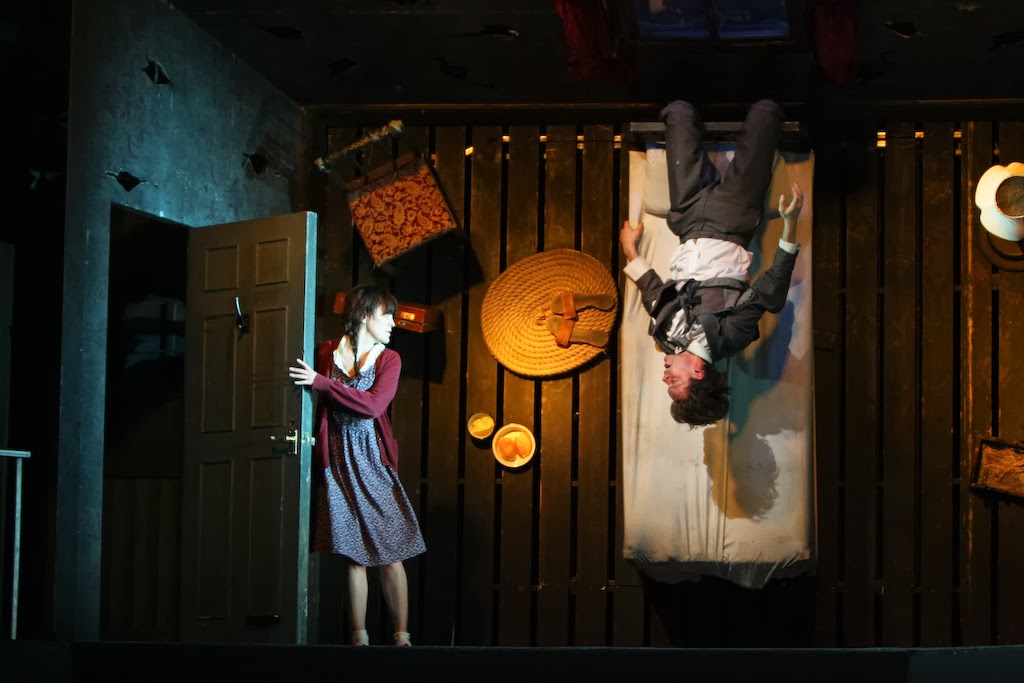
On the simple level, the production is outstanding and memorable for its physicality and athleticism.  Björn Thors as Gregor the insect hangs from the ceiling and performs athletic feats as if he were preparing for the Olympics.

His bedroom furniture is at a right angle to the floor so that his bed is facing the audience as if it were a picture hanging on the wall. This is an extraordinary piece of stage design by Börkur Jónsson as it immediately takes the story out the ordinary milieu of the two-story house in Eastern Europe. We have the mundane and the fantastical combined graphically. Gregor’s acrobatics and the commonplace activities of the dining room on the main floor are another juxtaposition of the fantastical and the conventional.

The play develops as Gregor, his family and visitors try to come to terms with his metamorphosis. Commonplace activities such as Gregor eating something, on one hand, and the nefarious issue of the slow rejection of him by all are intermingled. Gregor, the supporter of the family becomes an “outsider.”

Complimenting Thors on his acrobatic prowess is the least one can do for so outstanding a performance. From the moment he discovers that he has been turned into something almost unrecognizable to his final destruction, we see his amazing transformation. Outsiders are common in drama and literature but Gregor and Thors’s performance are unique.

The rest of the cast acts almost like a chorus to Gregor’s metamorphosis as we watch them react, comment and try to come to terms with it. His sister Greta (Unnur Ösp Stefánsdóttir), his father (Tom Mannion), his mother (Edda Arnljótsdóttir) and Víkingur Kristajánsson as Herr Stiethl and Herr Fischer are again both naturalistic and fantastical in keeping with the approach by the adapters who are also the co-directors.

Nick Cave and Warren Ellis have composed some eerie music for the play that is very effective and manages to be played and heard without interfering with the action on stage.
       
Like many people coming out of the theatre, you may end up using words such as “weird,” “bizarre” and “different.” On further reflection, you will come to the more sober verdict of “this is extraordinary theatre.” So much for a simple story!

_________


Metamorphosis by Franz Kafka, adapted by David Farr and Gisli Örn Gardarsson, continues until March 9, 2014 at the Royal Alexandra Theatre, 260 King St. W. Toronto, Ont. www.mirvish.com

Saturday, February 8, 2014

AGAMEMNON AT UPPER CANADA COLLEGE – REVIEW

Reviewed by James Karas


You cannot accuse Upper Canada College of lack of gumption.

Not only have they staged a Greek tragedy at the august private school but they have chosen one of the most difficult ones in the canon. Instead of tackling the more approachable Euripides or perhaps Sophocles, they have choses Aeschylus’s Agamemnon.

Directors Dale Churchward and Heather Crawford have chosen a straightforward reading of the piece in keeping with the age and limitations of high school students. They are well-served by Ann Carson’s poetic but approachable translation.

The play’s main character is the Chorus of old men of Argos. Usually made up of twelve actors, they carry a heavy burden of recitation, chant and dance. In this production, the Chorus consists of four students dressed in tuxedoes and they speak all the choral lines individually except for a couple of occasions where they speak in unison. The directors quite wisely use the Chorus as four Argives who discuss what is happening among them and with Klytaimnestra. The members of the Chorus are played by John Gilchrist, Mallory Long, Jake Bradshaw and Alex Green.

The murderous Klytaimnestra (Charlotte Miller) dominates the play. Stylishly dressed, Miller is imperious and nasty whose character goes as far as kicking Kassandra to the floor and killing her husband. I wish Miller wore a long dress or a cape to emphasize her haughtiness.

Agamemnon (Alex Czegledy) is the victor of the Trojan War and he returns triumphantly bringing home his concubine Kassandra. Czegledy is dressed in simple army fatigues with no indicia that he is in fact a king and the commanding general of the Greek forces in Troy. Czegledy’s performance would have gained considerable strength if he were suitably outfitted as a conqueror instead of a tired soldier.

Sian Lanthrop gives the most dramatic performance of all as Kassandra. Kassandra is the daughter of King Priam of Troy and one of Agamemnon’s trophies from the war. She is frightened, abused and fully aware of her fate and Lanthrop gives full range to her emotional turmoil.             

Aigisthos (Seth Zucker) is Klytaimnestra’s lover and his family’s avenger.  Zucker plays it coolly and he gets the queen and his revenge, at least in the short run.


Greek Tragedy in general and Agamemnon in particular are difficult to stage. UCC treats us to a good reading of the text with sufficient context to whet the appetite for more. The students made good use of the stage; they delivered their often difficult lines without a hitch. Those are no small achievements.

In case you think that is a small accomplishment, try to recall the last time you saw or could see Agamemnon in Toronto. The last time I saw it in Toronto was in a Russian Church hall some four years ago!   
______


Agamemnon  by Aeschylus in a translation by Anne Carson was performed from January 29 to February 1, 2014 at the David Chu Theatre, Upper Canada College   200 Lonsdale Rd, Toronto, ON M4V 1W6.

Wednesday, February 5, 2014

A MASKED BALL – REVIEW OF CANADIAN OPERA COMPANY PRODUCTION

Scene from A Masked Ball. Photo: Michael Cooper.

Reviewed by James Karas

During the curtain calls for the Canadian Opera Company’s production of A Masked Ball at the Four Seasons, the man behind me blurted out a “boo” with such force that it startled me. Vocal disapproval of a performance or a production is not unusual in opera, but this one seemed more ferocious than most. Before we get to that barbaric review, let’s give praise where it is deserved.

Let us praise Canadian soprano Adrianne Pieczonka for a moving, vocally stunning and flawless performance. She is Amelia, the hapless wife who falls in love with Riccardo (Dimitri Pittas) but does not want to be unfaithful to her husband Renato (Roland Wood).

Amelia and Riccardo meet in a graveyard at night and sing the gorgeous and lengthy duet “Teco io sto.” It moves from the breathless, to the ecstatic, to the sublime and makes huge demands on the soprano and the tenor. The duet displays an outstanding soprano meeting the emotional and vocal demands and, unfortunately, the comparative inability of Pittas to match her. It’s not that he has a bad voice; it’s just that he cannot keep up with Pieczonka.

For an outpouring of emotion and vocal splendour, her rendition of “Morro, ma prima” where she pleads for her husband to see her son before he kills her is simply outstanding.

Dimitri Pittas has a good voice at midrange but he cannot soar to the high notes as effortlessly as a first-rate tenor should. He does not have a particularly big voice and although he can do well in certain roles when paired up with a Pieczonka he simply does not measure up.

Roland Wood has a rich baritone voice and his Renato, the would-be-jilted husband of Amelia is very good. He moves from faithful servant and best friend of Riccardo to murderously jealous husband and assassin.

Mezzo-soprano Elena Manistina has the meaty role of Ulrica a.k.a. Mme Arvidson (check name of hotel below). She has a couple of dramatic arias that she delivered with relish but she was ill-served by a sorceress’s den that looked like a hotel basement. 

Soprano Simone Osborne played and sang a perky Oscar. He/she is Riccardo’s attendant who unwittingly betrays his master’s costume at the ball.     

Directors Jossi Wieler and Sergio Morabito created this production for Berlin’s Staatsoper Unter den Linden. The opera was originally set in Sweden and involved the assassination of a king. On the objections of the censor, the locale was changed to colonial Boston. Wieler and Morabito decided to move the action to 1950s America and squeeze a political scenario about a wise and benevolent leader concerned with racial issues and social justice while practicing infidelity. If they had called Riccardo Kennedy everyone one would have got the message without reading the programme notes. The interpretation, if you can call it that, is at best a stretcher.

The set by designer Barbara Ehnes represents the United States in the 1950's. It is meant to be the ballroom of the Arvedson Palace Hotel. On the left there is a stage at the back; on the right rear there is a bar with a balcony on top; at the front there are theatre chairs and red and white stacking chairs. The basic set, with minor changes, serves as the den of the black sorceress Ulrica, the graveyard where the gallows are and the house of Amelia in addition to a ballroom.

The costumes by Anja Rabes were modern, of course, but she showed an unusual attraction towards pajamas and housecoats. I have no idea why.

The set(s), the costumes, the general approach left one at sea as to what in the world was supposed to be going on. The singers, especially Pieczonka, and the Canadian Opera Company Orchestra under Stephen Lord gave us terrific entertainment but in the end there were some seriously flawed aspects.

No doubt the gentleman behind was simply trying to express his frustration at those unfortunate aspects of the production and he chose a less than usually civilized method of articulation.
    ____


A Masked Ball by Giuseppe Verdi opened on February 2 and will be performed eight times on various dates until February 22, 2014 at the Four Seasons Centre for the Performing Arts, 145 Queen Street West, Toronto, Ontario. Tel:  416-363-6671. www.coc.ca

Monday, February 3, 2014

CORIOLANUS – REVIEW OF DONMAR PRODUCTION LIVE FROM THE NATIONAL THEATRE


Reviewed by James Karas

Coriolanus is a sprawling play with numerous scene changes from the streets of Rome and Carioli, to army camps, and to other exterior and interior scenes. It has about sixty characters and is performed much less frequently than Shakespeare’s other Roma plays. It is not an easy piece to produce.

What can you get in a tiny theatre like London’s Donmar Warehouse (capacity 251) with a brilliant director and a first rate cast of fourteen actors? A great deal, in fact. You will get a taut, sinewy production that brings out the strengths of the play even if you are sitting in a movie theatre and witnessing a National Theatre Live telecast.

Director Josie Rourke has edited the play to its essentials by deleting or doubling up the minor characters. Citizens, senators, conspirators, servicemen, lords, officers - all are played by three ensemble actors, if at all.  The production gains much by not having a horde on stage and is thus able to transition from one scene to the next quickly and seamlessly.

The key to the play is the character of Coriolanus and his interplay with the citizens of Rome, his family and the enemy Volscians, especially their general, Tullus Aufidius.

Coriolanus (played by Tome Hiddleston in an extraordinary performance) is a war machine who slaughters for glory and country. Rourke has him covered in blood and that is the only time when Coriolanus feels at ease. Hiddleston is young, athletic and portrays the brave, arrogant and somewhat psychotic Coriolanus to perfection. Coriolanus professes love of country but his real and perhaps only love is martial glory that can only be gained through immense courage and slaughter on the battlefield.

His character is complemented by his mother, the powerful and equally ambitious Volumnia played by Deborah Findlay. Volumnia is a woman only because of her fixtures but that forces her to live for glory vicariously. Her son is the product of her ambitions and in the end she is the only one that can sway him. Findlay is equal to the role and she exudes power, authority and cunning.

The stunning-looking Birgitte Hjort Sørensen plays Virgilia, Coriolanus’s hapless wife. She is stuck between the mother-son vice and does not have any wiggle room to influence anything.

The source of glory for Coriolanus is Aufidius (Hadley Fraser), the leader of the enemy Volscians. He is the mirror image of Coriolanus as a war machine but has been repeatedly defeated by the Roman. Coriolanus, in act of ultimate treachery, goes to join the Volscians and kneels before Aufidius. Aufidius falls on his knees and kisses Coriolanus on the lips. A brilliant touch by Rourke.

Coriolanus despises the Roman plebeians with a visceral hatred that is almost matched by his opinion of the upper class. Rourke presents both the lower and upper crusts with economy and effectiveness and I think we see Coriolanus’s psychotic side more easily than if we head a huge crowd on the stage.

Menenius (Mark Gatiss) stands uneasily among the blood thirst, arrogance, fanaticism and hideous conduct as the voice of reason, decency and tolerance. He does not stand a chance.

The set by Lucy Osborne consisting largely of a back wall painted red with graffiti on it suggests a protest movement in a modern city. The costumes are modified modern meaning that some of the military uniforms hark back to another age whereas the rest of the clothing can be seen on the streets.

Rourke scores a final and stunning touch at the end of the performance. Coriolanus is stabbed and hanged by his feet. Aufidius stands underneath the bleeding corpse and the blood spills on his face. The two war lords are joined together inextricably.
    _____

Coriolanus by William Shakespeare was shown at the Cineplex Cinemas Yong-Dundas, 10 Dundas St. East, Toronto ON and other theatres on January 30 2014. For more information visit:  http://www.cineplex.com/