Saturday, October 8, 2016

THE WATERSHED – REVIEW OF SOUTAR’S DOCUMENTARY AT TARRAGON THEATRE

By James Karas

Annabel Soutar’s The Watershed is a full-fledged documentary about fresh water research in Canada and more particularly the research at a project called the Experimental Lakes Area (ELA). It is based, according to the author, on “verbatim testimony from interviews conducted by the playwright, as well as speech transcripts, House of Commons debate transcripts, film transcripts, press releases, and media articles collected between 2013 and 2015.” 

The script that resulted from all of the above-noted sources is acted by eight actors who represent some fifty characters (I did not count them). This is a documentary that we usually see on television or at the movie theatre but not, as far as I known, in this format in the live theatre.
 
Bruce Dinsmore, Amelia Sargisson, Ngozi Paul, Tanja Jacobs. Photo by Guntar Kravis
Soutar (played with great vigour and passion by Kristen Thomson) sets out with her husband Alex (Alex Ivanovici) and their daughters Ella (Amelia Sargisson) and Beatrice (Ngozi Paul) and their friend Hazel (Tanja Jacobs) in a Winnebago on a mission: to find out why ELA is being defunded and more importantly to save Canada’s fresh water supply.

Like all good missionaries, Soutar is a driven woman. She wants to interview ministers, MPs, activists, scientists, professors, entertainers and others, and get support and publicity from radio and television programs. It is a Marathon that would exhaust a Kenyan let alone a woman with a husband and three children in a gas-guzzling Winnebago on a trip that goes from Montreal to the tar sands (oops, oil sands) of Alberta and that lasts over a month.

If this were done by the CBC, there would be film clips of the people interviewed with a narrator putting the story in perspective. It is difficult to have some fifty people represented by eight actors presented to us without our interest flagging.

Soutar is well aware of that and she has taken steps to reduce that possibility. Humour is one method that she uses. The children come up with some funny scenes. There are some film projections that would have looked even better if they were not shown on a brick wall but it does help.
 Eric Peterson, Alex Ivanovici, Ngozi Paul, Bruce Dinsmore, Amelia Sargisson, Tanja Jacobs. 
Photo by Guntar Kravis
The other tool used is noise. Loud music, children screaming, engines revving, an airplane taking off and sundry others are provided. I did not find any of that in the least bit diverting and could have done without all of it.

Without the diversionary tactics, we are left with a display of well-meaning, intelligent, dedicated people trying to do a worthwhile job. They run into roadblocks put up by venality, greed, stupidity and politicians who have all of the aforementioned traits. It is a depressing picture.

The eight actors have their work cut out for them as does director Chris Abraham who has to marshal the large number of characters and numerous scene changes. Some of the characters are presented as caricatures but most are treated with respect. In that respect, it is an amazing show. The talented troupe is made up of Laura Condlin, Bruce Dinsmore, Alex Ivanovici, Tanja Jacobs, Ngozi Paul, Eric Peterson, Amelia Sargisson and Kristen Thomson.

The play was commissioned for the arts festival of last year’s Pan Am Games as a co-production by Soutar’s Porte Parole Productions and Toronto’s Crow’s Theatre. Chris Abraham, Crow’s Artistic Director played a part in the negotiations and run-around with the powers-that-be leading to the granting of the commission. Abraham appears as a character in the play as does his daughter Hazel. Has a director ever directed someone to play him in a documentary?

Soutar and Abraham are grafting a complex documentary onto a live theatre production. The demands of live theatre are different from the type of story they are trying to expose and they are forced to use many means to keep the work theatrical. Some things work; some don’t.

Go see how you like the result.
                                          ______


The Watershed by Annabel Soutar continues until October 30, 2016 at the Tarragon Theatre Mainspace, 30 Bridgman Ave. Toronto, Ontario.  www.tarragontheatre.com

Wednesday, October 5, 2016

NOISES OFF – REVIEW OF SOULPEPPER PRODUCTION OF FRAYN’S FARCE


**** (out of 5)

There are many very good farces but few can be rated as great examples of the genre. Michael Frayn’s 1982 Noises Off should make the top 10 in any listing of farces. It is a finely structured and intelligent play that starts funny and builds to absolute hilarity, if there is such an apogee of laughter.

That is all well between the covers of a book but it puts extraordinary and frequently unachievable demands on any theatre company that dares produce it. Soulpepper has not shied away from tackling the play which, according to a note in the programme, has never been produced by a professional Toronto company. The Stratford Festival did produce it in 2004 but that was a long time ago.
 
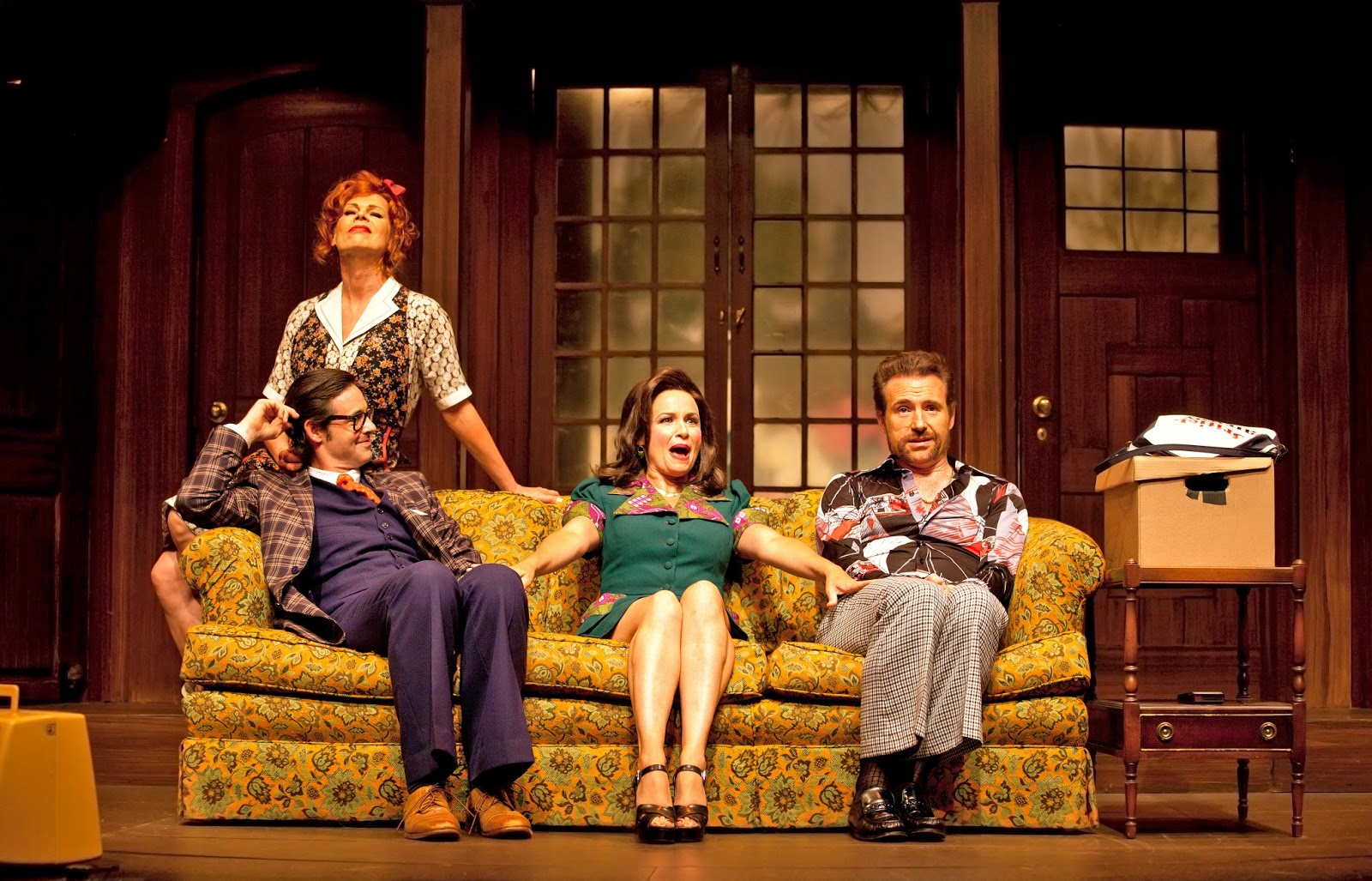
Brenda Robins, Matthew Edison, Raquel Duffy, Christopher Morris. Photo: Bronwen Sharp 
Noises Off is a multi-layered play that requires physical and mental agility at break-neck speed. The plot? Well, a second-rate theatre company is putting on a play called Nothing On in a provincial town in England. The play is about a tax-evading English couple, Philip and Flavia Brent who live in Spain but return surreptitiously to their country home in England and must not be detected by the taxman.

They have a classic maid called Mrs. Clackett. A real estate agent named Roger brings a nubile woman named Vicki to the house for a tryst. But the Brents, Mrs. Clackett and a Burglar soon join them to create pandemonium.

That is the plot of Nothing On, the play within the play which is directed by Lloyd Dallas with backstage help from Poppy and Tim.

In Nothing On, Mrs. Clackett is played by Dotty Otley and In Noises Off  Dotty (and Mrs. Clackett, of course) is played by Brenda Robins. The characters in Nothing On are played by actors of the company producing that play who in turn are played by actors in Noises Off. Got that?

The first act takes place on the set of Nothing On during the dress rehearsal. The actors are simply, hopelessly incompetent, drunk, missing, not-quite-there mentally and the result is laughter. The latter characteristics of the “actors” in Noises On are in reverse proportion to the talents of the actors of Soulpepper who play the actors who play the actors in the play and the play within-the-play, Confusing? Don’t worry about. It is quite clear in the theatre.
 Matthew Edison, Myrthyn Stagg. Photo by Bronwen Sharp
The second act takes place backstage during a performance of Nothing On and the problems of the actors’ incompetence is intensified by “real-life” jealousies and personal rivalries and differences. The laughter intensifies in direct proportion to the increased complications of the plot.

In the third act we are watching a performance of Nothing On some weeks later and everything goes to hell in a hand basket as the play moves to yet another level of confusion. The actors’ rivalries come out in the open as they sabotage each other’s lines, entrances are screwed up and if the words havoc and pandemonium have any meaning, it is illustrated on stage at fever pitch.

Ted Dykstra was quite brave to accept directorial responsibility for the production. Frayn makes sure that you will get lots of laughs; the Soulpepper cast will do at the very least a fine job for you. But will they be able to reach that theatrical pinnacle of ensemble acting that produces the magical connection between stage and audience to have us rolling in the aisles with laughter? Almost.

Brenda Robins as Dotty the awful actress who plays Mrs. Clackett the mouthy maid carries the roles with aplomb. Matthew Edison as the Roger who plays the real estate agent and would-be-seducer of the luscious blonde Brooke has a great deal of running to do and some serious pratfalls to perform and does a fine job at it.

Myrthin Stagg as Vicki as Brooke Ashton, the actor who plays Vicki is the classic sexy, dim babe of farce wearing only undergarments who in real life would have married Donald Trump.

Oliver Dennis plays the Burglar who does not have much to do in that part but as the drunk actor who plays the Burglar he muffs his lines and his entrances and goes AWOL at the most inopportune times and he is simply hilarious.

Raquel Duffy is exceptional as the actress Belinda who plays Mrs. Brent. She is noticeable for her superb acting as a fine actress and decent human being who holds or tries to hold the inept clowns of Nothing On together. A delight to watch.

There is only praise for the performances of David Storch as the Director whose nerves are not so much frayed as microwaved and gone over with a lawnmower or the almost equally put upon Tim of Anand Rajaram and Oyin Oladejo as Poppy. Christopher Morris plays Frederick Fellowes (who plays Philip Brent) a man who is near the end of his rope and who gets a bleeding nose when under pressure.

Total result: laughter.         
______
Noises off by Michael Frayn runs until October 22, 2016 at the Young Centre for the Performing Arts, 55 Tank House Lane, Toronto, Ontario. www.soulpepper.ca

Wednesday, September 28, 2016

TIDELINE – REVIEW OF HART HOUSE PRODUCTION

By James Karas

*** (out of 5)

A couple of thoughts crossed my mind after watching Wajdi Mouawad’s Tideline now playing at Hart House Theatre. The first was T.S. Eliot’s famous dictum that “humankind cannot bear very much reality”. The second was the enthusiastic “hey, let’s put on a show” heard in the Mickey Rooney and Judy Garland musicals of the 1930s.  The “show” that the young actors under the direction of Ken Gass are putting on is a very serious play and not a pleasant musical. They try to express the inexpressible; they try to make us bear some reality through descriptions of startling images in a war-torn place.

The play opens with a young man named Wilfrid (Danny Ghantous) narrating how he found out that his father had died. The phone rang while he was having intercourse and he tautly repeats the conversation more than once as “Hello.” Come. “Your father is dead.”
 
Wilfrid sets out on a journey to find a place to bury his father. But this is not a narrative but a memory play where the young are making a film and go or want to go from village to village to tell their story. Wilfrid’s dead Father (Erik Mrakovcic) is a walking and talking corpse. Wilfrid is possessed by an Arthurian Knight of God played by an unknightly looking Angela Sun who also doubles as the Director of the film. I could not make sense of the casting decision but Wilfrid is free to imagine a Knight anyway he likes.

Tideline has a blind poet named Wazâân (Kwaku Okyere) who recites the opening lines of the Iliad where the goddess sings of the fatal anger of Achilles that sent the souls of many valiant warriors to Hades, leaving their bodies as spoil for dogs and carrion birds. We will be reminded of that graphic image throughout the play.

The young people of the play remember unspeakable events in their lives and want to preserve the memory of acts too horrible to contemplate. Simone (Cassidy Sadler), Amé (Augusto Bitter) and Josephine (Madeleine Heaven) and Sabbé (Harrison Tanner) display enthusiasm (let’s put on a show) and stun us with events of obscene cruelty and bottomless inhumanity. All the young actors are given opportunities to spread their wings and showcase their talents. Madeleine Heaven even has what amounts to a mad scene.

The production is in association with Canadian Rep Theatre and ENSEMBLE: Canadian Youth Theatre/Théâtre Jeunesse Canadien. Most of the actors are university students or recent graduates. 

Tideline is an ambitious and poetic play. It reaches back to Homer for its images and distances us from the horrors and mutilations of war by having the young people remember events from the past and trying to recall and re-enact them for us. The walking and talking dead Father, the imaginary Knight, the making of a film are all devices used to make us bear the reality that Eliot said we cannot bear.

Ken Gass is reasonably successful in bringing out many of the qualities of the play with the young cast. All the characters wear every-day, ordinary clothes. The set, designed by Jung-Hye Kim consists of white painted chairs and benches with a ramp stage left.
__________

Tideline  by Wajdi Mouawad in a translation by Shelley Tepperman  continues until October 1, 2016 at Hart House Theatre, 7 Hart House Circle, Toronto, Ontario. www.harthousetheatre.ca Telephone (416) 978-8849

Thursday, September 22, 2016

JOHN GABRIEL BORKMAN – REVIEW OF STRATFORD FESTIVAL PRODUCTION

Reviewed by James Karas

*** (out of 5)

If you want to produce a play by Ibsen, especially a weighty one, you should treat it like an attack on a well-fortified city. You better have the best generals, bring out your heavy artillery and siege machinery and aim carefully. John Gabriel Borkman, his 1896 play, demands nothing else but if you are successful, you will be richly rewarded.

Borkman is a grand play that deals with complex issues that are as numerous as they are difficult to unravel. Director Carey Perloff and her stellar cast illuminate most of the complexity of the play in a superb production at the Tom Patterson Theatre.
 
From left: Lucy Peacock, Seana McKenna, Scott Wentworth. Photography by Don Dixon.
The play is aptly named after its central character. John Gabriel Borkman is a megalomaniac banker who committed moral and legal crimes on a grand scale. His greed had no bounds as he attempted to amass a great fortune while destroying the lives of people (it’s only money) including the lives of his friends and the woman who was in love with him. As with many such persons, he claimed to have a vision, a plan to do good for people. The vision was probably delusional or self-serving. The result was that he was convicted and incarcerated for five years. The play begins eight years after his release from prison.

Scott Wentworth as Borkman is completely egocentric and remorseless. He lives in the grand hall of his house alone and paces up and down most of the time. Vilhalm is his only friend (superbly played by Joseph Ziegler) and his daughter Frida (Natalie Francis) who visits and plays the violin for him. Borkman discards Vilhalm, a man of decency, forgiveness and understanding, who is unlike the delusional dreamer who hallucinates of making a comeback.

Lucy Peacock plays Borkman’s embittered wife who is full of hatred but just as delusional as her husband. She dreams of her son Erhart (Antoine Yared), in mythical heroic fashion, restoring her reputation. Her twin sister Ella (Seana McKenna) raised Erhart after the Borkmans lost everything (they are living in her house) but she too hates John Gabriel because he destroyed her ability to love. 

Peacock and McKenna have distinctive voices which can deliver tinges of bitterness, hatred and passion with individual intonation but at the same time sound like twin sisters which is what they are in the play. They fight for the soul of Erhart, the one because she needs a liberator and a restorer of her reputation, the other as the young man who will take her name and inherit her fortune. Peacock and McKenna are magnificent.
 
From left: Scott Wentworth as John Gabriel Borkman, Seana McKenna as Miss Ella Rentheim and Lucy Peacock as Mrs. Gunhild Borkman inJohn Gabriel Borkman. Photography by David Hou. 

Erhart is a nice young man who is in love with Mrs Wilton (Sarah Afful) who happens to be seven years older than him and a widow. He asserts his independence by breaking away from his mother and aunt (really his stepmother) and their ambitions for him.

For the final act Ibsen takes the two sisters and Borkman out in the stormy weather where they must account for themselves in a heavily symbolic scene.

The theatre-in-the-round Tom Patterson restricts design to stage furniture and lighting. Designer Christina Poddubiuk decorates the stage with a few pieces of furniture and with judicious lighting design by Bonnie Beecher, we do get the claustrophobic and closed world of the play.

Director Perloff takes a heavy-handed approach to this dark play that demands that type of treatment. The last scene in the snow smacks of melodrama but this is a production that   Ibsen would have certainly approved of.
           ______


John Gabriel Borkman by Henrik Ibsen in a translation by Paul Walsh continues in repertory until September 23, 2016 at the Tom Patterson Theatre, Stratford, Ontario. www.stratfordfestival.ca

Friday, September 9, 2016

THE HYPOCHONDRIAC - REVIEW OF 2016 STRATFORD FESTIVAL PRODUCTION

James Karas

***** (out of five)

The Stratford Festival’s production of The Hypochondriac is a hilarious piece of theatre and you could hardly do anything better than to see it in the waning days of summer and laugh wholeheartedly. If you have to choose between reading this review and ordering tickets to see it, choose the latter. I have to write a few hundred words. It is part of the job, you see.

Moliere wrote some of the best comedies since Aristophanes. But with classics one always encounters the Wife of Bath’s conundrum about women which applies even more aptly to translations: is she is beautiful she will be unfaithful; if she is faithful, she will be ugly. With Moliere the choice is never that drastic (nor is it true with regard to women) because he is funny even in a mediocre translation. But in Richard Bean’s version director Antoni Cimolino has found a text that is faithful in spirit to Moliere’s play and resonates with modern audiences. Did I say it is hilarious?
 
Members of the company in The Hypochondriac. Photography by David Hou.
Bean’s new version with a commedia dell’arte show thrown in and much more, the result is a colourful and vibrant production.

When you have a comic star like Stephen Ouimette as Argan, the hypochondriac of the title, you mop up your forehead with relief about your lead actor and go to solve other problems. Argan suffers from every disease for which there is a Latin name but his specialty is ailments of the lower intestine. He is prescribed every medication that the doctors’ imagination can conceive and his rectum withstand.

Ouimette’s Argan is cranky, bilious, cheap, cantankerous and very funny as he gets enemas every day, is harassed by his housekeeper, disobeyed by his daughter and is a man near the end of his rope. He times his lines with precision, plays the would-be sick with marvellous effect and he does not miss a beat in his characterization of the foolish Argan.

He has good company to play against. His lippy no-nonsense maid Toinette (Brigit Wilson) gives more than she takes from him despite the fact that she has to clean the result of his cleansing clyster. When he asks if she will help him kill himself, she replies “sure, when?” A spirited and superb performance by Wilson

Argan’s avaricious wife Beline (Trish Lindstrom) wants him dead and refuses to let him touch her. Marital nastiness can be funny and Lindstrom is good at it.    

Ben Carlson plays the sensible Beralde who tries to bring some sanity into Argan’s life with no success. Carlson is pitch-perfect in the role.

Amid the chaos, the bodily fluids and the ugliness, we have the lovers: Argan’s daughter Angelique (the lovely Shannon Taylor) and the handsome Cleante (Luke Humphrey) who will defeat all the obstacles placed in front of them and love will triumph.

From left: Stephen Ouimette as Argan/Molière, Shannon Taylor as Angelique/Armand Bejart and Brigit Wilson as Toinette in The Hypochondriac. Photography by David Hou.
The Hypochondriac is, of course, a frontal attack on the medical profession which was more quackery than medicine in Moliere’s time. The best part is that it resonates with today’s conditions. A specialist is someone way above a doctor and just try getting an appointment with one. Monsieur Diafoirerhoea (Peter Hutt) and his son Thomas (Ian Lake) and all doctors are ridiculed mercilessly and the audience responded warmly.

Designer Teresa Przybylski, Choreographer Stephen Cota, Commedia dell’Arte Coach Perry Schneiderman and Juggling Coach Doug DeForrest deserve special praise. There are dancers, jugglers and singers in the production that give additional energy and colour. There is a tent on the set as if these were travelling players putting on a show to entertain everyone. They do.  

Cimolino directs the play with his usual attention to detail, timing and inventiveness. A seemingly innocuous line can bring a laugh. Just time it perfectly – a slight delay, a quicker reply, an aside, a change in intonation and you have evoked laughter, pleasure and a great night at the theatre.
_____

The Hypochondriac by Moliere in a version by Richard Bean continues in repertory at the Festival Theatre, Stratford, Ontario until October 30, 2016. www.starfordfestival.ca 

Thursday, September 8, 2016

DEATH OF A SALESMAN – REVIEW OF ASHKENAZ FESTIVAL PRODUCTION

James Karas

Arthur Miller subtitled Death of a Salesman “Certain private conversations in two acts and a requiem.” In the Ashkenaz Festival production now playing at the Studio Theatre of the Toronto Centre for the Arts the conversations are not so much private as internal. Willy Loman, the pathetic travelling salesman and grandiose dreamer is talking to himself as he tries to come to terms with his utter failure as a husband, a father and a salesman.

Death of a Salesman is rightly seen as a parable of the American Dream, the idea and ideal of the constitutional right of the pursuit of happiness interpreted as entrepreneurial success and wealth. If the play resonated with America of 1949, it is far more relevant today than ever.

Avi Hoffman directs the production and takes on the role of Willy Loman. From the start Willy appears like an empty shell. His illusions of success, his bravado, his boasting and his dreams for his children are all lies. As we listen to Hoffman’s superb delivery of Willy’s lines, we realize that Willy may know in the depths of his soul the truth about himself but he makes Herculean efforts to hide it from himself and mask it in his useless sons. Hoffan gives us the quintessential common man who wants to be uncommon without the wherewithal. A great performance.

Death of a Salesman has a number of flashbacks and imagined occurrences such as Willy’s meetings with his brother Ben. They are Willy’s dreams and nightmares but those scenes are not substantially different from the scenes that take place in the present. In all of them Willy is mostly in his own world, in his private conversation, in his dream of success or nightmare of failure.
 
Suzanne Toren, Avi Hoffman, Mikey Samra and Ben Rosenblatt
This production brings another angle to the play. I always assumed that the Lomans are the all-American family. There is no hint that they are not Americans from their ambitions to rise above their station to Biff playing football and Willy wanting to eat only American cheese.

In this production Willy is clearly Jewish and he not only wants to succeed and be a somebody but he wants to belong. He wants to be American. He does not want to eat whipped cheese because it is not American and good Americans eat American cheese.   

Suzanne Toren plays Linda, the most sympathetic character in the play who sees and knows a great deal but fights off reality out of necessity. She sees what her husband is but pretends to joins in his illusions and delusions in order to save him from himself. A marvelous performance by Toren who displays both the depth of feeling and strength of Linda.

Daniel Kahn gives us a Biff who is a shallow wreck of a human being, a copy of his father in his search for easy success and wealth and a tragic man because he at last realizes what he is. A powerful portrait by Kahn. Mikey Samra plays the equally shallow Hap who also shares all the family traits but, unlike Willy and Biff, learns nothing.

The smaller roles are played equally capably by Sam Stein as the real mensch Charley, Ben Rosenblatt as his decent son Bernard, and Adam B. Shapiro as the odious Howard, the face of capitalism and the American success story.    

The set consists of a table and four chairs and almost nothing else. There are some video projections of the Loman house, a road and a car but it would be difficult to imagine a more barebones production. It is as if the play has been stripped of all paraphernalia and laid bare in all its searing drama. It is a stunning production.

One more point. The play is done in Yiddish and the title is Toyt Fun A Seylsman. If your Yiddish is meagre, there are English surtitles and you will hear the guttural and lyrical sounds of that language. I found the surtitles and the Spartan production concentrated my attention on the acting and the text. The result was a powerful production and a great night at the theatre.  
___
Death of a Salesman (Toyt Fun A Seylsman) by Arthur Miller opened on August 31 and will play until September 10, 2016 in the Studio Theatre, Toronto Centre for the Arts 5040 Yonge St. Toronto, Ontario. www.ashkenaz.ca

Thursday, September 1, 2016

BUNNY – REVIEW OF MOSCOVITCH PLAY AT STRATFORD

James Karas

***** (out of 5)

The Stratford Festival offers a world premiere of a play that it commissioned for the small Studio Theatre. There are several stumbling blocks in that venture and the only safety cushion is the size of the venue. In the case of Hannah Moscovitch’s Bunny they need not have worried. Bunny is an intelligent, funny, literate and well-produced play that earns kudos for all concerned. To put it more bluntly, you mix sex, literature and laughter, you get a winner.

At least Moskovitch does. Sorrel (Maev Beaty) is a bright and attractive girl who does not mix well with other teenagers. Her parents are leftist, anti-capitalist college teachers. Sorrel is steeped in 19th century literature from a young age but she is a bit of a geek. She dresses badly. She discovers boys (kissing 19 of them in high school) and then sex. She moves from the captain of the football team, to a professor, and just maybe another young man.
 Maev Beaty as Sorrel and Emilio Vieira as Justin in Bunny. Photography by David Hou
Sorrel tells us her own story as she tries to make contact with people. Her nickname is Bunny because she seems always scared and on the lookout. Her best friend or perhaps only friend is Maggie (Krystin Pellerin), a woman who has a child from a casual affair but displays spunk and common sense. Maggie is perceptive and deeply human. She succeeds in becoming Sorrel’s friend only near the end of her own life in a moving and dramatic scene.

Maggie’s daughter Lola (Jessica B. Hill) has a boyfriend named Angel (David Patrick Flemming) who is attracted to Sorrel and will play a defining role in her, Sorrel’s, life.

Justin (Emilio Vieira), the captain of the football team, is a nice Catholic boy and his parents are a bit more than the bright Sorrel can take.

Ethan (Cyrus Lane) is her professor who happens to be married and has sex with Sorrel in cheap hotels and backrooms of the bar where she works while a student. It is a mutual arrangement and attraction and one cannot attach too much opprobrium on him.

Maggie’s brother Carol (Tim Campbell) is a wooden business man who would never understand her. It is hard to say why she marries him but perhaps what is lacking is not in him but in Sorrel herself. There is a resolution in the end but she and the audience must decide what and if it is a true resolution.
 
Krystin Pellerin (left) as Maggie and Maev Beaty as Sorrel in Bunny. Photography by David Hou.
Every character and every incident represents a different layer in Sorrel’s life. From her literary tastes and references to her various relationships, we see a complex woman growing up, developing and maturing.    

Maev Beaty carries most of the show with rest of the cast being almost satellites in her various encounters and growth. She is steeped in Victorian literature and is often seen with a hefty book by George Elliot in her hand. She becomes a professor of Victorian literature and like, say, Elizabeth Bennett of Pride and Prejudice or Dorothea Brooke of Middlemarch she has intelligence and wit but lacks their strength. Her sexual partners seem to haunt her long after she has left them behind. An impressive performance by Beaty.

The small playing area of the Studio is changed efficiently to focus on Sorrell and to change the scene from a bar to a motel to Maggie’s house and a cottage up north. Kudos to designer Michael Gianfrancesco.

Director Sarah Garton Stanley has a fine play to work with and an excellent cast and she puts them through their paces with expertise and high effectiveness.

A major achievement all around.
______
 Bunny by Hannah Moskovitch continues until September 24, 2006 at the Studio Theatre, 34 George Street East, Stratford. Ontario. www.stratfordfestival.ca