Friday, February 2, 2024

AFTERGLOW – REVIEW OF SOUTHWARK PLAYHOUSE PRODUCTION

Reviewed by James Karas

In the opening scene of Afterglow, we see the outlines of three men behind a sheer curtain engaged in a wonderful sexual act. The curtain is removed, and we meet the three muscular young men, naked in loving embraces. They are content and happy in the climax of their encounter. The men are the married couple Alex (Victor Hugo) and Josh (Peter McPherson) and their visitor Darius (James Nicolson).  

Josh and Alex are expecting a child from a surrogate mother and have an open marriage that means they can have sexual relations with other men provided it does not include sleepovers.

The inexperienced and young Darius falls in love with Josh and the latter reciprocates with the rationale that his relations with Alex are not as frequent as they used to be. Alex discerns what is happening and demands that Josh terminate his contact with Darius.

In other words, Afterglow is the classic story of a love triangle only this time it involves only men. There is a great deal of nudity and displays of affection among the men as the love between John and Alex is sorely tested as the love between Josh and Darius increases.

The author S. Asher Gelman is an American actor, dancer, choreographer, playwright, and director. Afterglow is his first play and it opened Off-Broadway in New York in 2017 and ran for 14 months. The play has received numerous productions through his company Midnight Theatricals. He directs and choreographs the current production in the Southwark Playhouse, London.

Victor Hugo and Pete McPherson. Photo: The Other Richard

The play is a love story and a story about family. Josh and Alex initially take an open view of sex in their marriage with some limitations, but their main concern is the pending arrival of their child. The arrival of the handsome Darius acts as a disruption to the loving family and it shows the limits of free love. Josh complains that Alex has not been attentive to his emotional and sexual needs. Alex says he has work pressure and needs some air but that in no way diminishes his love and devotion to Josh. As they say, this is the classic triangle.

Darius is a young, inexperienced gay man who falls deeply in love with Josh and the situation among the three men reaches a climactic moment where a resolution is required.

The acting is superb. Victor Hugo as Alex is a hard-working chemist with a job that makes great demands on him. He tries to be understanding and accepting of his husband’s conduct, but it reaches a breaking point, and he demands that it cease. A superb performance by Hugo. McPherson as Josh is a successful actor with great emotional and sexual needs, and he feels that Alex is not fulfilling those needs the way he used to. Nicholson as Darius is an inexperienced gay man who falls in love with Josh and is open to be crushed if the relationship fails. A sensitive and nuanced performance.

The set by designer Ann Beyersdorfer is all black with small pieces of furniture rearranged by the cast to show Josh and Alex’s apartment, with a shower center-stage, and Darius’s place of work as a masseur and his apartment. All is done on a small stage with minimal changes. But the showers and lighting effects by Jamie Roderick are something to behold.

A superb production and a delightful night at the theatre in the small but highly creative Southwark Playhouse.
____________________
Afterglow by S. Asher Gelman in a production by Midnight Theatricals opened on January 17 and will run until February 10, 2024 at the Southwark Playhouse, 77-85 Newington Causeway, London SE1 6BD. http://southwarkplayhouse.co.uk/

James Karas is the Senior zeditor, Culture of The Greek Press

Thursday, February 1, 2024

THE MOTIVE AND THE CUE – REVIEW OF PLAY ABOUT THE GIELGUD/BURTON PRODUCTION OF HAMLET AT GARRICK THEATRE

Reviewed by James Karas

On April 9, 1964, a production of Hamlet opened on Broadway in New York. It starred Richard Burton and was directed by Sir John Gielgud. It received a great deal of publicity and was a successful production, but the brouhaha may have had little to do with the quality of the director and the star actor. The publicity was generated probably more by Burton’s recent marriage to Elizabeth Taylor than by the production of a play by William Shakespeare.

The production has become legendary and almost 60 years later it has spawned an outstanding play by Jack Thorne and a production by the National Theatre of Great Britain directed by the eminent Sam Mendes. It represents outstanding theatre and a lecture about the famous play that should not be missed. And it is great to hear what the great stars had to say about Shakespeare and their views of the iconic play.

The play takes us through many of the days of rehearsal of Hamlet with sections of the script performed for us in preparation for the opening. We get titillating views of the life of Burton and Taylor, but the main thrust is the relationship and confrontations between John Gielgud, the suave, gentlemanly, and brilliant actor of the previous generation who has undertaken the job as a knowledgeable and masterly director. He has detailed views of how scenes and soliloquies can be effectively performed. Mark Gatiss plays Gielgud brilliantly. He has mastered Gielgud’s voice and his mannerisms including thrusting his head upwards. It is as if we were listening to the great Gielgud himself. 

                                The cast of The Motive And The Clue.. Photo: Mark Douet

Richard Burton is a great or could-have-been a great actor except for the fact that he preferred the money of Hollywood to the adulation of serious drama. He is young, brash, opinionated, occasionally drunk, offensive and disagrees with Gielgud on many points. The disagreements cause flareups, but Gielgud never ceases to be a gentleman who wants to persuade and let Burton find his way into the great role.

There is a large cast that are in effect satellites to the director/actor differences. Rosencrantz (Huw Parmenter) and Guildenstern (Luke Norris), the comic nonentities of the play are treated seriously by Gielgud who points out that they do have a serious role in what they do. Allan Corduner plays Hume Cronyn who played Polonius in the production. Ryan Ellsworth is superb as George Voscovec who played the Player King in New York. David Tarkenter plays Alfred Drake who acted as Claudius in 1964.

If anyone can direct a play with masterly results it is Sam Mendes who is one of the best. The play has numerous scene changes from a rehearsal room to hotel rooms (one of which is used by Gielgud for an assignation with a male prostitute) to the stage for performance of specific scenes. Es Devlin is the set designer.

The production feels like a documentary, and it is, largely. Richard L Steme took it upon himself to record every word that Gielgud spoke about the play in rehearsal. He recorded everything including a private meeting between Burton and Gielgud. Before the session began, Steme climbed under the rehearsal platform and pulled a cloth over the tape recorder and himself. He wrote a book, “John Gielgud Directs Richard Burton in Hamlet” which has not only reliable but verbatim information about all aspects of the preparation of the production including the private session by Gielgud and Burton.

Who would not want to see Elizabeth Taylor play a peacemaker between her husband and the great Gielgud? Details about small points in producing Hamlet and life behind the scenes of a production are endlessly fascinating and this play has them all. A theatrical delight.
_______
The Motive and the Cue by Jack Thorne in a production by Neal Street and the National Theatre continues at the Noel Coward Theatre, St. Martin’s Lane, London, U. K WC2N 4AU.

James Karas is the Senior Editor, Culture of The Greek Press

Wednesday, January 31, 2024

COWBOIS – REVIEW OF ROYAL COURT THEATRE PRODUCTION IN LONDON

 Reviewed by James Karas

Playwright Charles Josephine’s Cowbois, now playing at the Royal Court Theatre in London is, according to a note in the program, “a love letter to the trans masculine people in history whose stories have been ignored or erased.” The play takes place in a saloon run by Miss Lillian (Sophie Melville) in 19th century United States. In the saloon we meet several of her women friends and other characters. All the husbands are away for a year prospecting for gold.

Miss Lillian has some interesting woman friends. They are Sally Ann (Emma Pallant), Jayne (Lucy McCormick), Lucy (Lee Braithwaite), and Mary (Bridgette Amofah). A drunk Sheriff Roger Jones (Paul Hunter) arrives, and we learn that he is looking for a criminal called Jack Cannon (Vinnie Heaven). He is a singing cowboy dressed in gaudy clothes, not so much a cowboy as a caricature of one. He sings, dances or gyrates his torso and causes a sensation not just with the ladies but with the audience who react to him as if he were a rock star.

The ladies do not allow the speaker to finish a sentence and they act and overact with frightful consistency. Some are hot and fan themselves with great vigor, they are religious and cross themselves regularly and create an atmosphere that the audience found hugely entertaining. The heat that the fans which they use so vigorously are supposed to relieve soon seemed to be more sexual than weather-related.

The cast of Cowbois. Photo: Ali Wright

The Sheriff acts and overacts in an equally showy and ridiculous manner. The ladies’ husbands, as I said, have been away for a year gold-prospecting somewhere and anything can happen. The handsome rock-star style Jack and Miss Lillian are attracted to each other and engage in protracted simulated coitus including finding a hot tub on stage. Yes, she becomes pregnant, and we see her with a grown belly for the rest of the show.

We are informed that Jack has committed an extremely wide range of crimes including murder, armed robbery, perjury bigamy, extortion, and a few others. He is a deadly shot and shoots enough bullets that combined with the shots of the other characters would wipe out a whole town. Remember, this is a rootin’ shootin’ western.


The husbands return from their prospecting, and they do not raise the atmosphere of silliness. I am not sure what Josephine as the author and co-director with Sean Holmes had in mind. Is the play a parody, a satire, a burlesque about westerns with LGBTQ themes? Yes, we do get the message about lesbians, transexuals and people of different sexual orientations. In fact, the author states that if the character is trans, so must the actor, if the character is queer, so must the actor.

There are plenty of guns and lots of shooting (almost too much) and the saloon and some of the costumes and the presence of guns indicate a western setting, of course. But all the actors speak with their own English accent and if you are looking for a western, you are in the wrong theatre.

There is some singing by the women and Jack picks up a microphone that is lowered from above or a microphone stand and sings what sound like ordinary tunes but neither he nor the ladies overdo it. Thank you.

The set by Grace Smart shows a western saloon with the addition of a bathtub that is revealed with the removal of some floorboards for the sexual activity. This is where Jack and Miss Lillian consummate their love at some length.

The farce or burlesque is tamer in the second half when the men return from their prospecting but not by much. In all the tomfoolery we do get the laudable message about the treatment of non-binary people, but I cannot pretend to have enjoyed the play or the production. I do not hesitate to mention that a large part of the audience followed the performance with rapt attention, boisterous laughter and gave the players an enthusiastic standing ovation. I don’t know what they saw in it.

_________

Cowbois by Charlie Josephine in a production by the Royal Shakespeare Company, continues until February 10, 2024, at the Royal Court Theatre, Sloane Square, London SW1W 8AS. www.royalcourttheatre.com


Sunday, January 28, 2024

HAMNET – REVIEW OF PLAY ABOUT SHAKESPEARE’S FAMILY AT GARRICK THEATRE

Reviewed by James Karas 

Hamnet is a fascinating view of William Shakespeare’s early life in Stratford-On-Avon and London. The title refers to his son who was born in 1585 and died at age 11. The play tells the story of the wooing, impregnation and marriage of Anne Hathway by William Shakespeare, their subsequent life together including the birth of their first child Susanna, their twins Hamnet and Judith and the death of their son Hamnet. It also tells the story of Shakespeare’s budding writing career and the production of his early plays.

Perhaps the most interesting aspect of the play is that Anne or Agnes Hathaway and her children are all of mixed heritage. The play is based on the novel by Maggie O’Farrell as adopted for the stage by Lolita Chakrabarti.

The story of Shakespeare getting the older Anne pregnant and the marrying of her is familiar, but O’Farrell gives it a healthy if fictionalized version. The 17-year-old William is truly in love with her and she is a self-assured, and assertive woman who stands up for herself in no uncertain terms. The play gives us a mime of their coitus on a bench in an apple orchard and their nuptials with no suggestion that either of them is anything but a willing and happy participant.

William is a Latin tutor and Anne (Agnes in the play with a silent g) is a healer and she hears voices from her dead mother. I could not hear what her mother was saying and have no idea what I missed.

The most critical part of the play may be that Anne and therefore her children are of mixed racial background. The actors playing those roles are of mixed racial background as well. I assume this is an invention of O’Farrell and a fascinating take on Shakespeare’s famous family. 

William and Mary getting married. Photo: Manual Harlan

We “witness” the birth of their first child, Susanna, and their twins Judith and Hamnet. Subsequently there is a plague and Hamnet dies at age 11. It is a catastrophic event in the life of the parents and the upshot is that Shakespeare memorializes his son years later by writing Hamlet.

In the second half of the play, we meet some of the actors in his company, Will Kempe (Peter Wright), Richard Burbage (Will Brown) Henry Condell (Karl Haynes) and Thomas Day (Ajani Cabey). They recite some lines from Hamlet that appear to pay homage to Hamnet as expressed by Shakespeare.

Kudos to the outstanding cast expertly directed by Erica Whyman. Madeleine Mantock is a lively and marvelous Anne Hathaway. Tom Varey is an energetic and ambitious Wiliam Shakespeare who wants to write and own a big house in Stratford. Sarah Belcher is Anne’s obnoxious stepmother. Peter Wright plays John, Shakespeare’s unpleasant father, and doubles up as the actor Will Kempe. Phoebe Campbell and Ajani Cabey do superb work as the twins Judith and Hamnet.

The play has 19 characters and director Erica Whyman handles the numerous roles and scene changes with expertise.     

The play is done on a set by Tom Piper that consists of an upside V that rises to the top of the stage. In the playing area various pieces of furniture are pushed on and off the stage very quickly at times and it was not always possible to know where the characters were.

Most of the script is spoken in thick Warwickshire accents and good luck in following everything that is being said. It is not the fault of the actors or the director but the fault of the untrained Canadian listener. I have not read the novel and that did not help.

Nevertheless, I enjoyed the performance. Even a fictional depiction of Shakespeare can hold our interest and I followed the performance with a keen attention and enjoyment even when the Warwickshire accent had me baffled.

_______

Hamnet by Lolita Chakrabarti adapted from the novel by Maggie O’Farrell in a production by the Royal Shakespeare Company and Neal Street Productions continues at the Garrick Theatre, 2 Charing Cross Road, London WC2.  www.Nimaxtheatres.com/

 Janes Karas is the Senior Editor, Culture of The Greek Press

Tuesday, January 23, 2024

NABUCCO – REVIEW OF 2024 LIVE FROM THE MET IN HD PRODUCTION

Reviewed by James Karas 

A friend, who has never seen an opera asked me where I was going recently, and I said “Nabucco, live from the Met.”

Oh, “Va, pensiero,” he replied. Even people who rarely go to the opera know the great chorus from Nabucco by Giuseppe Verdi, even my friend who has never been to the opera and never expressed any interest in it. But recognizing “Va pensiero” or The Chorus of  the Hebrew Slaves as it is also known is an indicator of the fame of that part of the opera.

Quite right of course because Nabucco is more famous for its choruses than its arias and duets (and there are some superb ones) and no one can claim that it has been over-produced. It was popular in 1842 when it premiered at La Scala but it was mostly shelved after that until New York’s Metropolitan Opera produced it for the first time in 1960. It went back on the shelf until 2001 when it was produced by Elijah Moshinsky and conducted by James Levine. That production was revived in 2016 and again for the 2023-2024 season. For those who are keeping count, the Live from the Met telecast on January 6, 2024, was the 74th performance of the opera by the Metropolitan Opera.    

The Met gives Nabucco a grand production with some of the best singers and of course the incomparable Met chorus under Chorus Master Donald Palumbo. The choruses of enslaved Hebrews are an integral part of the opera and “Va, pensiero” expresses the longing of the slaves in Babylon for their home, their native land, the beautiful land of Zion and the banks of the river Jordan. The plaintive tone of “Va, pensiero” contrasts with militaristic sentiments and and the different tones of the opera that go from fear to triumph.

Baritone George Gagnidze gives an outstanding performance as the arrogant king Nabucco who goes from sheer hubris (I am a god), to a brief mad scene, to a gentle convert to Judaism. A superb performance throughout.

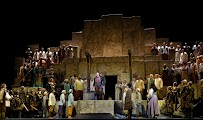
A scene from Verdi's "Nabucco" with George Gagnidze (center) 
in the title role. Photo: Marty Sohl / Met Opera

Abigaille is the most interesting and treacherous role in the opera. She is the ambitious and vicious daughter of Nabucco until she finds out that she is a slave. She wants to clear the deck of Nabucco and his legitimate daughter and the Hebrews. It is a killer role but soprano Liudmyla Monastyrska has been singing the role in major opera houses for years. At 48 she is still in her prime, sings superbly and goes from evil and arrogance (kill everybody) to repentance, conversion, ingestion of poison and death.

Monastyrska’s Abigaille is a perfect foil for Fenena, Nabucco’s real daughter. Mezzo-soprano Maria Barakova is lovely, humane and has a superb voice. But Fenena does have a complex moral life. She is Babylonian, of course, held hostage by the Hebrews, falls in love with Ismaele (tenor SeokJong Baek), a Hebrew, (Abigaille is in love with him too) and releases the slaves held in the Temple. She is about to be executed and sings of heaven and God but with a lovely voice and being on the side of the good people we love her all the way and cheer her release.

The set by John Napier gives us an opera on a grand scale. The revolving stage presents some huge rocky walls that are the abode of the Hebrew prisoners. The stage revolves to show a monumental staircase, one of which leads to a throne high up with a head of a bull. This is Baal and where we see Babylonian power and grandeur.

Moshinsky’s grand conception under Revival Director J. Knighten Smit is stupendous and breathtaking. Whatever shortcomings young Verdi’s third opera may have, they are all subsumed by the grand conception and execution.

The Metropolitan Opera Orchestra and Chorus are conducted by Daniele Callegari and the result is a thrilling afternoon at the opera, not quite live in New York but damn good on the huge Cineplex screen.
_____________________
Nabucco by Giuseppe Verdi (music) and Temistocle Solera (libretto) was shown Live in HD from the Metropolitan Opera on January 6, 2024, It will be reprised on February 24, 2024, at various Cineplex theatres. For more information go to www.cineplex.com/events

James Karas is the Senior Editor, Culture of The Greek Press

Monday, January 15, 2024

THE MERRY WIDOW – REVIEW OF 2023 TORONTO OPERETTA THEATRE PRODUCTION

Reviewed by James Karas

TORONTO OPERETTA THEATRE, like the feisty bunny in a battery commercial, does not give up. General Director Guillermo-Silva Marin continues to provide Toronto with quality productions of operetta since 1985. It is something that no other Canadian city can come close to let alone beat.

TOT closed 2023 with four performances of one of the hallmarks of the genre, Franz Lehar’s The Merry Widow. As usual Marin does it with at least one hand tied behind his back (or does he have hands and feet tied up) and refuses to deprive us of the pleasure of operetta. The problem, in case you did not guess it, is financial but there are dedicated lovers of operetta and generous donors to keep TOT going.

This is TOT’s sixth production of that delectable work but some of us still need a nudge of a reminder of its plot. We are in the Parisian embassy of the famous Kingdom of Pontevedro. Without IMF, the country is going broke and it can only be saved by Madame Glawari’s fifty million francs, a fortune she acquired by the timely death of her old husband. She must marry a Pontevedran  and keep the money in her old country otherwise the great nation will go to hell in a handbasket or suffer such other simile or metaphor that you may prefer.

Issue 1. Where can we find a suitable husband for her? The problem was faced by librettists Viktor Leon and Leo Stein and they settled on the great and suitable Count Danilo (Nathan Keoughan) who is tall, blond, handsome, broke and working for the Pontevedrian embassy  in Paris. His stated reluctance to marry will not last through the third act.

Jonelle Sills as Anna and Nathan Keoughan as Danilo. 
Photo: Gary Beechey, DFS Studios

Issue 2. Valencienne (Olivia Morton), the wife of Ambassador Baron Zeta, is more than mildly interested in Vicomte Camille (Matt Chittick), a Frenchman, and he is unmildly interested in her and we are in dire danger of seeing her disobeying One of the Big Ten Commandments. He even writes “I love you” on her fan and you know she will lose it and we tremble with the possible consequences. There are visitors and embassy personnel but let’s concentrate on the main stories and the songs and dances that they generate.

Canadian soprano Jonelle Sills makes a feisty and full-voiced Madame Glawari who sounds fine in midrange and can belt out high note fortissimo when necessary. Her pretend reluctant suitor Danilo is represented with vocal vigor and strong physical presence by baritone Keoughan. He has a good voice and he and Sills sound excellent in their two duets, “The Cavalier” and “Love Unspoken”.

Olivia Morton and Matt Chittick as almost-lovers get splendid vocal exposure and they do excellent work. They sing two duets, “A Respectful Wife” and “Love in my heart” beautifully but we do not approve of their (happily avoided) adultery.

Nathan Keoughan as Danilo and Gregory Finney as Zeta. 
Photo: Gary Beechey, DFS Studios

The reason for our disapproval is the fact that we like Baron Zeta, especially as played by Gregory Finney. Finney does not get much solo exposure but he is a master comic and as always delivers a superb performance.

The Merry Widow provides some splendid opportunities for some merry kick-your-heels-up dancing but that is not the forte of the cast, especially the seven Girls at Maxim’s   who do kick their heels pleasantly but unevenly.  To be fair none of the “dancers” seems to have any training for the task. They are singers. 

The operetta premiered in December 1905 but Silva-Marin lends a hand to them to give the plot current resonance by bringing in Premier Doug Ford, obnoxious billionaire Elon Musk and numerous other current personalities to good effect.

The 11-member “orchestra” lined up around the skirt of the stage does a fine job under the baton of Derek Bate. They are a major component for keeping operetta alive in Toronto.
_______________________
The Merry Widow by Franz Lehár was performed four times between December 29, 2023, and January 2,  2024 at the Jane Mallett Theatre, St. Lawrence Centre for the Arts, 27 Front Street East, Toronto, Ontario. www.torontooperetta.com

James Karas is the Senior Editor, Culture of The Greek Press. This review appeared earlier in the newspaper.

Monday, January 8, 2024

PRIDE AND PREJUDICE* (*sort of) - REVIEW OF PLAY AT CAA THEATRE

Reviewed by James Karas

Pride and Prejudice* (*sort of) is a play with a few well-placed songs by Isobel McArthur after Jane Austen. We can assume some familiarity with Austen’s masterpiece but none with the (*sort of) by McArthur that is now playing at the CAA Theatre in Toronto.

My guess is that seeing the latter may have one of the following effects. You may run home and dig up Austen’s book and start (re)reading it furiously to get past the send-off of the book by McArthur or never get near the novel again. Or you can enjoy the spoof where five women servants play eighteen characters and many episodes of the novel and leave us laughing and astounded by the brilliance of the play.

A few words about. Pride and Prejudice* (*sort of). We start with the five women servants in the Bennett household busily doing their job, for a while. They wear plain white dresses but they don’t intend to stay in 1813 England as they grab microphones and start singing modern songs and use profanities fearlessly and they have us in the palm of their hands.

That is just the beginning. The “servants” transform themselves into most of the characters of the novel with speed and irreverence, and sometimes by donning a bit of different clothing. We are anxious to meet their employers, the Bennett family of Mr. and Mrs. Bennett, their five daughters, Darcy and Bingley, the rich suitors or targets for their five daughters. Lady de Bourgh represents the ultimate snob. 

Mr. Bennett, you may recall, does not do much in the novel and in the play, he is represented by the back of an easy chair where he is holding a newspaper. Perfect representation of the paterfamilias.

Leah Jamieson, Dannie Harris, Lucy Gray, 
Megan Louise Wilson and Emmy Stonelake 
in Pride and Prejudice* (*sort-of). Photo Credit: Mihaela Bodlovic.

Dannie Harris gives us a wacky, neurotic, silly Mrs. Bennett who is anxious to get her daughters married off especially Elizabeth, the oldest and brightest of them to the rich, snobbish Darcy. Harris plays both roles with superb versatility. She changes from one role to the next quickly and she is ridiculous one moment and an arrogant, standoffish Darcy the next. 

We have the ridiculous Mr. Collins, a pompous clergyman, who proposes to Elezabeth and is told in un-Austinesque language to to eff off. Leah Jamieson is hilarious and dead-on in the role of the cleric where we see snobbery for the sake of being a snob and a bootlicker of his social superiors with hilarious results. Lady de Bourgh is snobbish and out of this world in her condescension to the lower orders (everybody, that is) and she personifies arrogance and is ridiculously funny.

With five actors going through eighteen roles, I had difficulty tracking who played what part. But the actors, Ruth Brotherton, Christina Gordon, Lucy Gray, Dannie Harris, Leah Jamieson deserve unstinting praise for outstanding work.

Pride and Prejudice*(sort of) was adapted by Isobel McArthur who also directs the production with Simon Harvey. They do stunning work in a high-speed but disciplined performance that does not miss any of the humorous and satirical aspects of the play. The servants do not stick to 1813 but jump to current dates and make current references. McArthur  and Harvey do not miss a beat.

The set by Ana Ines Jabares-Pita features an elegant staircase and well-appointed furnishings that the servants clean but treat irreverently.

The whole enterprise is an astonishing production. To take a masterpiece and turn  it into something as marvelous as the play is an astonishing achievement. And an English touring company comes here for us to see it.
__________________________________________
Pride and Prejudice*(sort of) by Isobel McArthur, directed by Isobel McArthur and Simon Harveyl continues until January 21, 2024, at the CAA Theatre, 651 Yonge St. Toronto, Ontario. www.mirvish.com

James Karas is  the Snior Editor, Culture of Thr Greek Press