Wednesday, March 16, 2022

THE MARRIAGE OF FIGARO – REVIEW OF GREEK NATIONAL OPERA PRODUCTION

Reviewed by James Karas 

The Greek National Opera has been around for 80 years and it boasts of 3000 performances of 500 works. In a huge step forward, it has started streaming some of its productions and the latest is a thoroughly entertaining staging of The Marriage of Figaro. It deserves praise for the singing, orchestral playing and the highly imaginative sets.

I will start with the work of Director Alexandros Efklidis and Set Designer Yannis Katranitsas. They have come up with an imaginative and at times brilliant idea for showcasing the goings on in the mansion of Count Almaviva. The action of The Marriage of Figaro in this production takes place in eight rooms and Katranitsas wants us to see all of them alone or as many as five  of them at once arrayed across the large stage of the Stavros Niarchos Foundation Cultural Center in Athens. I am not sure what the audience sees in a live performance. I could not make out if it was a revolving stage or the sets were changed as necessary with moving them around.

Angela-Kleopatra Saroglou has dramaturged Lorenzo da Ponte’s libretto to give us a fresh and vibrant view of the actions and interactions of the characters and has added a few more people and scenes for good measure. She is credited as Collaborating Director as well.
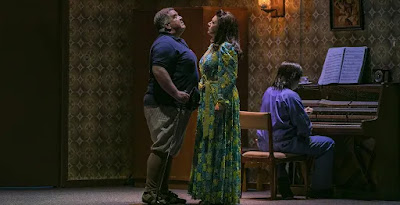
Dimitris Platanias and Cellia Costea. Photo GNO

We start with frantic activity during the overture where we  see people run in and out of rooms reminiscent of a Feydeau farce. Cherubino is caught with Barbarina. Count Almaviva is in his bedroom in an unmade bed and a pretty woman who is taking some of her clothes off and joins him. I will not tell you who she is and you may assume they are not playing chess. That and much more.

The opera starts in Figaro and Susanna’s new bedroom where Figaro is measuring the space for a new bed. Usually, they are alone but Efklidis provides him with three assistants. Count Almaviva is visible behind the door to his bedroom. As the plot develops, we will see a kitchen where maids prepare food and which has a handy refrigerator that serves as an escape hatch for many of the characters including, of course, Cherubino, who hides in it. And there is a toilet with useful shower curtains and all the amenities of a very busy large house. It also has a garden and they bring out plants and shrubs to accommodate the action in the last scene.

There is a smartly uniformed guard standing at attention by Count Almaviva. There are servants, including one preparing  a tray of food. When Marcelina sings about the happy life of billy-goats and she-goats and frets that poor women are always treated perfidiously and cruelly by men, she is mauled by the guard. He suggestively unbuttons her and then bares his athletic chest.

In the plethora of characters and comings and goings, there is a man in many scenes sitting at a harpsichord with some sheet music in front of him, I could not figure out what he is all about. But he does add to the very busy nature of the production. None of these people and actions appear in da Ponte’s text.

Let us praise the singers. A significant number of them are Greeks. That should not be worthy of comment but it is. Greece has a phenomenal cultural heritage but opera is not one of them. Some great singers, yes, but how many have made a career of their vocal prowess in Greece? Not many, to be polite. But the singers in this production as individuals and more importantly as an ensemble do outstanding work in performing this great opera.

Baritone Dionysios Sourbis is an excellent Figaro. His Figaro is smart (but not as smart as Susanna), inventive, loveable and his light baritone voice sounds beautiful. Soprano Aphrodite Patoulidou’s Susanna is attractive, clever and we root for her from the moment we meet her. He lovely voice captivates us from start to finish.

Bass-baritone Dimitri Platanias is perhaps the most well-known cast member and he plays the muscular, blustering and arrogant Count Almaviva. Efklidis, as I said, wastes no time in showing us that Almaviva has seriously wandering hormones. Platanias sings and acts the role with aplomb and we simply wait for him to be brought to earth and beg “Contessa, perdono.” Platanias shows superb vocal and acting prowess.

Romanian soprano Cellia Costea represents the Countess as a woman that is past her prime and may explain her husband’s roving eye. She is a sympathetic woman who is deeply hurt by his infidelity. She expresses her unhappiness in her great arias “Porgi, amor” and “Dove sono.” All we want is beautiful singing expressing sorrow and pain. Efklidis, in this case unfortunately, creates activity for her. She picks up some sheets of paper and a pen, signs something. She picks up a photo album and looks through it. She does not achieve the emotional depth that we look for and it may not be because she is not capable of doing it but because she is kept busy doing irrelevant things.

Mezzo-soprano Miranda Makrynioti is a petite, agile, hormonally supercharged Cherubino with a delightful voice and a wonderful performance. Marissia Papalexiou plays the plotting Marcelina who, with the devious Dr. Bartolo, (Yannis Yannisis) tries to score some money for breach of promise to marry. In this production she is played as a sexually attractive vixen. A positive change.   

Vassilis Christopoulos conducts the highly capable Greek National Opera Orchestra and Chorus.

The production strives to illustrate many aspects of the opera by showing a wealth of activity that one never sees. The odd time it seems like too much activity. But the result is a colourful, vibrant, well-sung and wonderful performance. A joy to hear and see.

__________________

The Marriage of Figaro by Wolfgang Amadeus Mozart in a production by the Greek National Opera at the Stavros Niarchos Foundation Cultural Center in Athens is being streamed by GNO TV. For more information visit https://www.nationalopera.gr/

James Karas is the Senior Eitor - Culture  of The Greek Press. This review first appeared in the newspaper. 

Thursday, March 10, 2022

OF MICE AND MEN – REVIEW OF FILM DIRECTED BY VASILIS BISBIKIS

 Reviewed by James Karas

A recycling warehouse in contemporary Greece is a long way from the farms of California in the 1930’s where John Steinbeck’s 1937 novella, Of Mice and Men, was set. But an adaptation of it has inspired a powerful Greek theatrical production that became a film and is being streamed around the world.

Of Mice and Men tells the story of an incredible friendship between two uneducated drifters who have no family, no friends and no social circle as they seek menial labour on a farm. That is not all. Vasilis (George in the novel) is  intelligent, strong, wiry and the dominant of the pair. Lennie in the novel and in the production under review has the mental capacity of a five-year old. He is a small man who shuffles his feet when he walks, knees apart and hands on his waist. He is pathetic as he speaks in a kind of slur with his tongue often hanging out of his mouth.

Vasilis and Lennie are friends who have a dream that unites them, a dream of owning a piece of land where they can grow vegetables and keep rabbits. Lennie loves patting soft animals and he wants George to repeat the dream to him constantly because he forgets things.

Vasilis Bisbikis adapted Steinbeck’s novella and directed the stage production as well as the film that is being streamed. The adaptation maintains some similarity with the novella but to a large degree it departs from it. There are about half a dozen workers at the recycling plant who sleep and eat in the warehouse. They are fundamentally the wretched of the earth who work there because they have no choice.

Stelios, the boss, [I don’t know who plays the role – more about that below] is a vicious bully, a foulmouthed creep who abuses his wife, Mary. She is a slut, the daughter of a prostitute, who can accurately be described as trash.

The other workers range from the decent to the psychotic with the latter seething with violence. One of them shoots a co-worker’s dog and there is a scene with prostitutes that is enough to make you sick. Another worker beats and almost rapes Mary in an extended scene of violence and foul language. Obscenities are used in almost every sentence.

The plots always returns to George and Lennie, to the oft-repeated dream by George for Lennie’s benefit of the paradisal piece of land and to the incipient violence of Lennie who pats soft animals to death.

Mary invites Lennie to pat her soft hair and the terrified Lennie does so but he loses control and strangles her. The end follows that and if you have not read the novel or seen a movie or stage production, I will not disclose the tragic conclusion.

The film has some extraordinary performances. Dimitris Drosos gives a moving, powerful and astonishing performance as Lennie. He contorts his body, makes the heart-wrenching facial expressions of a severely disabled human being who is desperate to find some, any,  happiness. Vasilis Bisbikis as Vasilis is big and strong and impatient with him. He hurls insults at Lennie and threatens to abandon him but always returns to the deep-rooted love that unites the two men. An astounding performance by Bisbikis. 

I confer the same kudos on the rest of the cast. They portray violent psychopaths, human wrecks and wretched people looking for something human. Bisbikis as director and adapter, however, does not know when to stop when he has a good scene going. The film lasts two and a half hours and it could have been cut down to about two hours. Some of the scenes of violence like the vicious fight and attempted rape of Mary could be shorter. The awful scene with the hookers could likewise benefit by being shorter.

Who are the fine actors who give the memorable performances? In addition to Bisbikis and Drosos, they are Mary Mina, Stelios Tyriakidis, Manos Kazamias, Giorgos Sideris, Gigmaz Erdal, Lefteris Agouridis, Angela Patseli, Mara Zaloni, Erato Aggouraki, Dimitris Galanis  and Dionisis Kokkotakis. These are the names given on the website of  the streaming company. I searched for more details, including reading some reviews from Greek media  and found only the names of the actors playing Vasilis and Lennie. It looks like the Greek movie critics did not know who is who in the cast (or simply did not disclose it)and did what I am doing here: copy and paste the list of names. Some of these names may be from the theatre performance and not necessarily the film but whoever knows is not telling. The names of crew members are given in full. I have no idea how to characterize this except to state that I have never run into it before. 

Nevertheless, the film with its violence, moments of tenderness, extremely foul language and brilliant acting is like a powerful punch in the face. It may daze you but you will never forget it.

_________________

Of Mice and Men (Άνθρωποι και Ποντίκια), by John Steinbeck, freely adapted by Vasilis Bisbikis) and performed in Greek was streamed by  https://www.viva.gr/tickets/streaming/420695/

This review was initially published in The Greek Press of Toronto

Saturday, February 26, 2022

THE THREE SISTERS – REVIEW OF STREAMING OF GREEK PRODUCTION

Reviewed by James Karas

Anton Chekhov’s The Three Sisters is a subtle and complex play that demands the highest  production values and acting talent from any company that dares produce it. Poreia Theatre of Athens, Greece produced the play and recorded it for streaming. This review is of the streamed version. Dimitris Tarloou has directed and, with Eri Kourgia,  dramaturged, the play in a creditable production that deserves praise and a few complaints.

The Three Sisters tells the story of the daughters of General Prozorov who died one year before the opening scene of the play. The young women moved to a provincial town eleven years ago when their father was appointed commander of the local artillery unit. The provincial town has proven to be a deadly place, a social bore. a destroyer of souls and a place that one wants to escape from. The three sisters dream of returning to Moscow and share pleasant memories of life in the capital as their situation in the provincial city deteriorates.

The production is done in modern costumes and Tarloou has made The Three Sisters a contemporary Greek play. There is some singing in the play and the characters sing snippets of popular Greek songs. The toast that two men make is with tsipouro, a popular hard liquor usually associated with Greek peasants who tended to distil it themselves.

The set is unrealistic with the most prominent feature being some rows of seats in front of the main playing area. It looks like an audience that watches the play, but members of the cast sit there and they walk onto the main stage when their turn comes up. It is an interesting touch that may be characterized as Brechtian. At the back of the set there is what Chekhov describes as a drawing room of a well-off family that has a large table. The rest of the set is sparsely decorated and a piano is prominently visible. One of the daughters was a piano player.

We also see at the corner of the screen two musicians, a clarinet player and a trombone player. The play does call for some music but I don’t recall the need for the latter two. Be that as it may, the two musicians are put to much use. Frequently they play during the dialogue and at about the same volume. The music they play is undistinguishable largely because it interfered with the dialogue and I found it, to put it politely, annoying. We see the musicians walk across the back of the stage and at one point other instrumentalists join them to form a band. No doubt, the director had something in mind by providing us with the musicians and their music, but unfortunately, the reason escaped me.

Alexandra Aidini plays the oldest sister Olga as a decent person, a teacher who is not married and is solicitous of the welfare of the old servant Anfisa (Marietta Sgourdaiou).The ill-tempered middle sister Maria or Masha is played by Ioanna Pappa. She is married to Kulygin but is unfaithful to him with Vershinin. The youngest sister Irina (Lena Papaligoura) at 20 is a bit immature and dreams intensely of returning to Moscow, a place of happy memories. She marries Baron Tuzenbach and the marriage does not go well.

Laertis Malkotsis plays their brother Andreas (Andrey in Russian) as man who has ambitions of becoming a professor at a Moscow university but he marries the despicable Natalia and settles for a job as secretary to the town council. He is a serious gambler who accumulates huge debts, is treated like the village idiot and has an evil wife who is having an affair with the President of the Town Council.

Andreas’s wife Natalia deserves special mention. Played by Marianna Dimitriou, she is petty, vengeful, destructive, cruel, shallow and disgusting. She starts as a country bumpkin not knowing how to dress and is the target of ridicule. By the end of the play, she has gained complete control of the house and driven the sisters out and her husband into abject submission. And of course, she is an adulterer whose second child may well be by her substitute husband.

The siblings live in a provincial town with dreams of escaping. The women smoke, dress well, at least reasonably well, and are attractive. Their disillusionment is at the core of their existence and it is this that the actors exude so masterfully in their performances.

The men share some of those traits but they try to be more optimistic or philosophical. Lieut. Col. Vershinin replaced the sisters’ father as commander of the army unit and knows them from their childhood. He is a direct connection to their memories and dreams of Moscow. Giannis Dalianis gives an exceptional performance as the philosopher officer, unhappy husband, lover of Masha and an optimist for civilization.

Chebutykin is an old, pathetic army doctor who has forgotten what he knew about medicine, gets drunk and finds peace in believing in nothing, Giorgos Biniaris takes advantage of the acting opportunities provided by this eccentric character.

Baron Tuzenbach  (Pantelis Dentakis and  Captain Solyony (Dimitris Bitos) are officers who bicker and in the end duel with one of them being unsuccessful.

The play has more than a dozen characters to present Chekhov’s subtle and complex vision of Russian society at  the turn of the twentieth century. Tarloou’s adaptation and transfer of that vision to modern Greece is imaginative and, in some respects, brilliant. But it has the inherent problem of such adaptations and chronological shifts. His fine directing of a superb cast allows us to suspend our disbelief and holds our attention and even if we know that a provincial town in 21st century Greece is a long way from 19th century Russia, we appreciate the production.

_________________

The Three Sisters by Anton Chekhov, adapted by Dimitris Tarloou and Eri Kourgia, in a production Poreia Theatre,  Athens, Greece was streamed on demand by www.poreiatheatre.com     


Monday, February 7, 2022

COFFEE READING – REVIEW OF FIRST NOVEL BY ELENI KARIPIDIS

COFFEE READING
by Eleni Karipidis
137 pp. ISBN 9798474936870
[no other publication information given]

 Reviewed by James Karas

Coffee Reading is a first novel by Eleni Karipidis that is centred on the ancient practice of predicting the future by examining the mud left at the bottom of a Greek coffee cup. After the coffee is drunk, the cup is turned over and the lines, blots and images are formed on the sides and the bottom. The coffee reader, a person who has the gift of interpreting them can foretell the future. The craft, as Ms Karipidis calls it, is well known in Greece but I am not sure how many non-Greeks are aware of it or practice it in North America.

The novel has three interwoven plot lines each narrated in the first person by three story tellers. Cassie, the first, is a fifteen-year-old who acquires the gist of coffee reading from her grandmother and she examines the coffee cup of Penelope. We meet her several times during the story.

Penelope is a beautiful girl, gifted with blessed hands in the making of pitas, who has ambitions beyond her peasant background. She consults coffee readers to learn about her future. She is waiting to find the right man but she is unsuccessful because she is very picky. Her coffee cup indicates that she will go on a long journey and her path is clear.

Penelope comes from an unpleasantly patriarchal family that runs an orchard. She has an uncouth father and brothers, Aris and Apollo, and wants to get out of that milieu. She visits the mysterious coffee reader, Madame Vivi, at her mansion on top of a hill. She predicts that Penelope will receive a visitor but can give few other details. Madame Vivi has predicted better things for Penelope and even though her mother warns her against relying too much on a coffee cup reader, Penelope is convinced that she is made for a life much better than farm living.

The frustrated and ambitious Penelope puts a note on a peach branch that reads: “American husband wanted” and gives her complete address. An American shows up at her house, but he is rejected by her family. Candidates for her hand come to her house but only one of them, Alexander or Mr. Blue Eyes, stands out. The two are attracted to each other.

Madame Vivi reads Penelope’s coffee and tells her that Alexander is no good. Penelope sees him as her ticket to a good life. It looks like Penelope will marry Alexander. Her father who supplements his income as a tailor, is busy making a suit for Alexander’s father with wads of money sewn in the lining. What he is doing is criminal but only if one gets caught, he surmises. In any event Penelope and Alexander go to the chapel to get married. Spoiler alert. You may see signs of the movie The Graduate, perhaps in reverse, but I will say no more.

The story telling is interspersed among the three tellers. The third plot strand is narrated by Lysander. He is a disaffected young man living in Greece in 1967 under the harsh dictatorship of the Junta (which forms a backdrop for the story) with his friends Socrates and Pericles. The three want to leave Greece and go somewhere. But where? One of them has an uncle in Canada and they reach for a globe to locate Canada and Toronto and thus choose it as their destination.

Before they leave, the three friends make their way to Madame Vivi’s mansion to have their coffee read. On the way they see a beautiful girl who looks like a forest nymph. Her handkerchief gets snagged by a tree branch and Lysander manages to grab it. It has the letter P embroidered on it. On reading Lysander’s coffee Madame Vivi sees the letter P in his cup.

As foretold by Cassie, Lysander, Pericles and Socrates do arrive in Toronto with $5 among them. Lysander stays for 10 disastrous months there before returning to Greece.   

That is the skeleton around which Ms Karipidis constructs her story. If there is a love story between Penelope and Lysander, it is entirely inchoate. That plot strand and many others are left dangling in the wind. What happened at the marriage chapel? What is happening to Penelope? Very little in the novel complies with the basic idea of having a beginning, a middle and an end. Perhaps Ms Karipidis dangles plot lines in front of us to whet our appetite for more development in future volumes. Perhaps.

As for the three young men, we know almost nothing about them except that they have already served in the Greek army and we are forced to deduce that they may not be educated at all or are perhaps not very bright. They never heard of Canada even though one of the has an uncle there?  Character development is kept to a minimum.

They address each other as Ly, Soc and Perry. Penelope becomes Penny. It may be appropriate and perhaps inevitable for people in Canada to use such short forms but shortening Lysander to Ly in Greece by people who speak no English? Unlikely.

There are many people who believe in fortune telling, astrology, tea leaves reading, seances and coffee reading. Ms Karipidis has stated that she has the gift of coffee reading but her views may be considered irrelevant in the work of fiction that she has written. Her characters believe in the craft assiduously.

I have gleaned a few fascinating facts about the author from the internet. She was a teacher for the York Region Bord of Education for twenty years. She was awarded 1st Prize at the Karolos Koon Theatre Academy in Athens in 1992 and studied at the University of Windsor, Concordia University and Ryerson University among other institutions.

For the rest, you will have to read her book.

Thursday, January 6, 2022

VENIZELOS – REVIEW OF BIOGRAPHY OF A GREAT GREEK

VENIZELOS
The Making of a Greek Statesman, 1864 - 1914
by Michael Llewellyn-Smith
Oxford University Press, 2021
516 pp. ISBN 9780197586495

Reviewed by James Karas

“What Venizelos has just done is great, a miracle. This traitor has doubled the size of Greece, giving her Epirus, Macedonia, Crete, the islands. His name will be immortal. Without a doubt he is the greatest statesman in the world today.”

This is what Nikos Kazantzakis wrote to his sister Eleni in 1912 after the first Balkan War. It is an astounding combination of damnation and praise. The greatest statesman in the world is a miracle worker and a traitor.

Michael Llewellyn-Smith has written the first of a two-volume biography, Venizelos: The Making of a Greek Statesman, 1864-1914, that is thoroughly researched and well-written where he tries to capture the many facets of the brilliant politician, warts and all. Kazantzakis called Venizelos a megalomaniac in 1901 when the politician fought with Prince George, the son of King George I of Greece, over the question of the union of Crete with Greece. The prince was the High Commissioner of Crete, appointed by the Great Powers. Venizelos was the Counsellor for Justice. The Prince had a serious propensity towards authoritarianism and nepotism and was clearly ill-suited for the job. Venizelos would have none of it.

Eleftherios Venizelos was born in 1864 in Mournies, Crete which was still a part of the Ottoman Empire. His father was a revolutionary who was twice deported to the island of Syros and Eleftherios spent part of his youth on that island. He became a lawyer, a journalist and a politician and he was distinguished for the clarity and eloquence of his oratorios, the brilliance of his mind and his frequently astute political tactics.

He practiced law, published newspapers and pursued the idea of enosis, union of Crete with Greece, a position that was contrary to the wishes of the Ottomans and unpalatable to the Great Powers. The latter’s naval presence around Crete was pre-eminent and their ambition was to maintain the peace.  

He was elected to Crete’s National Assembly in 1889 and the tumultuous relations between Cretans and the Ottoman Empire continued. By the end of the decade and after uprisings and massacres, the Great Powers stepped in and found a “solution” to the Cretan Question by declaring the island an autonomous state under Ottoman suzerainty. Elected Cretans could run the internal affairs of the island while the Ottomans still held ultimate control.  

Venizelos opposed the inept Prince on the question of enosis and in 1901 was fired as Counsellor for Justice. Llewellyn-Smith, always analytical and judicious, states that The High Commissioner was constitutionally right in his position and that Venizelos chose the wrong ground on which to take a stand. Venizelos’s motivation, according to the biographer, on the political side was to break the deadlock over Cretan union with Greece. On the personal side, Venizelos found it unacceptable to be subject to the Prince’s virtually absolute power.

The all-out political war between the Prince and Venizelos mentioned above extended to former wanting the latter’s “moral destruction” Venizelos using his newspaper in reply.  However, one may take the fight, Lewellyn-Smith tells us it was a foretaste of what was to come in 1915 when Venizelos disagreed with Prince George’s older brother who was King of Greece at the time. The result was the great National Schism but that will be examined in the second volume of the biography.

In the meantime, Venizelos was in the political wilderness, the struggle continued and even church leaders joined the fray. Archbishop Xiroudakis pronounced that a vote for Venizelos was a sin as black as a priest’s vestments. Venizelos struck back in his newspaper alleging that the archbishop and through him “those who are waging an unholy war were aiming to divide the people so as to have a pretext to deprive them of their freedoms.” He meant the Prince, of course. The archbishop sued for libel and won. Venizelos’s paper was closed and he was sentenced to two weeks in jail. He served his sentence.

The incident proved his fearlessness, his audacity and his relentless struggle for what he believed. Soon after that he was involved in a much more serious event, The Therisso Uprising was a revolt led by Venizelos that became tantamount to a civil war. It began in March 1905 and lasted until November but its aftereffects continued into 1906. Was it a legitimate uprising or a rebel insurgency? asks Llewellyn-Smith.

The insurgents worked hard to give legitimacy to the uprising.  They elected a provisional government, appealed to the people of Crete and appealed to the Church leaders. Venizelos wrote to the Great Powers explaining the reasons for the upspring. The aim was the union of Crete and Greece but the uprising had a long and tortuous road. The Prince, his father, the King of Greece, the Greek government and the Great Powers were against it. But in the end the Powers, except for Russia, were not prepared to supress the revolt by force and a settlement was negotiated. There were changes in the power structure and most importantly perhaps, Prince George resigned and left the island for good in September 1906. Venizelos had won.

Venizelos by that time had become famous and in 1909 became Prime Minister of Crete. By the end of the year, he left Cretan politics behind him and went to Athens. A revolt of a different kind was brewing which resulted in a bloodless a coup d’état in August 1909 by the the Military League, a group of disaffected army officers based in Goudi, a suburb of Athens. The League invited Venizelos and he took over the negotiations between the officers and King George I. The League was dissolved following concessions to the officers’ demands. Venizelos was elected to the Greek parliament and in October 1910 became Prime Minister. It was a meteoric rise reflecting his extraordinary intelligence and political skill.

The problems he faced were mammoth and he brought reforms across the board trying to achieve fundamental changes in Greek society. Land reform, education, national defence, the constitution and corruption are a few of the issues that he faced. For every fervent supporter that he had on these issues there was always a dedicated opponent. It took all of his immense skills to achieve a great deal but not all.

Venizelos was Prime Minister during the Balkan Wars (1912-1913) which resulted in the expulsion of the Ottomans from from the Balkans. He used his diplomatic skills to outmanoeuvre the Serbs and the Bulgarians and double Greece’s territory and population. No one could take that away from him.

Mark Mazower, an expert on Greek history, considers Venizelos the most prominent Greek statesman of the twentieth century. Llewellyn-Smith gives a well-rounded portrait of the man who spoke several languages, loved to read, was a great orator and was considered a Messiah by many. He was a unique politician in Greece.

Michael Llewellyn-Smith examines the historical milieu in which Venizelos lived and work and examines the political issues that he faced. He does so with thoroughness and admirable fairness. A large number if people are involved and the author takes pains to make us understand and remember who they were by providing Short Biographies of the more important ones.   

Llewellyn-Smith is a historian and retired British diplomat with intimate knowledge of Greek and Greece. His doctoral thesis at Oxford was on the Greek occupation of Smyrna and the Asia Minor Catastrophe of 1919-1922. He turned his thesis into a history of the Catastrophe titled Ionian Vision: Greece in Asia Minor 1919-1922.  He travelled on a donkey across Crete in the 1960s and wrote The Great Island about its history and culture and has written two books about the Olympic Games. He was the British Ambassador in Greece from 1996 to 1999.

VENIZELOS: The Making of a Greek Statesman, 1864 – 1914 is a major biography of one of the greatest statesmen of modern Greece. Maybe Kazantzakis was perfectly right in his positive assessment of Venizelos. 

James Karas is the Senior Editor - Cultire of The Greek Press. This review first appeared in The Greek Press.  

Thursday, December 9, 2021

JESUS CHRIST SUPERSTAR – REVIEW OF PRODUCTION AT PRINCESS OF WALES

Reviewed by James Karas

Jesus Christ Superstar has moved from one of the most popular rock operas and become almost legendary. Ten years ago, the Stratford Festival marked the fortieth anniversary of the premiere of the work and this year the Princess of Wales theatre offers the 50th Anniversary Tour of the opera.

The production chosen for the tour is the 2016 staging at London’s Regent’s Park Open Air Theatre directed by Timothy Sheader, designed by Tom Scutt and Choreographed by Drew McOnie. That production has taken off on a world tour and is making a pitstop at the Princess of Wales Theatre to huge audiences but under pandemic restrictions including the lineups for vaccinations checks.

For anyone living under a rock who may not know the story of the musical, it is about Christ’s last week on earth, call it Holy Week for Christians or Passover for Jews. We follow his arrival in Jerusalem, his trial and his crucifixion, based loosely on the Gospels. It is not suitable for fanatics who may prefer a more pious telling of the Passion.

Aaron LaVigne, Tommy Sherlock and the company of the North American Tour of JESUS CHRIST SUPERSTAR. 
Photo by Matthew Murphy, Evan Zimmerman - MurphyMade

It contains a lot of heavy-beat rock music, some beautiful melodies and dramatic dancing. Sheader has chosen to treat the production almost like a rock concert. He wants to generate energy, create excitement and rouse the audience to pitches of ecstasy as they listen to the music, hear the intense and sensational singing and watch the extraordinary events of the betrayal, arrest, trial and crucifixion of Jesus Christ. He is successful but one may complain about a few pitfalls.

A young Andrew Lloyd Webber provided the music and Tim Rice wrote the lyrics for the work. Scutt’s two-story set has the orchestra on top and the dark, foreboding and dramatically lit stage below. Lee Currant as the lighting director adds to the intensity of the performance with unremitting use  of spotlights that whirl around the theatre .

But the performance at the Princess of Wales has some issues. Generally, it is the excessive volume at which the music is performed. It struck me like a performance by a favourite rock star who sings at the highest pitch that he can reach and that he holds for as long as his lung capacity will allow with the accompanying orchestra competing for volume.

Aaron LaVigne and the company of the North American Tour of JESUS CHRIST SUPERSTAR.
 Photo by Matthew Murphy, Evan Zimmerman – MurphyMade

Take Tyrone Huntley as Judas. (He replaced James D. Beeks in the role on November 23, 2021 when the latter was arrested for involvement in the January 6, 2021 attack on Capitol Hill). He sang the role at Regent’s Park in 2016 and is not a haphazard replacement. He has a big voice and is an agile performer physically and vocally. He performs with a microphone in his hand at times as if this were a concert and he needs to hold the audience not just with his vocal ability but by reaching the highest notes even if it approaches falsetto levels and never coming down from the peak. That is done by some of the other performers including Aaron LaVigne as Jesus.

The dancing is used for the same purpose of arousing excitement in the audience. It is wildly frenetic and at times looked more like Zumba than ballet.

There is a way of performing Jesus Christ Superstar at a less frenzied pace and letting the music and lyrics be heard. The pace maintained in this production made some of the lyrics simply incomprehensible. There are quiet moments as well. Jenna Rubaii as Mary sings “I Don’t Know How To Love Him” with beautiful resonance and there are other less frenzied scenes that do justice to the opera. Unfortunately, there is also the unpleasantness of the eardrum-shattering scenes.

_______________________   
Jesus Christ Superstar by Andrew Lloyd Webber (music) and Tim Rice (lyrics) runs until January 2, 2022 at the Princess of Wales Theatre, 300 King St. West, Toronto, Ontario. www.mirvish.com/
 
James Karas is the Senior Editor - Culture of The Greek Press. This review appeared first in the paper. a

Tuesday, December 7, 2021

HOLIDAY INN AND A CHRISTMAS CAROL - REVIEW OF 2021 SHAW FESTIVAL PRODUCTIONS

Reviewed by James Karas 

The Shaw Festival has struck the perfect note for the holidays by bringing back two marvelous chestnuts. It would be hard to lift one’s spirits higher than with fine-tuned and delightful productions of A Christmas Carol and Holiday Inn. Both shows take us to distant, different but, in our imagination, familiar worlds that we watch with pleasure and extend a standing ovation to all concerned in gratitude.

Holiday Inn started as a movie that was being filmed in late 1941 when Pearl Harbor was attacked by the Japanese and catapulted America into World War II. The filming was completed in early 1942 and the movie was a hit. It contained incomparable music and lyrics by Irving Berlin celebrating major American holidays and with stars like Bing Crosby and Fred Astaire it could hardly fail.

Most of the songs of the movie were used to shape a stage musical with an improved script by Gordon Greenberg and Chuck Hodge. It opened on Broadway in 2016 where some embarrassingly racist content (Abraham Lincoln in blackface!) was mercifully removed. 

Kyle Blair as Jim Hardy with the cast of Irving Berlin’s 
Holiday Inn (Shaw Festival, 2021).
Photo by David Cooper.

What do you get at the Festival Theatre in Niagara-on-the-Lake?  You get a plot, okay?  Jim (Kyle Blair) and Ted (Kyle Golemba) are the best of friends, a song and dance duo who perform around the U.S.A. with the lovely Lila (Vanessa Sears). Jim loves Lila and wants to marry her and move to a farm in Connecticut. Lila wants stardom and she dumps Jim and goes off with Ted.

On the bankrupt farm Jim meets the lovely Linda  (Kristi Frank), the former owner of the farm. Jim and Linda will turn the rambling farmhouse into a holiday inn where they will put on shows only during holidays. Please, no guessing about what will happen to the two couples. You are here to have fun not to foretell the future.

Irving Berlin provides some very familiar songs which you will recognize even if you have never seen the movie. How about the following: White Christmas, Cheek to Cheek, Easter Parade and a dozen other melodies that mark Thanksgiving, New Year’s Eve, Valentine’s Day, Easter  and American holidays like the 4th of July. The singing by the principals, Louise (Gabrielle Jones) and the ensemble may be uneven at times but you are enjoying the production so much you skip such details.

And the dancing? These actors can tap, twirl and get in the air with abandon. What do you think Fed Astaire was doing in the movie? And  Golemba does the firecracker dance superbly. A huge bow to choreographer Allison Plamondo 

Singing and dancing look much better when there is an ensemble of beautiful women and handsome men on stage. The costumes are stunning and I did not count how many changes there were but their splendour was captivating. The sets which required numerous changes were handled judiciously and effectively. Chalk up a big one for set and costumes designer Judith Bowden.

Paul Sportelli is credited with the musical direction and Rachel O'Brien, the Shaw’s Music Intern, conducted a few of the musical numbers when I saw the production. I am advised that she is being prepared for her conducting an entire show. 

Kevin Lamotte designed the bright lighting that added to the pleasure of watching the production.

Kate Hennig directed the wonderful holiday bouquet and took us to another world. Unmitigated kudos to her for the two-hour trip.

Have you never seen or read Charles Dickens’ A Christmas Carol? The Shaw Festival has decreased that possibility by presenting Tim Carroll’s adaptation of that unforgettable story over the last several years in the appropriate season.

The telling is imaginative, creative, authentic but not slavish and a complete delight. You need a door? Well, an actor holds a small board tied to his arm and swings to open and shut, well, the door. An actor holds another board on her head and presto Scrooge has a desk. They use puppets and painted scenery to have the action move briskly and tell the famous story of reformation and redemption.

Julie Lumsden as Emily, Kelly Wong as Fred and Graeme Somerville as Scrooge in
 A Christmas Carol (Shaw Festival, 2021). Photo by David Cooper..

There are ten actors who do not hesitate to burst into singing Christmas carols and provide humour. We get to the story of course and Graeme Somerville leads the cast as a mean, stingy, horrible Scrooge but we know that underneath that nasty exterior there is a decent and generous man. (We have read the story and seen previous productions, you see.)  

We need three Spirits: the Spirit of Christmas Present (Peter Fernandes), of Christmas Past (Kelsey Verzotti) and of Christmas Future, a scary ghost floating in the air and terrifying Scrooge of the effects of his conduct. There is no room for doubt. Scrooge and the rest of us need to change.

His nephew Fred (Kelly Wong) and his wife (Julie Lumsden) set the example for family feeling and forgiveness. But what we want to see is the loving family of the poor Bob Cratchit (Andrew Laurie) and his wife (Marla McLean, who is also movement and puppetry Captain) and their disabled son Tiny Tim, judiciously played by a puppet.

Tim Carroll did the original adaptation and directed that production. This year’s staging is capably directed my Molly Atkinson.

Fit these two productions between shopping malls and credit card abuse and you will enjoy Christmas even more.

______________

A Christmas Carol by Charles Dickens, adapted by Tim Carroll and Holiday Inn by Irving Berlin continue until December 23, 2021, at the Royal George and Festival Theatres respectively in  Niagara-on-the-Lake, Ontario. www.shawfest.com/