Tuesday, October 31, 2023

A POEM FOR RABIA – REVIEW OF NEW PLAY AT TARRAGON THEATRE

Reviewed by James Karas

The announcement of the production of a new play is always met with excitement and a bit of trepidation. The latter fear decreases depending on one’s knowledge of the work of the playwright and perhaps information about the play. It usually vanishes and is replaced by the excitement and pleasure of seeing a new play. 

I met the announcement of the production of A Poem for Rabia by Nikki Shaffeeullah with the same hope and fear but a production by Tarragon Theatre in association with Nightwood Theatre and Undercurrent Creations increased the excitement and decreased the second possible reaction.

Hope springs eternal in the human breast but it is sometimes crushed by reality and that was my reaction to Shaffeeullah’s play. 

The author wants us to see three periods and phases of life in three parts of the world over two centuries. We begin in 1853 in Calcutta when Rabia (Adele Noronha) boards a ship headed for Guyana. I am not sure if does so voluntarily or if she is forced to board but we do know that she will become an indentured servant, which I take to mean a slave even though they are supposed to have been freed. This is not a cruise ship and the crossing takes several months during which Rabia suffers hunger and extreme discomfort. But she does meet Farooq (Anand Rajaram) on board and they manage to find diversions from the rigors of the voyage. 

Michelle Mohammed, Nikki Shaffeeullah, and Adele Noronha 
in A Poem for Rabia – Photo by Cylla von Tiedemann

We see Guyana in 1953 when it is called British Guyana for obvious reasons. Guyana is seeking its independence and we meet Betty (Michelle Mohammed) who works in the office of the British High Commissioner. Betty gets involved in the politics of the era with Marsha (Virgilia Griffith).

In 2053 we are Ontario where Zahra (author Nikki Shaffeeullah) is a disillusioned Canadian. Prisons have been abolished, a very progressive step, without much of a hint of what we do with criminals.   

I am not sure when confusion overtook me but it did and I had little idea of what was happening, who was what and in what century. Yes, there are differences in accent and dress but the going back and  the intrigues involved left me looking at my watch. The author’s note of the amount of work she put in the play is noted with approval. The women involved tell the story of the author’s far past and, I suppose, her guess about the future. If you see the play follow Rabia, Betty and Zahra and listen to the poem that is recited. 

The play has six actors who play ten characters. Virgilia Griffith plays Sheree and Marsha; Michelle Mohammed plays Betty and Anu and Jay Northcott plays Jem and Tom.  I have only praise for them and if I could not follow what they were all about it is not their fault. The set by Sonja Rainey emphasizes water and given the voyages and the abundance of water in Guyana and Canada, it is appropriate. In the last scene the actors stand in an ankle-deep  pool.

Donna-Michelle St. Bernard and Clare Preuss co-direct the confusion. St. Bernard is also listed as a dramaturge and one wished she were far more aggressive to bring clarity to this ambitious play.
_______________
A Poem for Rabia by Nikki Shaffeeullah in a production by Tarragon Theatre in association with Nightwood Theatre and Undercurrent Creations continues until November 12, 2023, at the Tarragon Theatre Extra Space, 30 Bridgman Ave. Toronto, Ontario.  www.tarragontheatre.com

James Karas is the Senior Editor - Culture of The Greek Press 

Monday, October 30, 2023

ORPHEUS AND EURYDICE – REVIEW OF 2023 OPERA ATELIER PRODUCTION

Reviewed James Karas 

Opera Atelier, a prime example of civilization in Toronto, has produced Gluck’s Orpheus and Eurydice for its fall season. There are three versions of Gluck’s opera, the Vienna version of 1762 in Italian, the Paris version of 1774 in French and the Berlioz version of 1859 to a French libretto by Pierre-Louis Moline. Marshall Pynkoski, the Co-Artistic Director of Opera Atelier, has produced all three versions and for this year he has chosen to reprise the Paris version that he directed in 2007 with Colin Ainsworth in the lead role.

Tenor Answorth, still looking boyish, sings Orpheus again this year with soprano Mireille Asselin as Eurydice and soprano Anna-Julia David as Amour. The French version changed the vocal range of Orpheus from castrato to countertenor and now is frequently sung by tenors. Pynkoski has made a major infusion of ballet into the production which fits perfectly with Opera Atelier’s style of providing plenty of ballet dances thanks to Co-Artistic Director and Choreographer Jeannette Lajeunesse Zingg.

It is a beautiful production starting with Ainsworth’s supple lyrical voice and wonderful delivery. The opera has few vocal flourishes for the tenor but he does have to maneuver through deep grief at the death of his wife on the day of their marriage to having to convince the Furies to let him into Hades and then try to endure the temptation to look at Eurydice  on their way out of the depths of Hades to the earth. Alas, he succumbs to her pleas and looks at disastrous results: she dies. Her death does have a positive aspect for us because Gluck composed the beautiful “J’ai perdu mon Euridice” aria that has the distinction of being the first big operatic hit.   

Colin Ainsworth as Orpheus, Mireille Asselin as Eurydice. 
Photo by Bruce Zinger

Asselin has a lovely and delicious soprano voice and we feel her distress as she expresses doubts about Orpheus still loving her when he refuses to even look at her. Excellent work. David does a fine job in the relatively small role of Amour.  

Zingg as expected choreographs gorgeous ballet sequences for the Atelier Ballet. The choruses are handled by the Nathaniel Dett Chorale and the Tafelmusik Chamber Chοir. The inimitable Tafelmusik Orchestra, another mark of civilization in Toronto, is conducted by David Fallis.

Gerard Gauci, Opera Atelier’s Resident Set Designer, designs the set with emphasis on colour, beauty and simplicity. The fires of hell are indicated at the back of the set although there are no dramatic efforts to provide idyllic dales or overdo the terrors of Hades but what we do get is effective.

There was great emphasis on a hazy or foggy Hades. There may have been a hitch, I suppose, and someone kept his finger on the haze making machine for far too long. Some of the dancers were hard to see as were the surtitles above the stage. Much of the theatre was enveloped in haze but I think it was a simple glitch in an otherwise wonderful production.

The Tafelmusik Chamber Choir and the Tafelmusik Baroque Orchestra conducted by David Fallis did superior work.
______________________
Orpheus and Eurydice by Christoph Willibald Gluck opened on October 26 and will run until November 1, 2023, at the Elgin Theatre, 189 Yonge St. Toronto, Ontario, M5B 1M4. www.operaatelier.com

James Karas is the Senior Editor -Culture of The Greek Press

Tuesday, October 24, 2023

THE PIRATES OF PENZANCE – REVIEW OF 2023 TORONTO OPERETTA THEATRE PRODUCTION

Reviewed by James Karas 

Toronto Operetta Theatre, alive and well, has mounted a redoubtable production of The Pirates of Penzance in front of an enthusiastic audience. Guillermo Silva-Marin delivers a smartly and imaginatively directed production with drive and humour. The 9-member orchestra is conducted by an animated Jennifer Tung. The musicians are all on the stage rather than being lined up around the front of it as in the past.

There is no shortage of operettas from Europe but it would be hard to imagine the genre without W.S. Gilbert and Arthur Sullivan in the English-speaking world. The Pirates may not be their best (I prefer The Mikado), but it is a thoroughly delightful work and TOT’s production’s is sprightly, funny and mostly well-sung.

The Pirates of the title are not the characters we see in movies set in the Caribbean but Englishmen who pursue their dastardly trade off the coast of Cornwall with some serious and unprofitable moral controls. They will not interfere with orphans. And wouldn’t you know, all English merchant ships are manned by orphans.


Ana Isabella Castro as Mabel and Alexander Cappellazzo
as Frederic. Photo: Gary Beechey, BDS Studio

We need a hero and a heroine. Frederic  is an apprentice pirate who must serve until his 21st birthday with the swashbucklers. He was supposed to be apprenticed to become a pilot but his nurse Ruth (delightful Karen Bojti) made a phonetic error and sent him to become a pirate. Alexander Cappellazzo strikes the right note of naivete and innocence with his shorts and bowtie at first and the ardent young man of love with Mabel and duty. Remember he is to be discharged on his 21st birthday and not at 21 years of age. He was born in a leap year if you get my message.

The lively and lovely Mabel (Ana Isabella Castro) loves Frederic. She has a lovely voice at midrange with a bit of difficulty with the high notes but a fine performance. And she is the daughter of the Major-General, which adds class to all her virtues. The program lists Mabel and her three friends as wards of the Major-General but I thought they were his daughters.  Baritone Gregory Finney is a veteran of the TOT and has done numerous roles in his vocal range. In Pirates he got the juicy role of Major-General Stanley and no one will deny that he is “the very model of a modern Major-General.”

The cast did overall excellent work with the numerous melodies that Gilbert and Sullivan provide. The eleven-member chorus deserves special praise for their marvelous work. They sang prettily and added significantly to the pleasure of the production.

Gregory Finney as Major General Stanley.
                                                    Photo: Gary Beechey, BDS Studio

Silva-Marin as director, lighting designer and décor manages the production with almost no sets. A few boxes are pushed on and off and for the rest he lets Gilbert and Sullivan do the work. As for costumes, the pirates look like pirates, the ladies are dressed prettily and the Mejor-General looks like a major-general. No complaints.

Jennifer Tung conducts the orchestra with a minor and amusing role as traffic cop. When some exits are called for, she directs the people to the wings. Nice gesture.

The performance was met by raucous enthusiasm from the audience which is always a pleasure to see.

May I repeat myself. The reason we have operetta productions in Toronto is Guillermo Silva-Marin. He is the General Director of TOT and, as noted above, the stage director, lighting designer and set designer. He adds some humour with references to current politics but he is relatively restrained. The directing is vigorous. The set is minimalist. He and TOT deserve more funding, a better theatre and more productions. Kudos to him for what he is doing.   

_____________________

The Pirates of Penzance by W. S. Gilbert and Arthur Sullivan was performed three times on October 20, 21 and 22, 2023 at the Jane Mallett Theatre, St. Lawrence Centre for the Arts, 27 Front Street East, Toronto, Ontario. www.torontooperetta.com

Saturday, October 21, 2023

WILDWOMAN – REVIEW OF SOULPEPPER PRODUCTION

Reviewed by James Karas 

Wildwoman is a new play written and directed by Kat Sandler and playing at the Young Centre in a production by Soulpepper. It is part of her words, a series of productions of plays by women. The program for the series describes Wildwoman as “a bold and sexy new comedy that explores class, gender and power.”

I found it a rigmarole of a play that  is manic, at times idiotic, shallow, funny and unfunny in the first half. It turns “serious” in the second act where brutality and oppression are real even if the dialogue does not improve. How many times can you describe things as effing this and effing that before it becomes  tiresome.

Sandler claims that the play is 99.9% true. 

Catherine de Medici (1519 – 1589) was born to the noble, wealthy and powerful Medici family in Florence. When it comes to being well-connected, she could blithely mention that the Pope was her uncle. Try topping that.  She was brought to France at age 14 to marry the fifteen-year-old second son of the King Francis I in 1533. He became King Henry II in 1547.

Dan Mousseau as Pete the Wildman and Rose Napoli as Catherine de Medici.  
Photo credit: Dahlia Katz

Love did not explode between the two teenagers. Sandler’s Catherine (Rose Napoli) and Henry (Toni Ofori) can’t quite “do” it but he does have a sexually alluring mistress Didi, more accurately, the noble Diane de Poitiers (Rosemary Dunsmore) who does a lot more than satisfy Henry’s hormonal needs. There is a servant named Kitty (Gabriella Sundar Singh) who plays a prominent role in the life of  Cathrine. In any event, we have three women in the turbulent 16th  century France.

When the heir to the throne dies in 1536, Henry becomes the heir apparent and the pressure is on for him and Catherine to produce an heir. I am not sure when the pressure was first put on but, in the play, it is a palpable demand, especially important when the young couple were not doing it.

Matters become very complicated when Henry gets a present of a hairy, wild man in a cage. Pete (Dan Mousseau) as the wild man is named is scary, was raised in a cage and is incapable of speech. That is soon remedied and Pete turns out to be a wise, well-spoken albeit still seriously hairy man. Catherine is attracted to him and it is possible that Beauty Catherine may have gone all the way with the Hairy Beast and he may have been the father of one of her children. I am not sure. In any event, she bore nine children in all.

The cast sings Happy Birthday to Henry (in French) and the boisterous audience at the Young Centre is invited to join in the singing. Henry is getting older and becomes King in 1547 and would last until 1559.

Didi or no Didi, the sexual problem of the couple is resolved but Henry ignores Catherine in matters of state completely and continues to place his trust in his mistress and in Hairy Pete. All that changed after 1959 when Catherine became regent to her underage son and she lasted in that position until 1563. She continued to be influential in varying degrees until her death in 1589.

Some of this information comes from the play and some from history. Sandler is not writing a biography of Catherine de Medici but dramatizes a few points in the life of the pathetic young bride and the powerful woman in the French court of her time.

The play is fast paced, at times farcical and not always compressible. Was Sandler as director having the cast deliver their lines at breakneck speed to finish the whole thing in about 2 hours and 40 minutes?  The set by Nick Blais and the costumes by Michelle Tracey are spectacular. The set looks like a grand throne room and the costumes are 16th century haute couture, I assume, elaborate, colourful, marvelous. 

The production has virtues but, in the end, it did not resonate with me. The claim that it is 99.9% historically accurate is, well, not 99.9%. I don’t know what Sandler’s assertion is based on but in the context of a play the claim seems gratuitous. It makes no difference in any event.

There may be more to the play and the production that I simply missed, but my views are unquestionably 99.9% truthful.
 __________
Wildwoman by Kat Sandler continues until October 29, 2023, at the Young Centre for the Performing Arts, 55 Tank House Lane, Toronto, Ontario. www.soulpepper.ca.

James Karas is the Senior Editor of The Greek Press

The Norman Conquests (2013)
Photos by Cylla von Tiedemann

Thursday, October 19, 2023

HEROES OF THE FOURTH TURNING - REVIEW OF ARBERY’S PLAY AT CROW’S THEATRE

Reviewed by James Karas 

Heroes of the Fourth Turning by Will Arbery is an extraordinary play that has several unique features. It is set in a small, private fundamentalist college in Wyoming. There are five characters, four of whom are connected with the college, three being former students and one being their professor who has just been appointed president of the institution.  All are conservative, fundamentalist Catholics. The fifth character is Emily, the daughter of the professor.

Arbery specifies that the college is in a town of 7,000, that it does not accept federal funding and that the action takes place on August 19, 2017, two days before the solar eclipse and one week after the Chancellorsville riot in Virginia.

The characters are Justin (Mac Fyfe), Teresa (Ruth Goodwin) and Kevin (Cameron Laurie). Gina (Maria Ricossa) was their former professor and her students are attending a party to celebrate the appointment. Emily (Hallie Seline) is Gina’s daughter who did not attend the same college.

They may all be fundamentalist conservative Catholics but there are differences among them that make up the riveting drama of the play. Teresa is a fiery fundamentalist who believes that people who try to help a woman get an abortion under any circumstances are murderers. In fact, they are Nazis perpetrating another Holocaust. The women who get an abortion for any reason are murderers. No exceptions. And parts of the bodies of aborted fetuses are sold, according to Teresa and it has been proven.

Mac Fyfe with Hallie Seline, Ruth Goodwin, Maria Ricossa, 
Cameron Laurie. Photo Dahlia Katz 

The title of the play refers to historical cycles in civilization that will culminate in war. In fact, we are at war according to Teresa. The expostulation of the meaning of the title is long and complicated but, in the end, it struck me as bovine feces.

Kevin is an oddball or a loose cannon or worse. He wants to have a girlfriend or become a priest. He drinks too much and vomits over himself and spends much of his time watching television or worse. He snitched on Teresa and Justin when he found out that they had sex. That’s one aspect of his miserable character but even more important for him is that Gina showed clemency towards them. And why do we worship Mary? Who the heck was she? And the Eucharist? We eat the blood and flesh of Christ? And he imagines blowing everything up. That is the colourful and despicable Kevin.

Emily has serious but unspecified health problems. She sees good in people as do her parents. She defends her friend that advises women about abortion and holds views that are anathema to Teresa. No one dares to move far from their fundamental views but Emily does display streaks of decency.

Justin, at whose house the reunion is held at times appears like a dishrag. He kills a deer in the opening scene and is ready to gut it but he does not. He carries a gun in the later part of the play and he launches into political analysis of the state of conservatism in the U.S.

Cameron Laurie & Ruth Goodwin. Photo by Dahlia Katz

The reunion, as I said, is held to celebrate the appointment of Gina as president of the college and she is a central character in the play although she appears late because she was drinking. She appears more moderate than Teresa but it is only a matter of degree. Where Teresa considers Donald Trump the saviour of the country, a strong man in the time of war, Gina thinks he is just a symptom. Gina hates Trump, Barack Obama, George W. Bush and even Franklin Delano Roosevelt who was a dictator. George Bush Sr. gets a pass. Where Teresa admires Steve Bannon, Gina finds him a charlatan.

I have spent a lot of time describing the views of the characters because I think the play is very much about the fundamentalism of Catholics in a certain part of America. The play is a brilliant exposition of the fundamentalist views of its characters but at times it sinks in verbosity in its attempt to be comprehensive.

I do not hesitate to praise the players for superb work. Rueth Goodwin, beautiful, poised, relentless, gives a compelling performance. Maria Ricossa as Gina is well-groomed, patrician and self-assured and she may be able to continue running the college with its fundamentalist positions and perhaps a touch of humanity. When she found out that Justin and Teresa had sex, she did not automatically expel them. But when she wants to appoint Kevin as dean of admissions, we start to wonder at her judgment.

Hallie Seline as Emily must tackle a role of a pathetic you woman who is quite ill but at the same time, she holds her own in defending her view that even people who may assist women to get an abortion can be decent. She has to stand up to the domineering and arrogant Teresa and does a great job.

Cameron Laurie as the unhinged Kevin has a tough role. He has some knowledge but cannot figure out the basic tenet of fundamentalism: belief. At one point he is asked if he is he is even a Catholic. He vomits, collapses and is treated with contempt by Teresa but Laurie’s performance is admirable.  

Mac Fyfe as the deer-killing, gun-toting host is almost a straight man to the others but he does get his chance to do politics and he performs superbly.

The tiny Studio Theatre does not allow much room for sets. Wes Babcock, the Set and Props Designer provides a view of a barn door for the deer carcass to be hung. A few chairs and a view of a small bar behind the glass is all that we need.

Directo Philip Akin does outstanding work in presenting a complex and at time verbose play. It is done without intermission and at 2 hours and ten minutes it was long and I could not see any reason for not giving us a break. But it is a compelling play that gets a stunning production.  
______________________________
Heroes of the Fourth Turning by Will Arbery in a co-production by the Howland Company and Crow’s Theatre continues until October 29, 2023, in the Studio Theatre of Streetcar/Crowsnest Theatre, 345 Carlaw Avenue, Toronto, Ontario.  http://crowstheatre.com/

James Karas is the Senior Editor -  Culture of The Greek Press

Friday, October 13, 2023

APPROPRIATE - REVIEW OF COAL MINE THEATRE PRODUCTION

Reviewed by James Karas

This is a rave review of Appropriate, a play by Branden Jacobs-Jenkins now playing the Coal Mine Theatre. Reading this review is optional; seeing the play ought to be mandatory.

A few words about the plot. We are in a former plantation house in Arkansas in 2014. The patriarch of the Lafayette family died recently and his three mostly estranged children arrive to dispose of the house and its contents. There are ferocious arguments just about everything but one of the main concerns is the character of their father.

He was successful lawyer who lived in Washington for twenty years but returned to the plantation late in life where he died in the care of his daughter Toni (a fiery Raquel Duffy) and her son Rhys (Mackenzie Wojcik). His son Bo (Clay Powell) arrives with his wife Rachel (Amy Lee) and their children Cassie (Hannah Levinson) and Ainsley (Ruari Hamman). The youngest son Franz (Andy Trithardt) comes with his young wife River (Allison Beckwith).

Those are the eight people in the dilapidated former planation house. The vicious arguments, loud recriminations, vile accusations and despicable discoveries about the dead father come pouring in. No one takes a back seat. Toni is a malicious, vindictive and foul-mouthed woman who does not take prisoners as they say.

Gray Powell, Raquel Duffy, Alison Beckwith, and Andy
Trithhardt in Appropriate- Photo by Dahlia Katz

She attacks her brothers Bo and Franz and their wives. Rachel tells her that her father was an anti-Semite and she counters with a thundering voice full of venom and does not hesitate to call Rachel antisemitic names. Rachel is just as capable in delivering blistering retorts that would send anyone looking for cover. The brutal verbal assaults continue leaving no one (except the children perhaps) free from assault.

The enraged arguments continue among them and they get worse when a photo album is found with grotesque pictures of lynching and hanging of Black people. Some jars are found containing ears, genitals and other anatomical parts of Blacks. There is a mass cemetery of Blacks on the estate dating no doubt from the days of slavery.

In the third act, we see a confederate flag as the estate sale approaches. The children’s defence of their father withers for us when one of his grandsons, Ainsley, appears wearing a Ku Klux Klan hood.

Singing cicadas are heard at the beginning of the play. The stage is dark and the insistent song of the insects rises to a loud crescendo. We hear that the cicada live the longest in their species – 13 years and appear only every eight years. Some crimes like those of the patriarch of the Lafayette family live forever.    

Let me heap praise on the actors, Raquel Duffy plays the complex, abusive and enraged Toni. She does not hesitate to attack her bothers for being absent during their father’s illness and death. She is divorced, her son Rhys is problematic, and her rage is reduced only when her brothers try to pacify her. Duffy gives a towering performance. 

Andy Trithhardt and Gray Powell. Photo: Dhulia Katz

Clay Powell is the more reasonable sibling who tries to pacify Toni and Franz and his own wife but he fights back when provoked. A stunning performance.

Franz is the pathetic brother who disappeared, changed his name and was found by the estate lawyers with difficulty. He was an alcoholic and a drug addict but there is more to him than that: he was also a paedophile.

He tries to apologize to his siblings and restore some dignity after a sordid past. We see him as a decent human being when he tris to steer Rhys away from his addictions. A sympathetic portrayal of a loser trying to reform himself. An excellent performance by Trithardt.

Amy Lee as Rachel proves that she can dish it out just as loudly as Toni, something that is against her character. But she provides a good antidote to Toni and her performance is second to none.

River is a flower child. Her hair is braided into a long ponytail and she looks like the flower child of yore or a native American. But she is the child of lawyers with no Indigenous blood. But she believes in ghosts and spirits. She loves Franz and he credits her for his ability to cope. A fine performance.

The set by Steve Lucas and Rebecca Morris represents a living room that has seen better days and it is intelligently designed to be disassembled at the end of every performance and, unlike Humpty Dumpty, put back together again for the next show.

Ted Dykstra proves once again that he is one of the most talented directors around He is able to marshal phenomenal energy, outstanding performances and keep us at the edge of our seats for a great night at the theatre.

Coal Mine Theatre provides some of the best productions in Toronto and yet it is housed in a tiny space at Danforth and Woodbine in Toronto. The best deserves much better.

_________________

Appropriate by Branden Jacobs-Jenkins continues until October 23, 2023, at the Coal Mine Theatre, 2076 Danforth Ave. Toronto, (northwest corner of Woodbine and Danforth)  www.coalminetheatre.com

Wednesday, October 11, 2023

LA BOHÈME - REVIEW OF 2023 CANADIAN OPERA COMPANY PRODUCTION

Reviewed by James Karas

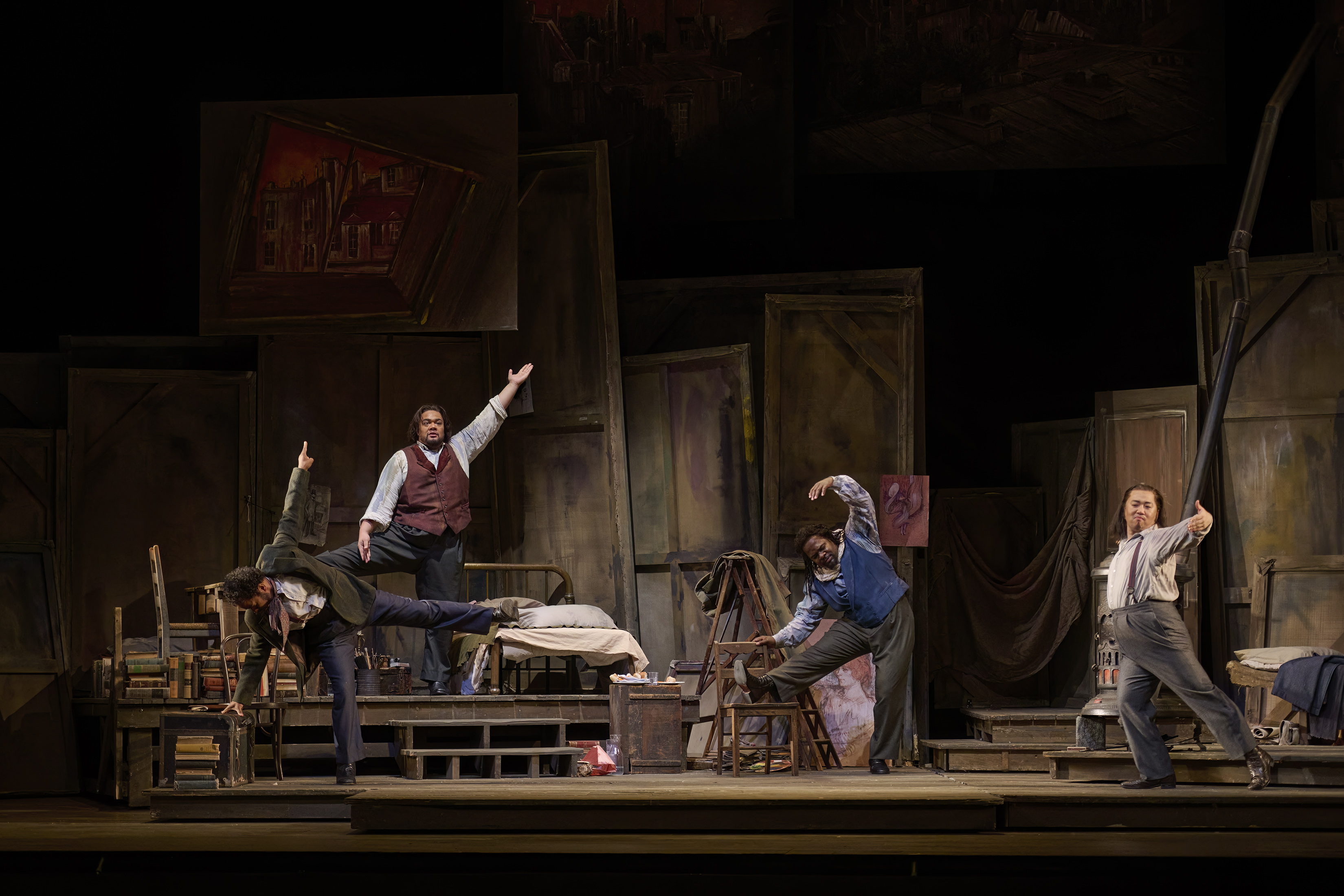
Puccini’s La Bohème  is one of the most reliable crowd pleasers and the Canadian Opera Company has wisely revived John Caird’s 2013 production again after repeating it in 2019. It is a sound production and was enthusiastically received by the audience. Rightly so.

Any production of La Boheme needs to fulfill certain prerequisites for the audience. We want a lovely, lovable, seamstress named Mimi who just happens to have a beautiful soprano voice and can sing with such passion to make us cry. Egyptian soprano Amina Edris fulfills those requirements quite nicely. She does not have a big voice but she is never not heard and her tenderness from “Mi chiamano Mimi”  to “Addio, senza rancor” (Goodbye without resentment) she delights and moves us.

All her love and passion need a suitable partner and that is the poet Rodolfo who is smitten by her at first sight. They search for her key and he touches her hand and erotic electricity is transmitted as he sings “Che gelida manina” (What a frozen little hand.) Samoan tenor Pene Pati launches into his two-word  (says he) autobiography very quietly and then soars to his high notes. He is a poor poet and dreamer with the soul of a millionaire. Now he sees the beautiful eyes of the seamstress and the rest is operatic eros.   

Pene Pati as Rodolfo and Amina Edris as Mimì in the 
Canadian Opera Company’s production of La Bohème, 2023, 
Photo: Michael Cooper
But she coughs and that’s no ordinary cold. Their love cannot last because Rodolfo cannot afford the medical bills and there is no health insurance on the South Bank of the Seine. But he pretends that the separation is a result of his jealousy and believes that Mimi can find someone who can pay the medical bills. Pati does a good job vocally and he is convincing in his acting. There is not a dry eye in the house during the final scene.

Rodolfo’s three friends deserve praise. The painter Marcello (South Korean baritone Joo Won Kang) is a real mensch who is in love with the flighty Musetta. The philosopher Colline (Congolese bass Blaise Malaba) and the musician Schaunard (Canadian baritone Justin Welsh) make up a fine ensemble of friends and singers. They are the lighter side of the opera with their tomfoolery and enjoyment of life under financially dire circumstances. They are also the support group of the two lovers. Well sung, well played, well done.

A scene from the Canadian Opera Company’s 
production of La Bohème, 2023, photo: Michael Cooper

The singer Musetta (Canadian soprano Charlotte Siegel) is a flirt and superficial seeker of fun. Her aria “Quando me’n vo” (When I walk all alone in the street) expresses her pride in men staring at her. The aria is also known as Musetta’s Waltz expressing her flirtatiousness, energy and love of fun. Unfortunately Siegel fell short of expressing those qualities in her portrayal of Musetta. Her voice, her vivacity and her movements fell short of what Musetta expresses and stand for.

The set by David Farley featured hanging panels with some furniture for the first act. The same panels in a different position and additional furniture made the scene in the café Momus of the second act, not opulent but adequate. The third act near the gates of Paris on a snowy February morning is again adequate but don’t look for too many snowflakes. The set is unimportant. What happens between Rodolfo and Mimi and between Marcello and Musetta and among the friends is what we are focusing on.

Katherine M. Carter is the revival director as she was in 2019 and the production works very well on all levels.

Jordan de Souza conducts conducts the Canadian Opera Company Orchestra in a marvelous performance of Puccini’s wonderful score. 
_______________________
La Bohème  by Giacomo Puccini with libretto by Giuseppe Giacosa and Luigi Illica opened on October 6 and will be performed eight times on various dates until October 28, 2023, at the Four Seasons Centre for the Performing Arts, 145 Queen Street West, Toronto, Ontario.  www.coc.ca

James Karas id the Senior Editor - Culture of the Greek Press