Nicolas Dromard as ‘Bert’ performs “Step In Time” with the National Tour Company of MARY POPPINS. ©Disney/CML. Photo by Joan Marcus.
Reviewed by James Karas
Walking up the wall and on the ceiling; flying across the stage, over the audience and landing back on the stage using an umbrella: these are some of the hijinks offered in Mary Poppins, the delightful musical now playing at the Princess of wales Theatre in Toronto.
The story of Mary Poppins, the nanny with magical powers, started as a series of children’s books by P. L. Travers and hit the big times and big screen in the 1964 Walt Disney movie of the same title. The movie had Julie Andrews as the marvelous nanny with Dick Van Dyke as Bert and major comic talents such as Ed Wynn and Arthur Treacher. The film garnered numerous awards and added the word supercalifragilisticexpialidocious to the English language. The movie is exceptionally enjoyable.
Forty years after the movie opened Cameron Mackintosh brought out a stage version of the film with some changes. The 2004 London production made it to Broadway and road companies have taken it just about everywhere. It has now reached Toronto and one has to admit that Mary Poppins provides marvelous light entertainment on stage especially for the young who seemed to be enjoying it even more than the adults.
The musical contains most of the songs composed by Richard M. Sherman and Robert B. Sherman for the movie as well as some new songs by George Stiles and Anthony Drewe. Richard Eyre, who directed the London production, directs this staging as well and he is as good as they come in the business.
What happens? Well, lots! George Banks (Laird Mackintosh) is a banker and the head of a British household in the early 1900’s. He is a strict disciplinarian while his wife Winifred (Rebecca Thornhill) is an indulgent but flustered mother. They have two ill-behaved children, Jane (Camden Angelis) and Michael (Reese Sebastian Diaz), a hilarious cook (Valerie Brill) and a servant (Dennis Moench).
The children are smart, rambunctious and cute. But they are badly behaved and the current nanny is storming out and everything is in an uproar at the Banks residence.
We have already met Bert (Nicolas Dromard), a jack-of-all trades who can sing dance and be funny – a Bert and Dromard that we can definitely take to. But we now need the big star. No sooner than the Banks children wish for a perfect nanny than Mary Poppins (Megan Osterhaus) descends.
She is pretty, with a lovely voice, has extraordinary powers and a bagful of tricks that can delight the most hard-to-please children and even adults. Osterhaus is splendid in the role.
Plot complications abound, of course, from banking and business issues to a visit with the Bird Woman (Janet McEwen) where you “Feed the Birds” and Mrs. Corry (Michelle E. White) who sells words like “Supercalifragilisticexpialidocious” and even if the sound of it may be atrocious it makes for a very invigorating song.
You do not need “A Spoonful of Sugar” to make this musical with its delightful comic scenes and very vigorous dancing go down. You will “Step in Time” with Mary, Bert and the Chimney Sweeps, “Chim Chim Cher-ee” down Cherry Tree Lane, feel like you want to “Fly a Kite” and in the end have a “Jolly Holiday” and a damn good night at the theatre.
________
Mary Poppins by Julian Fellowes (book), Richard M. Sherman and Robert E. Sherman (original music and lyrics) and George Stiles and Anthony Drewe (additional songs and lyrics) continues until January 8, 2012 at The Princess of Wales Theatre, 300 King St. West, Toronto, Ontario. www.mirvish.com.
Tuesday, December 27, 2011
Thursday, December 22, 2011
CHRISTMAS CONCERT WITH ARIANA CHRIS, HANNAFORD STREET SILVER BAND AND CCOC CHORUSES
Reviewed by James Karas
Review a Christmas concert?
Children with shining faces and intense attention to the conductor singing “Silent Night”, a choir, joined by an enthusiastic if somewhat cacophonous audience, intoning the Hallelujah Chorus – that’s a Christmas Concert and you don’t review that. You just enjoy it.
The event at the Metropolitan United Church in Toronto was not called a Christmas Concert but a Yuletide Celebration and there was a wide variety of musical offerings from opera to Greek songs. That gives an opening for comment. The Hannaford Street Silver Band, mezzo-soprano Ariana Chris, The Canadian Children’s Opera Company Youth and Principal Choruses performed and with that kind of array you have carte blanche to praise and even criticize without being assigned to a particularly hot cauldron for your eternal residence.
With a group like The Hannaford Street Silver Band you are guaranteed some powerful accompaniment and solo pieces. The most interesting piece was a cornet solo by Marcus Venables which was played by his father Robert Venables. “Eternal Life” demands some intricate playing that was done well. David Briskin conducted with assurance and enthusiasm.
The Hannaford Band performed several pieces ranging from robust Fanfares to more lyrical pieces. It also accompanied most of the choral and solo singing.
The Principal and Youth Choruses under the firm hand of conductor Ann Cooper Gay sounded wonderful in the high vaulted church, the perfect setting for Christmas carols. There were times when I wished they were accompanied by an organ or simply sang a cappella rather than having the over-powering Band especially in carols that have Gregorian chant modulations.
We were treated to the Finale from Laura’s Cow: The Legend of Laura Secord, a new opera by Errol Gay, a work that is not scheduled to premiere until next June.
You probably can’t have opera arias and Greek songs and still qualify the evening as a Christmas Concert. This Yuletide celebration had four songs by Greek composers and “Una voce poco fa” from Rossini’s The Barber of Seville. Ariana Chris’s rich and mellow had little problem dealing with the aria but the brass accompaniment gives one pause. You need to make some quick aural adjustments to listening to the very different accompaniment.
There was an issue of balancing the band, the singer and the acoustics and the powerful sound of the band provided strong competition for Ms Chris and she did not always win the contest.
Ms Chris sang four Greek songs accompanied by Leonidas Zafiris on bouzouki and Fotis Tubanos on guitar. Manos Hadzidakis’s “The North Star” gained a haunting quality in the large church but there were problems. The acoustics swallowed the music and prevented the crisp chords that we want to hear from the bouzouki and the guitar. Loizos’s “Lullaby” gained a dream-like quality from the acoustics. The audience responded enthusiastically to Ms Chris’s performance.
As is de rigueur in a Christmas concert, the audience joined in for a couple of the carols. A very civilized evening but let’s get to the real complaint. With all those cornets present and the chorus where in the world was the “Hallelujah Chorus” from Messiah? Even a Yuletide Celebration should have it. And as for “Silent Night,” it was only added as an encore. You can see the problem!!
Needless to say, my complaints are registered as a possible point-getter from the Keeper of the Pearly Gates just in case I am brought to task for complaining about something that I thoroughly enjoyed.
Monday, November 28, 2011
LAVISH LA TRAVIATA FROM OPERA AUSTRALIA IN MELBOURNE
Reviewed by James Karas
Opera Australia has the good fortune and the intelligent planning to present its productions in two major cities and two magnificent opera venues: The Sydney Opera House and Melbourne’s Arts Centre.
I caught a lavish production of La Traviata on the opening night of its performances in Melbourne. It is a magnificently designed production and superbly directed by Elijah Moshinsky. The singing was generally very good with some excellent performances and some gaps.
Russian soprano Elvira Fatykhova sang the title role and in the end gave an extraordinary performance. Her “Addio del passato” near the end of the opera is sung and acted with heart-breaking pathos. Indeed her final scene should not leave a dry eye in the house. That height is not achieved throughout the evening. Her performance was at times uneven and there were moments when she came frightfully close to being drowned out by the orchestra.
At the beginning I thought that she simply did not have a big enough voice and the rather large opera house (seating capacity 2085) was going to swallow her vocal prowess. It did not and in the end she proved her mettle but she and the conductor need to do some fine tuning.
Tenor Aldo Di Toro had some fine moments as the lover Alfredo Germont but he had to strain for the high notes and I was not always thrilled with his singing.
The most impressive and consistent performance was given by Michael Lewis as Giorgio Germont, the man who must tell Violetta to leave his son in order to save the family’s honour. He has to convince his son Alfredo as well and in each case he appeals to higher emotions, love and duty. Lewis does marvelous vocal work and is also emotionally convincing. His scenes with Violetta and his son are superb.
Director Moshinsky and Set Designer Michael Yeargan have put together a detailed and plush production that works superbly. The set for the opening scene in Violetta’s house is plush with heavy drapes, gorgeous dresses (designed by Peter J. Hall) and furniture and furnishings of convincing authenticity. When the lights need to be dimmed, a servant with a long candle snuffer appears!
A set of similar lavishness is used for the ball in Flora’s house with appropriate variations. In both instances, the places look a bit crowded but I think it is more appropriate thus than to present us with a set that looks like the grand ballroom at the Ritz. These courtesans do quite well but keeping their success within reasonable bounds is advisable.
For the second act scene in the country, Moshinsky places us outside Violetta and Alfredo’s house in the autumn. There are some denuded trees and the leaves are falling. This is preferable to having an indoor scene in a room with little furniture with Alfredo singing about how happy he is and then realizing that Violetta has sold the furniture because they are broke. A fine touch by director and designer.
For the final scene we return to Violetta’s apartment in Paris where all the furniture is gone and we are treated to the very dramatic and moving death scene and a truly fine night at the opera.
Orchestra Victoria and Opera Australia Chorus were conducted by Marko Letonja in an exemplary performance.
____
La Traviata by Giuseppe Verdi opened on November 16 and will run until December 17, 2011 at the Arts Centre Melbourne, 100 St. Kilda Road, Melbourne, Australia. www.operaaustralia.com,au
Opera Australia has the good fortune and the intelligent planning to present its productions in two major cities and two magnificent opera venues: The Sydney Opera House and Melbourne’s Arts Centre.
I caught a lavish production of La Traviata on the opening night of its performances in Melbourne. It is a magnificently designed production and superbly directed by Elijah Moshinsky. The singing was generally very good with some excellent performances and some gaps.
Russian soprano Elvira Fatykhova sang the title role and in the end gave an extraordinary performance. Her “Addio del passato” near the end of the opera is sung and acted with heart-breaking pathos. Indeed her final scene should not leave a dry eye in the house. That height is not achieved throughout the evening. Her performance was at times uneven and there were moments when she came frightfully close to being drowned out by the orchestra.
At the beginning I thought that she simply did not have a big enough voice and the rather large opera house (seating capacity 2085) was going to swallow her vocal prowess. It did not and in the end she proved her mettle but she and the conductor need to do some fine tuning.
Tenor Aldo Di Toro had some fine moments as the lover Alfredo Germont but he had to strain for the high notes and I was not always thrilled with his singing.
The most impressive and consistent performance was given by Michael Lewis as Giorgio Germont, the man who must tell Violetta to leave his son in order to save the family’s honour. He has to convince his son Alfredo as well and in each case he appeals to higher emotions, love and duty. Lewis does marvelous vocal work and is also emotionally convincing. His scenes with Violetta and his son are superb.
Director Moshinsky and Set Designer Michael Yeargan have put together a detailed and plush production that works superbly. The set for the opening scene in Violetta’s house is plush with heavy drapes, gorgeous dresses (designed by Peter J. Hall) and furniture and furnishings of convincing authenticity. When the lights need to be dimmed, a servant with a long candle snuffer appears!
A set of similar lavishness is used for the ball in Flora’s house with appropriate variations. In both instances, the places look a bit crowded but I think it is more appropriate thus than to present us with a set that looks like the grand ballroom at the Ritz. These courtesans do quite well but keeping their success within reasonable bounds is advisable.
For the second act scene in the country, Moshinsky places us outside Violetta and Alfredo’s house in the autumn. There are some denuded trees and the leaves are falling. This is preferable to having an indoor scene in a room with little furniture with Alfredo singing about how happy he is and then realizing that Violetta has sold the furniture because they are broke. A fine touch by director and designer.
For the final scene we return to Violetta’s apartment in Paris where all the furniture is gone and we are treated to the very dramatic and moving death scene and a truly fine night at the opera.
Orchestra Victoria and Opera Australia Chorus were conducted by Marko Letonja in an exemplary performance.
____
La Traviata by Giuseppe Verdi opened on November 16 and will run until December 17, 2011 at the Arts Centre Melbourne, 100 St. Kilda Road, Melbourne, Australia. www.operaaustralia.com,au
Friday, November 18, 2011
PYGMALION FROM QUEENSLAND THEATRE COMPANY IN BRISBANE
Reviewed by James Karas
Brisbane, with a population of more than 2 million, does not pop up on the world cultural map all that often. Sydney and Melbourne are bigger cities and have more to offer but Brisbane is no slouch. It boasts the Queensland Performing Arts Centre on the banks of the Brisbane River where you can find four halls that provide opera, concerts, major theatrical events and more intimate performances.
I was able to catch the opening night of Shaw’s Pygmalion in the 850-seat Playhouse in a production by the Queensland Theatre Company directed by Michael Gow. It proved to be an uneven success with some strengths and some questionable directorial choices.
Pygmalion is, of course, the source for My Fair Lady and it is fair to say that far more people have seen the musical than Shaw’s 1912 “Romance in Five Acts.”
Most directors tinker with the text of the play but Michael Gow has done a bit more than is strictly necessary. First, he adds a narrator who tells us where the play is set. This is normally indicated by the dialogue or by stating in the programme where each act takes place, At QPAC, a programme costs $10.00 and perhaps not everyone buys one. Having someone walk across the stage telling us where we are is not an acceptable solution. Hand people a cast list with the rest of the information.
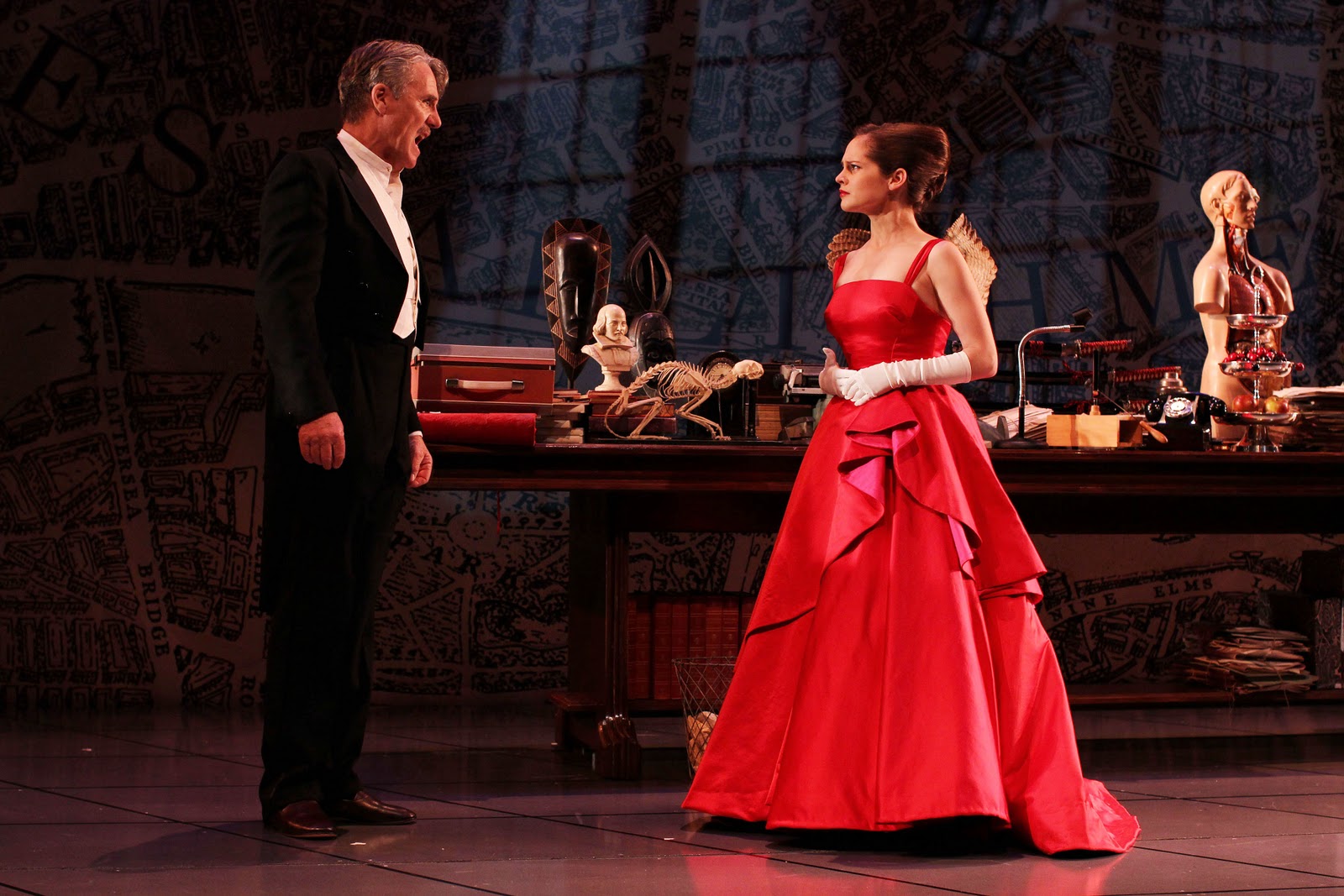
Gow and Designer Stephen Curtis have replaced Prof. Higgins’ book-lined study and Mrs. Higgins’ elegant drawing room with a map of London at the back and a few pieces of furniture. The map has markings like Oxbridge, Cockney and Establishment as well as the names of actual areas of London. This may be a reflection of the budget available for sets and one must be sympathetic but one must also note that it is an unsatisfactory solution. The sets take away a great deal from the play.
The acting was uneven. Melanie Zanetti was a spunky, almost too spunky, Eliza who hides under the table in Higgins’ study at one point. Her nerve however is what she needed to attempt to get out of selling flowers on the street.
Robert Coleby had the ease and self-assurance of the upper-crust gentleman who can afford to be rude and crude. My complaint is that he spoke too quickly at times and did not enunciate sufficiently. A professor of phonetics who would teach a squashed cabbage leaf beautiful English would be more emphatic in his enunciation.
Colonel Pickering is a rich and sophisticated gentleman and older than Higgins. He is a true “gentleman” in manners and in heart. In the hands of Bryan Probets, Pickering looked like a geek who lacked any self-assurance and despite his Cambridge education sounded as if he needed a few lessons in phonetics from Higgins.
Chris Betts was a convincing Alfred Doolittle, the poor dustman who philosophizes about life and drinks as much booze as he can bum from others. Betts convinces us that Doolittle can become a cabinet minister or a preacher if he could change his accent.
The other actors were competent but Gow let some of them overact and went for the cheap laugh when some restraint would have been more appropriate.
The big punch line of the first production of Pygmalion was Eliza’s reply to the question if she was going to walk. “Not bloody likely” she replies and Western civilization almost collapsed. Try getting a laugh out of that line today! Michael Gow finds a solution: “Not f...g likely” blurts out Eliza and the audience roars.
___
Pygmalion by Bernard Shaw opened on November 7 and will run until November 27, 2011 at the Queensland Performing Arts Centre, Brisbane, Australia
www.queenslandtheatre.com.au/
Sunday, November 13, 2011
ANONYMOUS - FICTIONALIZED MOVIE ABOUT SHAKESPEARE IS ABOUT AS BAD AS IT GETS
Reviewed by James Karas
The movie Anonymous is set in 16th century England and deals with people named William Shakespeare, Queen Elizabeth I, Christopher Marlowe, Ben Jonson the Earls of Oxford, Southampton and Essex and a host of other historically familiar personages.
At the end of the movie, after the interminable credits roll by, there is a fulsome disclaimer to the effect that this is a work of fiction and if any person or incident bears any resemblance to actual events or people, it is entirely coincidental.
The movie deals ostensibly with the authorship of Shakespeare’s plays and involves us in the convoluted politics, plots and treacheries of Elizabethan England. The punch line, if it can be called that, is that Shakespeare did not write a single word of the works attributed to him and that everything was penned by Edward de Vere, the Earl of Oxford.
The idea that the Earl of Oxford wrote what we consider Shakespeare’s works is not new. There are numerous candidates for the position of giving authorship credit to anybody but the glover’s son from Stratford-upon-Avon. It is a fair game engaged by hard working enthusiasts and bringing the subject to the big screen can only increase interest in the plays and the question. But could they not make a better movie? Did it have to be a convoluted bore where you stay awake merely to see if you can figure out the chronological changes as the film jumps back and forth over decades? Did it have to be that dumb?
According to Anonymous, the best thing that can be said about Shakespeare is that he was a dunce. He can read enough to learn his lines (he is an actor) but he cannot write and it is downhill from there. He is given Oxford’s plays by Ben Jonson and is paid well to pretend that they are his own. When he runs out of money or simply wants more (he is a greedy pig), he blackmails Oxford into giving him huge amounts. Meet Roland Emmerich’s Shakespeare: an illiterate idiot and an extortionist.
On the political side, we have Queen Elizabeth who is a very sensual woman in her youth and has numerous lovers and several bastard children. One of her sons and subsequent lover is the Earl of Oxford and their lovechild is none other than the Earl of Southampton, the man to whom the sonnets are dedicated. The Queen does not know what happens to her child and the incest is done unknowingly. Remember Oedipus and Jocasta?
The political battle lines are drawn between the Cecils and the Earl of Essex. Oxford has been forced to marry William Cecil’s daughter while his son Southampton keeps company with Essex. The Cecils plot against Essex to ensure that their choice of king will succeed the aging Elizabeth while Essex wants to be king.
By this time you have lost all interest in the political permutations and are in danger of causing ruptures to the corners of your mouth from excessive yawning.
There are a few scenes from Shakespeare’s plays, we see Ben Jonson being tortured and some boom, boom and bang, bang as Essex tries to start a rebellion and ends up with his head on a chopping block but by that time you have probably lost the plotline and run out of popcorn.
Enough fulmination about a stupid movie and some well-deserved credit to the actors. Rhys Ifans is a man full of thought and talent with little political ability. He has poetry and drama in his veins in this fine performance as the Earl of Oxford.
Queen Elizabeth is a very sensuous young woman played by Joely Richardson and as the old, imperious but crumbling monarch played by Vanessa Redgrave.
Derek Jacobi is wasted as a narrator at the beginning and end of the movie but his voice is always a pleasure to hear.
David Thewlis plays the conniving and corrupt Sir William Cecil and Rafe Spall plays the nasty William Shakespeare.
There are some fine scenes of London and its theatres and the lines from Shakespeare’s plays simply burn holes in this turgid movie that does a disservice to everyone, especially the audience.
The movie opened in Australia on November 3, 2011 and I saw it in Brisbane on November 5. There were precisely four people in the Event Cinema with my wife and I making up 50% of the audience. Those Australians sure know how to judge movies.
The movie Anonymous is set in 16th century England and deals with people named William Shakespeare, Queen Elizabeth I, Christopher Marlowe, Ben Jonson the Earls of Oxford, Southampton and Essex and a host of other historically familiar personages.
At the end of the movie, after the interminable credits roll by, there is a fulsome disclaimer to the effect that this is a work of fiction and if any person or incident bears any resemblance to actual events or people, it is entirely coincidental.
The movie deals ostensibly with the authorship of Shakespeare’s plays and involves us in the convoluted politics, plots and treacheries of Elizabethan England. The punch line, if it can be called that, is that Shakespeare did not write a single word of the works attributed to him and that everything was penned by Edward de Vere, the Earl of Oxford.
The idea that the Earl of Oxford wrote what we consider Shakespeare’s works is not new. There are numerous candidates for the position of giving authorship credit to anybody but the glover’s son from Stratford-upon-Avon. It is a fair game engaged by hard working enthusiasts and bringing the subject to the big screen can only increase interest in the plays and the question. But could they not make a better movie? Did it have to be a convoluted bore where you stay awake merely to see if you can figure out the chronological changes as the film jumps back and forth over decades? Did it have to be that dumb?
According to Anonymous, the best thing that can be said about Shakespeare is that he was a dunce. He can read enough to learn his lines (he is an actor) but he cannot write and it is downhill from there. He is given Oxford’s plays by Ben Jonson and is paid well to pretend that they are his own. When he runs out of money or simply wants more (he is a greedy pig), he blackmails Oxford into giving him huge amounts. Meet Roland Emmerich’s Shakespeare: an illiterate idiot and an extortionist.
On the political side, we have Queen Elizabeth who is a very sensual woman in her youth and has numerous lovers and several bastard children. One of her sons and subsequent lover is the Earl of Oxford and their lovechild is none other than the Earl of Southampton, the man to whom the sonnets are dedicated. The Queen does not know what happens to her child and the incest is done unknowingly. Remember Oedipus and Jocasta?
The political battle lines are drawn between the Cecils and the Earl of Essex. Oxford has been forced to marry William Cecil’s daughter while his son Southampton keeps company with Essex. The Cecils plot against Essex to ensure that their choice of king will succeed the aging Elizabeth while Essex wants to be king.
By this time you have lost all interest in the political permutations and are in danger of causing ruptures to the corners of your mouth from excessive yawning.
There are a few scenes from Shakespeare’s plays, we see Ben Jonson being tortured and some boom, boom and bang, bang as Essex tries to start a rebellion and ends up with his head on a chopping block but by that time you have probably lost the plotline and run out of popcorn.
Enough fulmination about a stupid movie and some well-deserved credit to the actors. Rhys Ifans is a man full of thought and talent with little political ability. He has poetry and drama in his veins in this fine performance as the Earl of Oxford.
Queen Elizabeth is a very sensuous young woman played by Joely Richardson and as the old, imperious but crumbling monarch played by Vanessa Redgrave.
Derek Jacobi is wasted as a narrator at the beginning and end of the movie but his voice is always a pleasure to hear.
David Thewlis plays the conniving and corrupt Sir William Cecil and Rafe Spall plays the nasty William Shakespeare.
There are some fine scenes of London and its theatres and the lines from Shakespeare’s plays simply burn holes in this turgid movie that does a disservice to everyone, especially the audience.
The movie opened in Australia on November 3, 2011 and I saw it in Brisbane on November 5. There were precisely four people in the Event Cinema with my wife and I making up 50% of the audience. Those Australians sure know how to judge movies.
Friday, November 11, 2011
VISITING PINTER’S SHIFTING GROUND IN NO MAN’S LAND IN SYDNEY AUSTRALIA
Steven Rooke, John Gaden, Andrew Buchanan and Peter Carroll Photo by Rob Maccoll
Reviewed by James Karas
Harold Pinter’s No Man’s Land opens with an unprepossessing situation. Two men are having drinks in a room full of books with a well-stocked bar. They just met in a bar but seem affable enough but we sense that there is little basis for the relationship and their attitudes will change. We will spend about 95 minutes with the two of them and we will be thoroughly confused as to who they are. That is a classic Pinteresque situation and one can see it at the Sydney Opera House in a production by the Sydney Theatre Company and the Queensland Theatre Company.
Spooner (Peter Carroll) is a gray-haired man who meets the aristocratic Hirst (John Gaden) in a bar and is invited to the latter’s book-lined home. Spooner is a bit nervous and becomes rather garrulous compared to the taciturn Hirst. The men reminisce about the past and one quickly develops serious doubts about their veracity or the accuracy of their memories.
The reserved Hirst soon tosses a glass at Spooner. The men become increasingly more drunk and their attitudes and behaviours change.
They are joined by Briggs (Andrew Buchanan) and Foster (Steven Rooke). Foster is ostentatiously gay and Briggs is a t-shirt-wearing tough guy who may burst out into violence at any moment. Their attitudes will change as well as the play progresses.
You never know who these people are because you can never trust what they say. Interestingly, no man’s land is defined by Hirst as a place that “does not move ... or change ... or grow old ... remains ... forever ... icy ... silent.” That may be one view of no man’s land but Pinter’s characters who occupy that land do move and change, they do grow old and are neither icy nor silent. In some ways the reverse is also true because despite what they say, we do not know who they are and under the veneer of civility, there lurk possible violence and the unknowable.
No man’s land has many other meanings including the patch of land between two armies which was very dangerous to cross or disputed property. All of these meanings can be applied to the complex memories of the characters.
Carroll manages to go through all the chameleon-like changes of Spooner with extraordinary acting agility. He dominates the play. Gaden is very effective as the patrician Hirst. Rooke and Buchanan go though some kaleidoscopic changes as well in what can only be described as bravura ensemble acting.
Hirst and Spooner are also perhaps poets and they certainly display a joyous use of the English language.
The whole thing is orchestrated by director Michael Gow who maintains the sands shifting and the audience trying to follow the changing dunes. He defines the characters in their different permutations and allows physical activity to supplement the intellectual permutations and variations as the audience tries to follow the play’s shifting sands.
___
No Man’s Land by Harold Pinter opened on November 1 and will run until December 11, 2011 at the Drama Theatre, Sydney Opera House, Sydney Australia www.sydneytheatre.com.au,au
Tuesday, November 8, 2011
TERRIFIC DON GIOVANNI FROM OPERA AUSTRALIA AT SYDNEY OPERA HOUSE
Andrew Jones and Tary Fiebig in Don Giovanni. Photo: Branco Gaica
Reviewed by James Karas
Opera Australia wrapped up its current season at the Sydney Opera House with a performance of Don Giovanni. The revival of Swedish director Goran Jarvefelt’s production which was first seen at the Sydney Opera House in 1991 proved to be vocally and theatrically quite superb.
Jarvefelt has a fairly traditional approach to the opera. No tampering with the plot or egregious search for psychological byways. Mozart has provided everything and all you need is excellent singers, a superb orchestra and a director to bring out the best in one of the best operas ever composed.
The single set designed by Carl Friedrich Oberle consists of a beige room with high windows at the back and a sloping stage. There are a good number of interesting touches by Jarvefelt including the Commendatore’s coffin being left center-stage for much of the second act. The Commendatore himself emerges and stands beside his coffin near the end of the opera and it proves a highly effective way of treating the “statue”.
The singing was generally first rate. Argentinean baritone José Carbó was an agile, virile and very well-sung Don Giovanni. He is not a big man but he dominated the evening as the hormonally over-active, selfish and amoral lothario.
Soprano Teresa La Rocca has a gorgeously luscious voice and she had no difficulty expressing her distress and pain as Donna Elvira, one of Don Giovanni’s victims. She fell short of expressing her rage, however. For example, when she threatens to tear out Don Giovanni’s hear in “Ah! Chi mi dice mai” her entrance aria, there should be more rage in her voice even if she has no intention of doing anything to her lover. Other than that hers was a moving and thoroughly enjoyable performance.
Soprano Anita Watson showed a superb vocal and emotional range as Donna Anna, the woman who is (almost?) seduced by Don Giovanni. She is a mysterious character in some ways but Watson’s handling of the role is quite amazing.
The soubrette role of Zerlina is sung by Taryn Fiebig, who is indeed pretty, flirtatious and a master at handling men like her future husband, the dolt Masetto. Fiebig has that beautiful, light and almost fragile voice that threatens to crack. With Zerlina her “weakness” is her strength and she can flirt and be almost seduced by Don Giovanni and get away with it. Excellent work.
Australian baritone Andrew Jones was a suitably angry and manipulated Masetto but in dress and acting I would have preferred him to be a bit more dense. His singing was superb.
Stephen Bennett is a big middle-aged Leporello who has been following Don Giovanni and making lists of his conquests for too long and he has every right to be sick and tired of his job.
Stephen Smith has a good tenor voice but he sang a bit too pianissimo at times and was overwhelmed by the orchestra on a couple of occasions. Crank up the volume.
The costumes tended to be generally colourless. Donna Elvira does wear a beautiful red gown but the rest of the characters are not nearly as well attired. The peasant girls can be suited up in colourful costumes and I am not sure why they are dressed rather plainly.
There was a problem with visibility. A large number of people could not see the window where Donna Elvira and her maid sit and are serenaded in the second act. The problem is easily solvable by having the window at the back of the stage instead of on the side.
The Australian Opera and Ballet Orchestra conducted by Benjamin Northey played magnificently.
___
Don Giovanni by W. A. Mozart opened on September 24 and played until November 5, 2011 at the Sydney Opera House, Sydney Australia www.operaaustralia.com,au
Subscribe to:
Posts (Atom)