Showing posts with label THEATRE REVIEW. Show all posts

Thursday, July 24, 2014

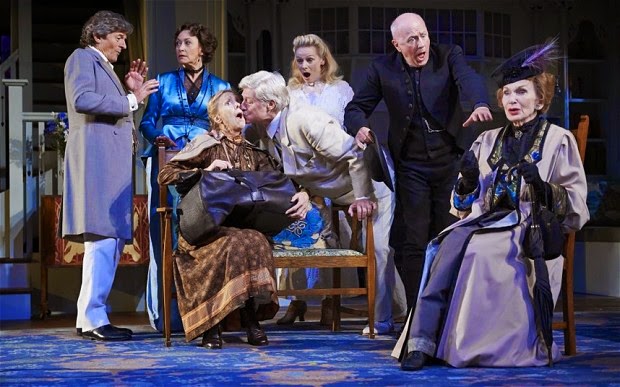
THE IMPORTANCE OF BEING EARNEST – REVIEW OF PRODUCTION AT HAROLD PINTER THEATRE


Reviewed by James Karas

The billboards and the ads went up promising a new production of “Oscar Wilde’s Immortal Comedy The Importance of Being Earnest at the Harold Pinter Theatre.” If you are in London for only a few days, you would not want to miss something like that.

When you arrive at the theatre, you notice something strange on the large billboard: “Additional Material Written by Simon Brett.” Good grief! Additional material for The Importance of Being Earnest? That is tantamount to amending Genesis 1. In any event, you try to keep an open mind and brace yourself for the worst.

I did not brace myself sufficiently for this travesty of a production. Wilde’s comedy becomes a play-within-a-play. The Bunbury Company of Players is putting on The Importance and they are in the final stages of rehearsal in George and Lavinia’s sitting room. The whole thing will be done there and we will not need the three sets that Wilde’s play calls for.

We have the “actors” of the fictitious Bunbury Company who will portray Wilde’s characters in rehearsal. The “actors” will bicker among themselves as they rehearse and things will wrong, such as no cucumber sandwiches when there is supposed to be some and a plateful of them when there should be none. It sounds funnier that it really is. 

The “actors” of the Bunbury Company are mildly geriatric or let’s just say that there is a generation gap between their age and the age of the characters that they portray in Importance. This applies only to the young. Lady Bracknell, Miss Prism, Chasuble   and the servants can be any age.

Nigel Havers is no doubt a fine actor but he is not exactly suitable for the role of Algernon who will woo the lovely eighteen year old Cecily played by Christine Kavanagh. Let us avoid words such as geriatric or even senior and say that a middelageiatric love affair using Wilde’s lines is not funny. To put it a bit more strongly, it looks stupid. The same applies to Martin Jarvis as John Worthing and Cherie Lunghi as Gwendolyn.

Siân Phillips would make a good Lady Bracknell and she was not bad as Lavinia if she were directed to play that virago. In this split-personality production her performance was just passable. Rosalind Ayres had better luck as Miss Prism and a fussy wardrobe lady but then those are easier roles.

Patrick Godfrey had better luck as Lavinia’s hen-pecked husband George and the servants Merriman and Lane. Niall Buggy was also good as Canon Chasuble and an “actor.”

They did not kill all the lines or the whole play because in the latter part they stuck to the script and gave Brett a wide berth. There were some laughs but the credit goes more to Wilde than to the actors and director.

Michael Frayn showed in Noises Off how funny a botched rehearsal or behind-the-scenes play can be. Director Lucy Bailey, Additional Material Writer Simon Brett and everyone involved with this travesty should keep their hands off The Immortal Comedy.

Stay away from this production.        
____

The Importance of Being Earnest by Oscar Wilde with Additional Material by Simon Brett continues until September 20, 2014 at the Harold Pinter Theatre, Panton St, London, SW1Y 4DN

Sunday, May 11, 2014

BINGO! – REVIEW OF MACIVOR PLAY AT FACTORY THEATRE


  John Beale, David Keeley, Dov Mickelson, Jane Spidell and Sarah Dodd - Photo Credit Joanna Akyol

By James Karas

Nostalgia, those wistful reminiscences of times past when the world was young, the sun was always shining and all our future was ahead of us. Remembering the past, coming to terms with the present and perhaps glancing at the future are the themes of Daniel MacIvor’s Bingo!, now playing at the Factory Theatre.

Thirty years after graduation from high school in Cape Breton (it’s not mentioned but we can guess it), three friends get together in a hotel where they are celebrating a class reunion. Paul (John Beale)l is a shy engineer who has returned from Calgary for the occasion. Doug (David Keeley) is a real estate agent working in Halifax. He lies to his wife and is a braggart about his achievements as a salesman. Jeff (Dov Mickelson) is a “swinger” who would have preferred to have children but his wife barred such thoughts.

There are two women in the play: Kathy is a lonely and shy woman who has not found a lasting relationship with a man. Laura (Jane Spidell) is a mail carrier and just as lonely as Kathy. She finds some fulfilment by being a foster parent to children in Africa. All the characters have nicknames but I am using their real names.

That is an interesting collection of people and there is a play in them as they look back to their golden years in high school, reveal their present situation and give us a glimpse of their hopes for the future – what is left of it or the “first day” of what is to come.

The main preoccupation of all of them is drinking. In the first act the men are gulping booze in the hotel room, punching each other in the stomach and going on with a forced enthusiasm that is of limited appeal. Drunks are rarely amusing for long. The aim of their drinking is to reach the “bingo” stage when one of them runs to the bathroom and vomits. That certainly sounds like a barrel of fun.

  Dov Mickelson and Jane Spidell - Photo Credit Joanna Akyol

We meet the women in the hotel bar where the reunion is held. They are more subdued than the men and we learn about their past and present. They are lonely and sympathetic. The golden years of their high school are perhaps brighter in memory than they were in reality and the present does not amount to much nor does the future hold a lot of promise. Kathy has been left emotionally scarred because she did not finish high school because she did not want it to end.

The five get together in the hotel room where through the miasma of excessive drinking we get more nostalgic memories and revelations. Jeff’s swinging lifestyle includes posting pictures of his private parts on the internet. His wife may be out for the evening swinging and posting without him.

Doug’s wife finds out that he is deceiving her and that is his third strike. He is out, as he told us at the beginning.

There are some good lines, some fast-paced dialogue, some forced roistering and lots of drinking as the play moves towards its conclusion. There is a lyrical scene at the end as Paul and Kathy sit on the boardwalk by the sea watch the moon and the two shy people connect for a “happy ending”.

MacIvor sketches out his characters quite nicely. They are recognizable people and we have some empathy for all of them except for the philandering real estate agent, I suppose. The actors do an excellent job in conveying these people. Director Nigel Shawn Williams does a very good job with the cast.

Lindsay Anne Black’s set is simple and effective. A hotel room with a couch, a table and a bar provides the drinking venue for the men. To the right is the hotel bar where the two women meet. There is no break between the two locations. Stretching from the left of the stage and running across the front is the boardwalk where the last scene will take place. Again, there is no brake and we only realize that it is the boardwalk when Paul and Kathy sit on in the final secene.

The play, for all its charm and sympathetic people “remembering” the past, is rather thin on plot. There are hints that Jeff may have seen the light and will give up his swinging life and, I guess, Laura may hook up with him; Doug will be thrown out on the street by his wife. Paul and Kathy will live happily ever after. That is all good but it is not enough to make for a completely satisfactory play.      
     ____


Bingo! by Daniel MacIvor opened on May 8 and will run until June 1, 2014 at the Factory Theatre, 125 Bathurst Street, Toronto, Ontario. www.factorytheatre.ca. 

Monday, April 28, 2014

OF HUMAN BONDAGE – REVIEW OF SOULPEPPER PRODUCTION


Of Human Bondage, Somerset Maugham’s massive and moving novel was published one hundred years ago and it has never been out of print. Soulpepper Theatre Company has scored a first in dramatizing the novel for the stage in a version by Canadian playwright Vern Thiessen.

Of Human Bondage is centered on the story of Philip Carey, a young man with a club foot who tries to become an artist in Paris but realizes that he has little talent for art and returns to London at the turn of the twentieth century to study medicine.

He falls in love and becomes obsessed with Mildred Rogers and much of the story is concerned with that relationship. She is a waitress in a tea shop and, aside from her physical attractiveness, is one of the most repellent persons imaginable. She uses and abuses Phillip and he repeatedly takes her back. She runs off with one man and returns pregnant. Phillip pays for her confinement and forgives her. She goes away with Philip’s  friend and he forgives her again.

By that time, our sympathy for Philip is strained to the breaking point. How stupid is this man to be risking his career (he can’t pay his medical school fees or his rent) for this odious creature who offers him absolutely nothing?

The adaptation and the staging are quite superb. Thiessen has extracted a great deal of the novel for the stage and this is made possible by the brilliant staging. The method used is quick and seamless change of scenes and entrances of characters. The scene changes are accomplished by pushing a couple of pieces of furniture on or off the stage and characters played by the same actors appear with extraordinary speed.

The programme lists eleven actors and nine of them play so many roles that they are not even listed.

Gregory Prest plays Philip, a man scarred by his club foot who is decent and sympathetic except when he goes overboard with his obsession with Mildred. Michelle Monteith plays the flakey, pretentious and emotionally abusive Mildred. Fine performances.

Dan Chameroy plays the unsuccessful and addicted poet Cronshaw and like the rest of the cast handles several other roles.

Notable performances are turned in by Jeff Lillico as the playboy doctor who becomes addicted to drugs and wastes his life. Sarah Wilson as Norah provides a contrasting character to Mildred. She is an attractive and successful writer whom Philip rejects. Oliver Dennis handles several roles with his usual ability.

The play, like the novel, has elements of sentimentality and melodrama, but director Albert Schultz never allows it to get mawkish. Much credit belongs to Set and Lighting Designer Lorenzo Savoini who makes it possible to put so many people on stage quickly.

I have a prejudice against adaptions of novels for the stage and many of them have done nothing to disturb that attitude. Thiessen’s adaptation did not change my mind but I was moved and enjoyed the production almost in spite of myself.
     _________


Of Human Bondage  by W. Somerset Maugham adapted by Vern Thiessen opened on April 24  and will run in repertory until May 17, 2014 at the Young Centre for the Performing Arts, 55 Tank House Lane, Toronto, Ontario. www.soulpepper.ca  416 866-8666

Tuesday, April 15, 2014

SOLICITING TEMPTATION – REVIEW OF ERIN SHIELDS’ PLAY AT TARRAGON THEATRE

Miriam Fernandes and Derek Boyes. Photo by Cylla von Tiedemann.

Reviewed by James Karas

Child prostitution, especially in developing countries, has reached such levels that many countries have made it a criminal offence in the place of origin of the offender. Stories about men going on “sex holidays” in the Far East are common and prosecutions may be increasing but their effectiveness is doubtful.

Playwright Erin Shields has tackled the subject from an angle all her own in Soliciting Temptation which is playing at the Tarragon Theatre Extra Space until May 4, 2014.

A Canadian on a business trip to an unnamed country has made arrangements to meet a young girl in a cheap and sweltering hotel room. A shy, pretty girl arrives, wrapped in a see-through sari and wearing only panties and a top underneath. She says nothing and proceeds to unwind the sari from her body in a sexually suggestive manner. The man takes the first steps towards sexual contact and the girl explodes in his face like a hidden hand grenade.

She is no child prostitute but an intelligent, well-educated, self-assured and articulate young woman (we never find out her age) who was raised in Canada and has returned to her country of origin to fight child prostitution.

The positions of power are reversed and the man becomes a blubbering idiot begging for mercy. She shows none as she displays her own power. She knows his phone numbers and can inform his wife and daughter; she knows his employer; there are pimps protecting her and she can call the police.

The uneven battle stops when the girl is bitten by something and goes into anaphylactic shock. The man saves her life with a shot of adrenalin but the battle between them resumes. She goes on the offensive again and has him take off his puts and shirt. She puts them on, leaving him in his underwear. The man’s humiliation is complete.

The power struggle takes a turn when she admits that she is a virgin and somehow that provides an opening for the man to take the upper hand for a while.

The two actors, Derek Boyes as the man and Miriam Fernandes as the girl, are on stage throughout the eighty minutes of the play and they have their work cut out. They engage in highly emotional scenes, nasty arguments and some lyrical exchanges. They never falter and give superb performances. Director Andrea Donaldson does a fine job except for allowing both the man and the girl to reach dramatic heights a bit too quickly. 

I have problems with the play. The situation is a set up to get a man who is by no means the worst sex tourist that one reads about. The plot is reminiscent of David Mamet’s Oleana where a hapless professor is set up in a power struggle by a student and is destroyed. I am not looking for another play by Mamet but Soliciting Temptation lacks inner coherence and convincing dramatic development. It reaches a climax quickly when the man is brought to his knees begging for mercy and the reversal of the girl’s behaviour is not convincing. There are times when the play simply creaks.

Soliciting Temptation is a good example of bringing a current issue on the stage but the play needs a few sessions with a talented dramaturge to be completely credible.
   
______


Soliciting Temptation by Erin Shields opened on April 9 and will run until May 4, 2014 at the Tarragon Theatre Extra Space, 30 Bridgman Ave. Toronto, Ontario.  www.tarragontheatre.com

Monday, April 7, 2014

THE GIGLI CONCERT – REVIEW OF SOULPEPPER PRODUCTION


Stuart Hughes and Diego Matamoros. Photos by Cylla von Tiedemann

Reviewed James Karas

The Gigli Concert is a fascinating play whose characters live in a truly bizarre world. They exist between reality and their fantasies (with the latter predominating), between psychoses and sanity, and between alcoholic stupor and bouts of sobriety. Yet it is a world of intelligence, philosophical musing, religious references and some mundane concerns. And don’t forget the great Italian tenor Beniamino Gigli.  

Soulpepper gives Tom Murphy’s 1983 play a creditable production directed by Nancy Palk with Diego Matamoros, Stuart Hughes and Irene Poole.

Matamoros takes on the tough role (he never leaves the stage) of JPW King – Dynamatologist. The word means nothing, of course, but it is supposed to describe some kind of movement or idea. JPW lives and works out of a dingy room that has a desk and a convertible couch. He is frequently drunk and is described as a quack and a charlatan. He admits that he has not achieved anything in his life but when an Irish Man walks in his office, JPW undertakes to makes him sing like Gigli in six sessions.

Matamoros has no difficulty bringing out the absurdity, irrationality and ridiculousness of JPW as well as of his thinking and philosophical side. But there is another side to JPW that does not come out very well. He is an upper-class Englishman living in Ireland and trying to imitate an Irish accent. He is a man who does not belong where he is in many ways, including as an Englishman in Ireland. Accents are not Matamoros’s strong point and you could not place him anywhere especially as a displaced Englishman in Ireland.

The Irish Man is a successful builder, well-dressed and just as looney as JPW. He wants to sing like Gigli and thinks that JPW can make him do it. His appearance of normality is superficial and the man belongs on a psychiatrist’s couch but he has no use for psychiatrists. Stuart Hughes has a gruff voice and his Irish Man is in turn aggressive, pathetic, wistful and just plain nuts.

Irene Poole has the smaller role of Mona. She is JPW’s mistress, a woman who seeks sex with men but who also lives in her world of fantasy. After giving birth to a child while still in her teens and having to give it up for adoption, she dreams of having another one. The three characters face reality in different ways but Mona’s encounter with it comes in the form of cancer.

Gigli’s voice provides a unifying theme to the bizarre world of the characters and we hear a number of arias. The Irish Man does not do a concert but JPW does get to perform as if he were Gigli even if it is in his dream.

Palk has a tendency of leaving her characters to stand in one place as if nailed to the floor for too long. Pacing up and down may not be the solution but some kind of stage business is preferable to standing in one place. That and the failure to establish the Irish-English milieu and tension are the main complaints about the production. Otherwise, Murphy avalanche of ideas in extraordinarily rich language and verbal dexterity is a treat not to be missed. As for Gigli, you will probably  end up on YouTube listening to his recordings.

Ken MacKenzie’s single set and costumes are very good.
     _____

The Gigli Concert by Tom Murphy opened on April 2 and continues until May 16, 2014 at the Young Centre for the Performing Arts, 50 Tank House Lane, Distillery District, Toronto, Ontario. www.soulpepper.ca 416 944-1740


Monday, March 17, 2014

MEDEA - REVIEW OF THEATRE LAB PRODUCTION


Reviewed by James Karas

Hammersmith is nowhere near Ancient or Modern Athens but that is where you have to go to see one of the finest productions of Greek tragedy. Director Anastasia Revi has captured all the essential elements of Athenian drama in her recreation of Medea, a production that takes some liberties with the text but remains fundamentally faithful to Euripides’s play.

Ancient tragedy contained music, singing and dancing in addition to the script or libretto, if you will. Except for the few scripts that have been miraculously saved, we know precious little of how the plays were in fact produced and why Athenians went to the theatre in the pre-dawn hours by the tens of thousands.

Revi provides her personal view and it is convincing and brilliant. Her Medea is a gypsy who married a Greek. A gypsy is, of course, a foreigner, an outsider as was Euripides’s Medea who came from the eastern shore of the Black Sea (think of Sochi) when she fell in love with Jason who just stole the Golden Fleece.

Revi’s production opens with a wedding. A young man is pawing his bride, the bridesmaids are having fun and an older man is enjoying the event as well. Above them all is a woman dressed in black with her back turned to the party. We hear melodious and pleasant Mediterranean music.

None of this is in the play but it fits completely as a prologue. Then the Nurse (Helen Bang) speaks the first lines of Euripides’s play in the excellent translation of Ian Johnson. We quickly learn that the groom of the prologue is Jason (Tobias Deacon) getting married to Glauce (Denise Moreno). The other man is her father King Creon (George Siena).

Jason is already married to Medea and they have two sons. His marriage to a foreigner is not valid and he is marrying the daughter of the king for obvious reasons. Medea is quite angry, to use an understatement.

Glauce does not appear in Euripides play but Revi adds her without disturbing the integrity of the play. She appears again in her wedding veil when the Messenger is describing her hideous death. She acts out the description of her death in a brilliant coup de théâtre by Revi.

Revi tightens up the play by doing away with the Tutor and giving some of his lines to the Nurse and having the children appear only imaginatively. They are made quite real by Medea walking on stage with their shoes strung around her neck after she murdered them. Another brilliant directorial touch.

Because of the long choral passages and speeches, Greek drama can easily descend into static and often boring recitatives. Revi will have none of that. The play is choreographed from simple body movements of the Chorus of three young women, to more complex dances. When Jason visits Medea, the scene becomes one of sexual passion and erotic dancing using two folding tables as props. It explains what brought the Greek and the gypsy together.

Medea becomes almost raving mad as she plots the death of Glauce and the murder of her children. As she crouched on the floor filled with grief for her children, we hear a gorgeous obbligato sung in Modern Greek. One can barely make it out but it is a nanourisma, a lullaby that a mother would sing to her children when putting them to bed.

Kaminsky plays a brilliant Medea. She is not a young woman in contrast well with Glauce, her replacement who is young and pretty. This Medea is passionate, cunning, angry and full of hatred. She speaks with an accent that I can only describe as Mediterranean but she slides out of it during her more dramatic moments. We are so enthralled with what she is doing, we hardly notice it.

Deacon is a playboy Jason. He has to do what he has to do but he will never forget Medea and his children, he tells us. He does have a very dramatic scene when he finds out their fate and does a fine job in Revi’s view of the character.

George Siena plays Creon, the Messenger and Aegeus and does a very good job. Helen Bang is equally good as the Nurse.

The Chorus (Denise Munro, Laura Morgan and Charlotte Gallagher) comes in for special praise both for the performances of the three women and the conception of Revi. They provide movement and poetry and, as I said, solve one of the major issues of producing Greek drama.

The music and musicians deserve special mention and praise. The music of Daemonia Nymphe (Spyros Giasafakis and Evi Stergiou) forms an essential part of the production. We are not talking about a few dissonant chords at lengthy intervals but music that is an essential part of the production.

If you have solved the delivery of text, the choral and musical aspects of a Greek tragedy, you have gone a long way into grasping what those early risers may have seen on the foothills of the Acropolis in 431 B.C.         
  _________

Medea  by Euripides in a translation by Ian Johnson opened on March 7 and will play until March 22, 2014 at the Riverside Studios, Crisp Street, Hammersmith, London, England. www.theatrelab.co.uk

Saturday, March 15, 2014

TWELVE ANGRY MEN – REVIEW OF REGINALD ROSE PLAY AT GARRICK THEATRE


Reviewed by James Karas

One benchmark for the quality of a play or of a production is how much you can enjoy the second or third time you read or see the work. This is even more critical when you know the play well and whose dramatic effect depends to a significant extent on not knowing how it will end.

Anyone who has seen the film version or a stage production of Reginald Rose’s Twelve Angry Men will recall that it is about twelve jurors who must decide the guilt or innocence of a young black boy who stabbed his father. Eleven of them, gathered in a sweltering jury room in New York, have no doubt about the guilt of the accused and are quite prepared to send him to the electric chair. One juror has some questions that he wants clarified.

The result is an explosive drama that comes down to a dramatic resolution in the last minutes of the play. If you do not know the jury’s final decision, you are in for a treat. If you do know it, you will still experience a searing drama as if you had never seen the play before. That is the effect of the current production at the Garrick Theatre in London.

Twelve Angry Men started as a TV script but was re-written for the stage in 1955 and, in addition to the superb drama, it gives a snapshot of American society of that era. Some people may say that very little has changed.

Juror 8, played by Marty Shaw, (the characters have no names – just numbers and it can be annoying) is a gruff-looking but soft-spoken architect who has some questions about the guilt or innocence of the accused. He does not express doubts nor is he prepared to vote “not guilty” before he gets some answers. Shaw holds a steady hand on the wheel through some very stormy waters and his performance stands out for its boldness, sagacity and intelligence.

The opposite of Juror 8 is Juror 3 (Jeff Fahey) who is irascible, passionate and a threatening bully who may explode into violence. He gives us a key to his emotional outbursts and unshakeable convictions at the beginning of the play but we probably miss it. Fahey as the juror, standing tall and indomitable will stop at nothing to get a conviction. The knife that the murderer stuck in the victim’s chest is felt by Number 3 as if it were driven in his own heart. I will not spoil it for those who do not know the story but Fahey’s performance is one of the most powerful and emotionally charged that I have seen in a long time.

There are jurors who make their points quietly, others who are flashy and shallow but as a group most of them show a real concern for justice. The one who brings some unintended clarity and provides an emotional peak (one of several) is Juror 10 (Miles Richardson). When he becomes exhausted and emotionally drained from the lengthy arguments, he bursts out with his diseased and disgusting bigotry. Blacks are taking over his racist America and they do not deserve any consideration. This is racist America fully exposed and extent and depth of this juror’s evil awakens some of the others whose judgment was at least subconsciously clouded by the colour of the accused’s skin. A superb performance by Richardson.

Robert Vaughn, old, gray-haired and wearing a bowtie appears a Juror 9. He says relatively little but represents the type of patience and rational thinking that jury panels require.

The jurors represent a cross-section of white American society. The salesman (Nick Moran), the blue-collar worker (Robert Blythe), the advertising executive (Owen O’Neill), the foreign-accented immigrant and watch-maker from Europe (Martin Turner), the hospital worker who grew up in the slums and knows something about switchblades (Ed Franklin), the stock broker (Paul Anthony-Barber), the successful businessman (Jeff Fahey), the shy and indecisive clerk (David Calvitto), the football coach (Luke Shaw).

Even if you have seen the play before, this production, masterfully directed by Christopher Haydon and acted by a first-rate cast, will stimulate, infuriate and confuse you. And that is what theatre is supposed to do, isn’t it.
_______

Twelve Angry Men by Reginald Rose opened on November 11, 2013 and continues at The Norman Conquests (2013)
Photos by Cylla von Tiedemann
The Garrick Theatre, 2 Charing Cross Road, London WC2.  Tel: 0844 579 1974

Friday, March 14, 2014

BEING SHAKESPEARE – REVIEW OF SIMON CALLOW PERFORMANCE


Simon Callow in Being Shakespeare Photo: Alastair Muir

Reviewed by James Karas

Simon Callow provides a couple of very pleasant hours of theatre with his one-man show Being Shakespeare at the Harold Pinter Theatre in London.

The show is written by renowned Shakespeare scholar Jonathan Bate and directed by Tom Cairns. Bate structures the programme around Jaques’ speech in As You Like It which is referred to as “The Seven Ages of Man” or “All the World’s a Stage.”

Callow has a marvelous voice and an impeccable delivery of poetry and it was a delight listening to some biographical and historical information about Shakespeare and his times and, of course, hearing some lines from the plays, the sonnets and the poems.

Callow starts with the infant “mewling and puking” and informs us that Shakespeare coined that colourful word for bringing up. Shakespeare was raised very much by his mother, we are told, he wore dresses and his father had very little to do with his upbringing.

Shakespeare attended the local grammar school, a new idea in public education at the time, where he learned grammar, rhetoric and Latin and not much else. Was he a whining school boy with a shining face creeping unwillingly like a snail to Stratford’s new educational establishment? We will never know but there is no doubt that what he learned there stood him extremely well as a writer for the rest of his life.

We know something about the lover who got Anne Hathaway pregnant and had to marry her in a hurry. As to whether he sighed like a furnace, with a woeful ballad
made to her eyebrow, we can only guess at.

After marriage come children, acting, writing and success but where was he for all those years that we know nothing about?

Being an actor, Callow is very interested in Shakespeare’s acting career and even more so in his advice to actors. Henry V’s speech to his soldiers and Hamlet’s advice to the players are in effect acting lessons.

Callow tells the story of the Earl of Essex offering Shakespeare’s company forty shillings to perform Richard II and add a few lines that will hopefully foment rebellion. The company had not done the play for a while but the offer of twenty thousand pounds in today’s money convinced them to learn their lines quickly.

The play went on, the rebellion got nowhere and Essex, Shakespeare’s patron Southampton and their followers were arrested, as were the actors. The latter could have been charged with treason and beheaded but they got off because they were believed when they said they were just trying to make a living.
 
All the ages lead inevitably to the last scene of all, that ends Shakespeare’s and everybody else’s strange eventful history. When he died at age 52 in his home town, almost no attended his funeral. Francis Beaumont, a second-rate playwright who died around the same time in London, got almost a state funeral.

Callow is a first-rate Shakespearean and, as I said, you get resonant recitations, some facts and a very good night at the theatre.  
_______

Being Shakespeare by Jonathan Bate played from February 26 to March 15, 2014 at the Harold Pinter Theatre, Panton St, London, SW1Y 4DN.

Wednesday, March 12, 2014

THE MISTRESS CONTRACT – REVIEW OF PLAY AT ROYAL COURT


Saskia Reeves (She), Danny Webb, (He). Photo: Manuel Harlan

Reviewed by James Karas

As titles go, few can match Abi Morgan’s play for expressing a succinct and titillating paradox: The Mistress Contract. On the left you have a mistress, the image of sexual dalliance – furtive, risky, immoral, perhaps tawdry, and delightful. On the right you have the weight of the Law – a contract: an agreement freely entered into between two parties that is binding and legally enforceable by a court. How can the two concepts co-exist?

In The Mistress Contract, a man and a woman jump in bed easily and without any tawdriness or furtiveness but with a lot of questions and much discussion. The furtiveness is eliminated by the fact that the man and the woman are divorced and therefore free to engage in any sexual relation that pleases them. But they are very talkative and do ask a lot of questions and strive for answers.

She and He, the two characters in the play, know each other from university but they do not begin their unusual affair until they are in middle age and divorced. She is a feminist, an intelligent and erudite teacher in an alternative elementary school on the American west coast.

He is equally bright but is financially more successful than her. Both want sex without commitment but She wants money. There is a word for women who offer sex for money and it is far less polite than mistress. In this case, that is not applicable, as far as the couple is concerned.

She decides to put down their relationship in writing and drafts The Mistress Contract. He will pay substantial amounts for her accommodation and other needs and she will provide all the sexual services that he requires. He lives in another state and visits several times per month and as an example of what she has to provide, on one visit, on the way to her house, he stops the car and she fellates him.

The affair lasts for about three decades and in the end She is 88 and He is 93. Near the beginning she decides to record their conversations and they both agree to express their views and thoughts on tape. The result is a book which has been adapted into a play.

Morgan’s distillation of those recordings makes ninety minutes of wonderful theatre. Like the title, their conversations may be mildly titillating but they are invariably intelligent and frequently moving. There are witty lines but there is very little laughter. Are they simply avoiding cheap, low comedy? Perhaps.

Saskia Reeves and Danny Webb are superb as we watch them grow from middle age into, let’s say, advanced adulthood. Director Vicky Featherstone never lets them lose dignity and keeps their relationship tasteful and mature.

The set is a beautiful glass-enclosed living room and we hear that there is an artificially watered garden and a pool. In the background there is an endless desert. Is the relationship an oasis in the desert of life or am I reading too much in the coincidence of where She happens to live?

The Mistress Contract makes for enjoyable theatre but like Shylock’s contract for a pound of Antonio’s flesh, it is unenforceable in a court of law as being against public policy. You can’t have everything.   
__________

The Mistress Contract by Abi Morgan based on the book by She and He opened on February 5 and will play until March 22, 2014 at the Royal Court Theatre, Sloane Square, London, SW1W 8AS.  Box Office 020 7565 5000. www.royalcourttheatre.com

Tuesday, March 11, 2014

A TASTE OF HONEY – REVIEW OF NATIONAL THEATRE PRODUCTION

Lesley Sharp as Helen and Kate O'Flynn as Josephine  Photo: Alastair Muir

Reviewed by James Karas

In the closing scene of A Taste of Honey, Helen, one of the main characters finds out that her teenage daughter Jo (Kate O’Flynn) is about to give birth to a black child. “You mean to say that…that sailor was a black man? ...Oh my God! Nothing else can happen to me now.” As her daughter is going into labour, Helen goes out for a drink.

This is the ultimate indicator of this woman’s character. She is a shallow, selfish, crude, promiscuous and pathetic “semi-whore” as her creator calls her, and a slice of life that one would just as soon not taste.

Shelagh Delaney’s 1958 play is now playing on the Lyttleton stage of the National Theatre, London. Helen (Lesley Sharp) and her daughter Josephine (Jo) live in a rundown part of Manchester. The play is classic kitchen-sink realism where there is economic poverty but more importantly poverty of mind and spirit. If the fate of the characters is intended to infuriate you, the play succeeds marvelously.

Jo shows some artistic talent but there is no opportunity to develop any ability that she may have in the squalid life dictated by her mother’s character. Helen brings Peter (Dean Lennox Kelly) to the apartment; a rich young man who seems to be as crude, dirty minded and heavy drinking as her.

The pathetic teenager meets Jimmie (Eric Kofi Abrefa), a black sailor who promises to marry her and leaves her pregnant. Jo then meets Geof (Harry Hepple) a tall and decent homosexual who is genuinely caring.    

A black man getting a teenager pregnant,  a mother making a living from sex, a decent gay man when homosexuality was still a crime – all of this was pushing the envelope very far in the 1950s. We are no longer shocked by the relationships but the way of life of the two women is no less depressing.

Sharp is so good in the role that she infuriated me to the point where I wanted to metaphorically strangle her. O’Flynn as Jo is equally convincing as the pathetic teenager caught up in her mother’s squalid life. Kelly, Abrefa and Hepple handle their roles well.

Designer Hildegard Bechtler has designed a stage showing the streetscape at first and then revolving to reveal the squalid apartment with the gas works in the background. Very effective.

For all its depressing and infuriating effectiveness, the production did seem to drag a bit during the first act. I think the issue was with the pacing imposed by director Bijan Sheibani. Some more energy could and should have been infused in the performances to move the action. An inordinate number of the audience heading out for the intermission displayed or suppressed yawns. 

Aside from that, it was a pleasure to see a play that made its mark when Delaney was only 18 years old and was able to paint such a realistic and depressing view of reality.
 __________

A Taste of Honey  by Shelagh Delaney continues in repertory  until May 11, 2014 at the Lyttleton Stage, National Theatre, South Bank, London, England.  http://www.nationaltheatre.org.uk/

Monday, March 10, 2014

THE KNIGHT OF THE BURNING PESTLE – REVIEW OF BEAUMONT PLAY AT WANAMAKER PLAYHOUSE

Pauline McLynn and Phil Daniels in 'The Knight of the Burning Pestle'

Reviewed by James Karas

The Knight of the Burning Pestle is a hilarious play by Francis Beaumont that is now playing at the new Sam Wanamaker Playhouse in Shakespeare’s Globe Theatre, London. It is possible that The Knight has been produced professionally somewhere in Southern Ontario in recent decades but it is highly unlikely. Too bad.

The play was first produced in 1607 when Shakespeare and Ben Jonson were very much around and English renaissance drama was at its height.

We are in London and a play called The London Merchant is about to begin. A Citizen (Phil Daniels) and his Wife (Pauline McLynn) who are seated in the front row object vociferously to the subject of the play. Why are they not putting on a play about common people? The Citizen is a grocer and he wants to see his son Rafe (Matthew Needham) on stage.

So begin the mirth and hilarity. We meet the fired apprentice Jasper (Alex Waldmann) who is in love with the pretty Luce (Sarah MacRae) who happens to be his former employer Venturewell’s daughter (John Dougall) who dismissed him for the very reason. He has a better match for his daughter in Mr. Humphrey (Dickon Tyrrell). There you have the love interest of most comedies – the parents disapprove and the lovers triumph.

Rafe does go on stage as The Knight of the Burning Pestle, we meet Jasper’s family of misfits and a few other characters. There are hijinks and lowjinks as the plots develop with the Citizen and his Wife always ready to interject and interfere.

The cast directed by Adele Thomas create so much energy and laughter one wants to believe that they have captured the rollicking fun of the early seventeenth century free-wheeling theatre. The actors jump into the audience; the Citizen passes grapes to people close to him and serves them beer; there is a chase that goes around the theatre and the laughter keeps rolling in. They sing and dance as well.

Daniels and McLynn have the audience in the palm of their hands. We just wait for them to object to what is happening on stage so we can laugh. Needham as Rafe, looks and acts like a dolt to hilarious effect. The usually drunk Merrythought of Paul Rider, the foolish Humphrey, the blustering Venturewell are all stock characters from comedy but they were done well and fulfilled their mission: leave them laughing.    

The Sam Wanamaker Playhouse is a small indoor theatre attached to Shakespeare’s Globe. The small stage and proximity to the audience probably make it easier to involve people in the action and evoke laughter. I need hardly add that seasoned actors and fine directing are the essential ingredients.

I had not seen The Knight or any other play by Beaumont or Beaumont and Fletcher as the two playwrights are usually referred to. Our Stratford Festival has dropped Shakespeare from its name and shows great reluctance in approaching Elizabethan and Jacobean plays because they may not fill the theatres. The Shakespeare Festival should lead us to the whole range of drama and create an audience for it rather than following our limited tastes. Shakespeare’s Globe is doing exactly that by introducing plays that have been largely ignored for centuries.
_________

The Knight of the Burning Pestle by Francis Beaumont opened on February 20 and will play until March 30, 2014 at the Sam Wanamaker Playhouse, 21 New Globe Walk, London. www.shakespearesglobe.com

Thursday, March 6, 2014

GHOSTS – REVIEW OF RICHARD EYRE VERSION OF IBSEN


Adam Kotz, Jack Lowden and Lesley Manville. Photo: Alastair Muir

Reviewed by James Karas

Henrik Ibsen was one of the greatest and most revolutionary playwrights of the 19th century but he is now treated more like Miss Havisham’s house in Great Expectations, full of cobwebs and dust, a relic from the past that has seen better days.

Richard Eyre does not share that view and he prepared and directed a version of Ghosts for the Almeida Theatre last year. That production has now transferred to the Trafalgar Studios in London and it makes Ghosts as fresh and dramatic as it must have appeared to the shocked audiences of the nineteenth century. True we are not likely to be as traumatized as they were or pretended to be but the basic revolutionary ideas about hypocrisy, intolerance and bigotry are as forceful today as then.

Lesley Manville gives an outstanding and defining performance as Helene Alving, an attractive, intelligent, rational, wronged and sexually repressed woman. She is the wife of the late Captain Alving and a woman who was born in the wrong century. Her whole life is a fraud that she commits against herself in an attempt to comply with the rules of her close-minded, oppressive and repressive society.

Her husband was a pillar of the community in appearance but a drunken philanderer who impregnated their servant, in reality. She went to Manders (Adam Kotz) then a divinity student and later a pastor, for advice and fell in love with him. He rejected her and told her to return to her husband and put up with him.

Manders has come to the Alving home in order to bless an orphanage built in honour of Captain Alving. Helene approaches him and puts his hand on her breast. The emotionally dead pastor rejects her again. 

Adam Kotz plays Manders as a fire-and-brimstone man of the cloth who is close-minded hypocritical and the worst that any society can offer. This pastor thinks that an orphanage needs no insurance because it is under the special watchful eye of God. Insuring it may cause tongues to wag. A frightful and disgusting character is brought to life by Kotz.

The other victim of Helene’s acquiescence to the repressive society and her husband’s gross sexual misconduct is her son Oswald (Jack Lowden) who is born with congenital syphilis. The servant Regina (Charlene McKenna) is in fact his half-sister. The Honorable Captain Alving impregnated another servant, paid her off and passed her to Jacob (Brian McCardie) who accepted the money and the fiction that he was the father of Regina.

Lowden gives an outstanding performance as the young artist who was sent away as a boy to escape the situation at home and then returns in the final stages of his illness. The part requires immense emotional depth and Lowden never falters.

McCardie limps his way around the stage as he displays his contempt for everyone and uses them for his benefit. He is so disgusting that he wants his “daughter” to work in his philanthropic retreat for sailors, a poorly disguised brothel.

Eyre gives a taut, dramatic and riveting production of the play that will leave you emotionally drained.

This Ibsen has no cobwebs or dust and if Miss Havisham had seen it she would have left her house and lived a happy life, glad that she had escaped Helene Alving’s fate.
__________
 
Ghosts by Henrik Ibsen in a version by Richard Eyre opened on December 17 and continues at Trafalgar Studio 1, 14 Whitehall, London, SW1A 2DY

Wednesday, March 5, 2014

KING LEAR – REVIEW OF SAM MENDES PRODUCTION AT NATIONAL THEATRE


Anna Maxwell Martin (Regan) and Simon Russell Beale (King Lear). Photo: Mark Douet

Reviewed by James Karas
 
When you hear that Sam Mendes is directing King Lear at the National Theatre with Simon Russell Beale in the lead, you are well advised to check for flights to London. If you make it, you will see Shakespeare done on a grand scale with some definitive performances for the modern theatre.

Mendes sees Lear as a modern dictator. In the opening scene when Lear demands to hear extravagant expressions of love and devotion from his daughters, there is a large contingent of soldiers in black berets and uniforms in a semi-circle on the large Olivier stage. The division of the kingdom is a public event and Lear explodes into a violent rage, knocking tables over, when he is not satisfied with Cordelia’s answers. We will see soldiers a number of times. Dictators and civil wars need them.

Russell Beale, stocky, stooped, with short-cropped white hair, struts around the stage seething with violence like a beast that wants and gets nothing but obedience. He has a booming voice and is the epitome of dictatorial brutality. He is quickly disabused of his power after giving his kingdom to his daughters. When he curses Goneril and accuses her of filial ingratitude, she stands her ground and slaps him roundly across the face. The game has changed and the king is on his way to humiliation and degradation.

Russell Beale gives an outstanding performance as the pathetic and abused king. His strut becomes a shuffle and in his madness, he rails against the wind and bludgeons the Fool to death. His recovery and realization are extraordinarily moving and his entire performance is one of the finest Lears one is likely to see.

Stephen Boxer’s Duke of Gloucester is a decent man in a smart suit who is as unperceptive as Lear where his children are concerned. The self-assured Duke is humiliated and is subjected to a modern torture technique. He is hooded and alcohol is poured over his face. His eyes are then gouged out using a corkscrew. Boxer gives a wrenching performance during that scene and his trip to Dover where he wants to commit suicide.

Kate Fleetwood is a sharp-nosed Goneril who carries her deeply-rooted evil lightly and smartly and she quickly establishes dominance over her father with a quick slap. Anna Maxwell Martin as Regan is equally evil and she embraces the gouging of Gloucester’s eyes with relish. She is also coquettish and sexy which makes her even more frightful.  

Aside from Lear’s and Gloucester’s Promethean suffering and display of emotional extremes, Mendes understates the evil in the heart of most characters. The treacherous and malevolent Edmund (Sam Troughton), Gloucester’s bastard son, is almost business-like in his despicable behavior.

The Fool (Adrian Scarborough) wears a distinctive hat but other that he is in a suit and his clowning is understated. In the opening scene, we see him seated downstage and away from the action. When Cordelia is thrown out, he embraces her. Lear will pay him back for that by killing him. A brilliant move by Mendes.

Stanley Townsend as the faithful Duke of Kent starts as a self-assured and vocal officer and then converts to a more sedate, undercover supporter of King Lear. Again, well-done characterization and detailed reading of the play by the director.

The overall effect of the production is that of a modern nation in a state of war. The stage is dark and threatening clouds are frequently visible. The murky sky is projected by video on the backstage and we hear thunderclaps and airplanes whirring by.

Mendes has done some judicious editing of the text that makes the play move more smoothly.

And if you can’t find a flight or get tickets to the production, all is not lost. King Lear will be shown in movie houses in Canada on May 1, 2014.

__________

King Lear by William Shakespeare opened on January 23 and continues until May 28, 2014 at the Olivier Theatre in the National Theatre, South Bank, London, England.  http://www.nationaltheatre.org.uk/

Tuesday, March 4, 2014

VERSAILLES – REVIEW OF PETER GILL PLAY AT DONMAR


 Gwilym Lee and Tamla Kari in Versailles

Reviewed by James Karas

There is a small genre of plays about significant current events or historical happenings that are important today. Plays about Richard Nixon, Enron, the banking crisis, the war in Afghanistan and the American invasion of Iraq come to mind. The playwright uses actual persons, fictitious or semi-fictitious characters, invents subplots and comments on the events or crisis at hand.

Peter Gill’s Versailles, now playing at the Donmar  Warehouse in London, is very much in that category of drama. This year is the 100th anniversary of the start of World War I but rather than dealing with the summer of 1914, Gill has chosen to dramatize the Paris Peace Conference of 1919.

He has created two upper crust families in Kent for the first and third acts and takes us to Paris for the second act. Mrs. Rawlinson (Francesca Annis) and her children Mabel (Tamila Kari) and Leonard (Gwilym Lee) live in a fine house in the country with servants and all the amenities of class and culture. Their friends Arthur (Christopher Godwin) and Marjorie Chater (Barbara Flynn) belong to the same world but they suffered the tragedy of losing a son in the war.

The Rawlinsons have several visitors such as Constance (Helen Bradbury), Hugh (Josh O’Connor) and Geoffrey (Adrian Lukis) who are necessary for the development of the plot. The play has thirteen characters, all of them gentry except for the servant Ethel (Eleanor Yates).

The play moves on two levels: the interpersonal relations of the characters and the commentary on the peace negotiations in Paris. The tragedy of the Chaters, the homosexual relations of Leonard and Hugh, the romantic attraction of Geoffrey to Constance and Mabel’s lack of interest in romance and matrimony are among the personal entanglements that are intermingled with the political arguments.

The problem with the personal stories is that Gill allows an emotional range that goes all the way from A to B as someone once said. These are Victorian English men and women and we expect reserve but in this play they are practically dead. Mabel does shriek at her mother and Arthur Chater does display momentary emotion at his son’s death but the scene is closed with lightning speed. When the gay men confront each other they are practically standing at attention. There is almost no physical contact.

Perhaps the real point of the play is a critique of the peace negotiations especially the onerous terms imposed on Germany. The protagonist here is Leonard who attends the peace conference and tries desperately to find a compromise position where Germany is allowed to survive economically instead of being plunged into economic crises by the reparations it may be forced to pay.

Gill had to steer between meaningless generalities and hard facts as to the terms imposed on the Germans. Leonard gives us hard facts about the effects of reducing Germany’s coal producing capabilities and foresees social upheaval in the offing. Hard facts require hard numbers and statistics and parts of the play look like a debate among opposing views of the war and its aftermath.

Gill takes some easy shots at the British class system with its sense of entitlement, blindness, snobbery and even stupidity. They learned nothing from the war and all they want is to go back to the good old days as if the devastation did not occur.

Gill directs the play and the cast seems to have no difficulty in handling the roles. Lee as  Leonard is eloquent and fervent in his criticism of the peace terms. Lukis is convincing as a cultured businessman who with some of the others, represents prewar attitudes. Annis and Flynn are good as women who wear long gowns, expect servants to do the work and find discussions of class just boring.

Kari and Bradbury as Mabel and Constance are attractive, educated and independent, more or less, and represent the new woman.

Gill does present some cogent arguments in relation to the Treaty of Versailles and Leonard is prescient in his comments but it is easy to be prophetic one hundred years after the fact.
 
The Paris Peace Conference was an utterly fascinating gathering of hundreds of politicians, diplomats and experts. Perhaps no play can do justice to the almost six months of complex negotiations. But a first-rate historian can. Pick up a copy of Margaret MacMillan’s Paris 1919 and you will read about fascinating people, extraordinary situations and learn a great deal about the subject.

__________

Versailles by Peter Gill opened on February 27, 2014 and continues until April 5, 2014 at the Donmar Warehouse, 41 Earlham Street, London, England. http://www.donmarwarehouse.com/

,     ,  n Conquests (2013)
Photos by Cylla von Tiedemann

Monday, March 3, 2014

THE WEIR – REVIEW OF McPHERSON PLAY AT WYNDHAM’S


Peter McDonald as Brendan, Brian Cox as Jack, Ardal O'Hanlon as Jim, Risteard Cooper as Finbar and Dervla Kirwan as Valerie ©Alastair Muir
 
Reviewed by James Karas

The Weir is a lyrical play by Conor McPherson that consists almost entirely of memories recalled by five people in a bar in a remote village of Ireland. There is almost no plot and the catalyst for the confessional is the arrival at the bar of a young woman named Valerie (Dervla Kirwan).

Brendan (Peter McDonald) operates the bar where people gather to drink and talk. One of the most talkative ones is Jack (Brian Cox), a mechanic who spends a lot of his time drinking with his friend Jim (Ardal O’Hanlon), a rather dim labourer.

They are joined by the rich and arrogant Finbar (Ristéard Cooper) who comes accompanied by Valerie. She just purchased a house from the flamboyant Finbar who seems to own much of the village.

Valerie is the catalyst for the conversations that follow as each one of the characters delves into memories real or imagined.

Director Josie Rourke steers the cast through memories and ghost stories with us joining the company but not the drinking.

The cast is first-rate in presenting a highly sympathetic rendering of McPherson’s lost souls who tell their stories as confessions or perhaps emotional bridges among them.

McPherson’s lyrical prose, delivered to perfection by the cast has such musicality that you are drawn to the worlds of the characters. The short play strikes me more like a poem than a theatrical piece. This is the third time I have seen the play and I recall the ambience, the music of the words and the characters without remembering much of the soulful tales told by them.

This revival of McPherson’s 1997 play was originally produced at Donmar Warehouse in 2013 and has now transferred to Wyndham’s Theatre.

Worth seeing.

__________

The Weir by Conor McPherson opened on January 21 and will play until April 19, 2014 at Wyndham’s Theatre, Charing Cross Road, London, WC2H 0DA

Sunday, February 23, 2014

TRIBES – REVIEW OF CANADIAN STAGE PRODUCTION

The Company in Tribes. Photo by David Hou

Reviewed by James Karas

Tribes is a brilliant, thought-provoking and complex play that should not be missed. It was first produced in London in 2012 and is now receiving its Canadian premiere at the Berkeley Street Theatre.

Playwright Nina Raine has chosen a dysfunctional Jewish family in England for her examination of the lives of deaf people. Billy (Stephen Drabicki) was born deaf in a family of intelligent, eccentric and creative people. A great deal of the humour and cogent commentary is derived from the outrageous behavior of Billy’s parents and siblings.
   
The father, Christopher (Joseph Ziegler), is a retired professor who writes books of criticism. The mother (Nancy Palk) is trying to write a novel. Billy’s sister Ruth (Patricia Fagan) is trying to become an opera singer but lacks the talent for it. His brother Daniel (Dylan Trowbridge), smokes pot, hears voices and is trying to write a thesis. All of them are argumentative, rude, intelligent, funny and sarcastic.

But in the midst of the pleasant and unpleasant family dynamics, there is an elephant in the room. They are all pretending as if Billy is normal and no one notices that when he is not able to read their lips Billy is not part of the family. In fact, they have done everything possible to raise Billy as if he had no handicap.

Then Billy meets Sylvia (Holly Lewis), a young woman who is losing her hearing and who teaches him sign language, the powerful tool of expression for the deaf. This is not broken English, as Billy’s father wants to believe, but a fully developed method of communication. It is something that Billy’s family did not learn despite promises to the contrary, because they did not care enough, could not be bothered or they preferred the myth that Billy was simply normal.

Raine develops the characters with a sure hand and their lives become subplots to the play. Sylvia’s tortured descent into deafness, Daniels’s disturbed reaction to Billy’s leaving home and the parents’ need to come to terms with their well-intentioned but wrong-headed conduct add depth to this extraordinary play.

One’s compliments for Director Daryl Cloran and the overall success of the production cannot be as effusive. Cloran fails to achieve a cohesive and convincing performance of the play. The usual problem with accents is there. The play is set firmly in southern England (most likely London but I do not recall any specific reference to that city). There are a lot of jokes about northerners which did not strike a chord with the audience. Many good lines went AWOL because of simple carelessness on the part of the director and the overall rating of the production is second rank.

This does not take away from individual performances such as Drabicki’s who starts as an almost invisible member of the sometimes obnoxious family and finds immense inner strength to confront them.

Palk as the mother shows decency and love but she was also a big part of the problem in teaching Billy to talk without learning to sign herself. Ziegler is good as the foul-mouthed and supercritical intellectual but both of them kept sliding out of their accents.

Lorenzo Savoini’s set consisted mostly of a large dining room table with unmatching chairs and a few other pieces of furniture. It looks as if this family has barely made it into the middle class.  

The play has a compelling theme and it was invigorating to hear intelligent dialogue and some fine acting. Too bad the production did not do full justice to the play.

______


Tribes by Nina Raine in a production by Theatrefront in association with Canadian Stage and Theatre Aquarius runs from February 2 to March 2, 2014 at the Berkeley Street Theatre, 26 Berkeley Street, Toronto, Ontario. www.canadianstage.com